 鴸
南山经
《南山经》
鴸
Zhu
4.431k南山经
Divine BirdOmenPunishment
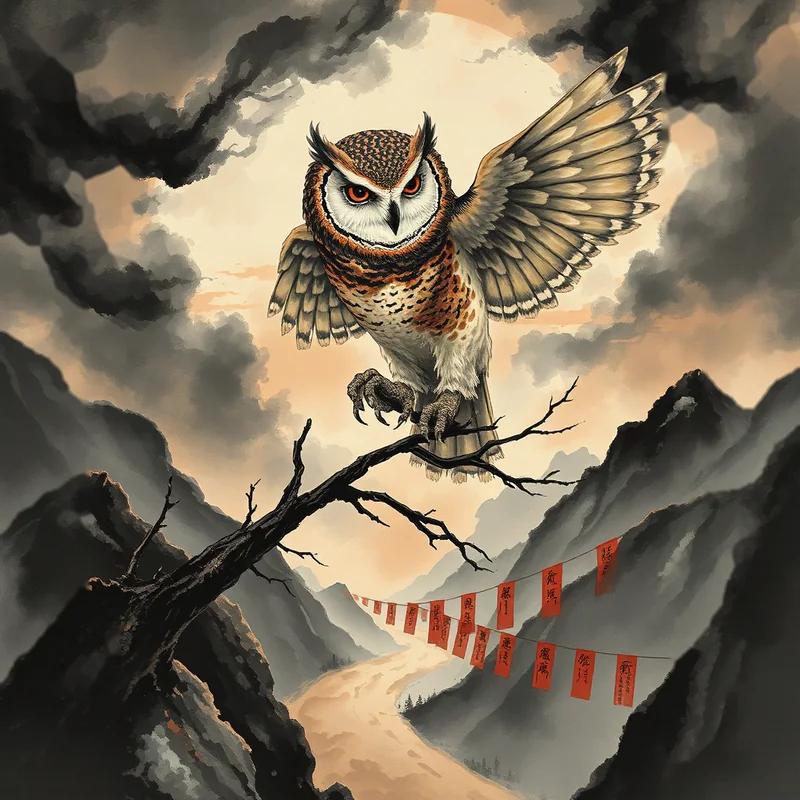
On Mount Gui lives a bird like an owl with human hands. Its cry is like a moan. Its name is Zhu, and its call is its own name. When it appears, the county exiles many scholars.
Original & Translations
南山经曰:南次二山之首,曰柜山……有鸟焉,其状如鸱而人手,其音如痺,其名曰鴸,其名自号也,见则其县多放士。
鸱,是猫头鹰。人手,是人的手。
一只猫头鹰,长着人的手。这句话在纸上很怪,但如果蹲在笼子前看一只鸮,就一点都不怪。
鸮类的脚,和别的鸟不一样。
大多数鸟是三趾向前、一趾向后。鸮不一样:它的第四趾可以反转,想朝前就朝前,想朝后朝后。这叫"可逆趾"。
抓树枝的时候,两趾向前两趾向后,像钳子一样夹住。抓猎物的时候,四趾全朝前,爪尖同时刺入。
而且鸮的脚上,从跗跖到趾,覆盖着厚厚的羽毛,只露出爪尖。整只脚看上去是一团毛,前面伸出几根弯曲的黑爪。
那团毛,那几根抓握的指,那个握的动作——
一个人看见鸮抓住一只老鼠,抬起脚来,慢慢收拢,把老鼠换个方向,再收拢。这个动作,和人用手拿起一个东西、翻过来看看,是一样的。
"人手"两个字,记的就是这个。
再说"其音如痺"。痺,是麻木、是痹症,引申为低沉的、含混的呻吟。
鸮的叫声正是这样。雕鸮的叫声是低沉的"呜——",间隔很长;角鸮是一连串短促的"咕咕";长耳鸮是像叹息一样的"呼——"。
夜里,山林里,一声"呼——"。这个声音没有任何鸟类的高音,全是低频。低频在山谷里传得远,而且方向难辨。
然后是"见则其县多放士"。
放士,是被流放的士人。放,是放逐。
为什么一只猫头鹰,意味着有人要被流放?
有三层。
第一层,鸮是不祥之鸟。从《诗经》开始,鸮就是凶兆:"鸱鸮鸱鸮,既取我子,无毁我室。"鸮夜里叫,叫声像哭,抓的是老鼠和鸟——也抓小鸡。农家听见鸮叫,第二天发现鸡少了,这个联想非常直接。
第二层,"鴸"这个字音同"朱"。而"丹朱"是尧的儿子,被舜流放。后世注家把鴸和丹朱连在一起,说鴸是丹朱之魂所化——一个被放逐的人,变成了一只夜里叫的鸟,飞到哪个县,哪个县就要流放人。
第三层,也是最实在的:流放这件事,在古代是有季节的。
处决是秋后,流放多在春夏之间——因为要走远路,要等路通。而鸮在春天育雏,叫声最频繁。四月到六月,山村里夜夜有鸮叫。
于是"鸮叫"和"流放"在时间上重合了。
一个村子,春天听见鸮叫,夏天看见衙役押着人上路。第二年春天又听见鸮叫。三年之后,这两件事在记忆里就绑定了。
所以这条记录的真相,可能非常朴素:每年春天鸮叫得最凶,每年春天有人被押走。鸟不知道自己在预报什么,人以为它在预报。
而柜山,在南次二经的起点,西临流黄,北望诸毗。这一带是山地,是流放路线的必经之处——往南是岭南,往西是黔中,都是古代的主要流放地。
一座山,一条路,一群夜里的鸟,一批走过去不再回来的人。
"多放士"三个字,写的是这条路。
The Classic of Southern Mountains, second section: its head is Mount Gui... A bird lives there, shaped like an owl with human hands. Its cry is like a moan. Its name is Zhu, and its call is its own name. When it appears, the county exiles many scholars.
An owl with human hands. On paper it is bizarre. Sit in front of an owl in a cage and it is not bizarre at all.
Owl feet are not like other birds' feet.
Most birds have three toes forward and one back. Owls are different: the fourth toe can reverse. Forward when it wants, backward when it wants. Zygodactyl.
Perched, they grip with two toes forward and two back, like pliers. Striking, all four rotate forward and the talons drive in together.
And an owl's foot, from tarsus to toe, is covered in dense feathers with only the tips of the claws showing. The whole foot reads as a ball of fluff with a few curved black hooks protruding.
That ball of fluff, those few gripping digits, that motion of closing —
A person watches an owl take a mouse, lift its foot, slowly close, turn the mouse, close again. That is the same motion a human hand makes when it picks something up and turns it over to look.
"Human hands" records exactly that.
Then "its cry is like a moan." The character means numbness, palsy, and by extension a low, indistinct groan.
Which is what owls sound like. The eagle owl gives a deep "hoo—" with long intervals. Scops owls give short runs of "kup-kup". Long-eared owls give a sighing "hooo—".
Night, mountain forest, one long sigh. There is no high frequency in it at all. Low frequencies travel far in valleys, and they are hard to localize.
Then: "when it appears, the county exiles many scholars."
Exile. The word is fang — to cast out.
Why would an owl mean somebody is about to be deported?
Three layers.
First, owls are ill-omened. From the Book of Songs onward: "Owl, owl, you have taken my young; do not destroy my house." Owls call at night, the call sounds like weeping, and they take rodents and birds — and chicks. A farm family hears an owl, and next morning the chickens are short. The association is immediate.
Second, the name zhu sounds like Zhu — as in Danzhu, son of Yao, who was exiled by Shun. Later commentators linked the bird to him: Zhu is the soul of Danzhu, a banished man turned into a night-calling bird, and wherever it flies, that county will banish people.
Third, and most concrete: exile had a season.
Executions waited for after harvest. Exile usually moved in spring and early summer, because the roads had to be passable for a long march. And owls nest in spring, when they call most.
April to June: owls every night in the village. Spring: a constable leading a man away.
One spring the owl calls, that summer a man is marched off. Next spring the owl calls again. After three years the two things are welded together in memory.
So the truth behind the entry may be very plain: every spring the owls are loudest, and every spring men are taken away. The bird does not know what it is forecasting. The people believe it does.
And Mount Gui stands at the head of the second southern section, facing the Liuhuang, looking north to Zhu Pi. This is mountain country, and it lies on the exile routes — south to Lingnan, west to central Guizhou, both classical destinations for the banished.
One mountain, one road, a crowd of night birds, and a procession of people who walked past and did not come back.
"Many scholars exiled" — the entry is a description of that road.
เขากุ้ยมีนก "คล้ายนกเค้า แต่มีมือคน" ชื่อจู "เห็นเมื่อไรอำเภอนั้นเนรเทศบัณฑิตมาก"
"มือคน" ไม่ใช่เรื่องประหลาด ถ้าเคยดูนกเค้าเกาะกิ่ง: นกเค้าให้นิ้วที่สี่หมุนกลับได้ (zygodactyl) เกาะกิ่งก็สองนิ้วหน้า สองนิ้วหลังเหมือนคีม และเท้าปกคลุมขนหนาจนเห็นแค่ปลายเล็บ
เวลาใช้เท้าจับหนูแล้วพลิกไปมา ท่าทางเหมือนมือคนหยิบของขึ้นดู
"เสียงเหมือนคนคราง" ก็ตรง: นกเค้าเสียงต่ำ "ฮู่——" ดังไกลในหุบเขา
"เห็นแล้วมีการเนรเทศ" — สามชั้น: (1) นกเค้าเป็นนกอัปมงคลตั้งแต่ซือจิง (2) ชื่อ "จู" พ้องกับ "ตานจู" โอรสเหยาที่ถูกเนรเทศ (3) การเนรเทศทำในฤดูใบไม้ผลิ ซึ่งเป็นฤดูที่นกเค้าร้องมากที่สุด
ดังนั้นมันไม่ได้นำการเนรเทศมา แต่ร้องตรงฤดูที่คนถูกจับขึ้นทาง
Gunung Gui ada burung "seperti burung hantu tetapi bertangan manusia", namanya Zhu. "Muncul, daerah itu membuang banyak cendekiawan."
"Tangan manusia" bukan keanehan jika pernah lihat burung hantu bertenggek: jari keempatnya boleh berpusing (zygodactyl) — dua ke depan dua ke belakang seperti penyepit, dan kakinya berbulu tebal hingga hanya hujung kuku kelihatan.
Bila ia memegang tikus dan memusingkannya, geraknya seperti tangan manusia membelek barang.
"Bunyi seperti rintihan" pun tepat: burung hantu berbunyi rendah "huu—" yang kedengaran jauh di lembah.
"Muncul, ramai dibuang" — tiga lapis: (1) burung hantu lambang sial sejak Shijing (2) nama "Zhu" sama bunyi dengan "Danzhu", anak Yao yang dibuang (3) pembuangan dilakukan pada musim bunga, musim burung hantu paling kerap berbunyi.
Jadi ia tidak membawa pembuangan; ia berbunyi tepat pada musim orang diheret pergi.
Núi Quỹ có chim "như cú mèo nhưng có tay người", tên Chu. "Xuất hiện thì huyện ấy lưu đày nhiều sĩ tử."
"Tay người" không lạ nếu từng xem cú đậu: ngón thứ tư xoay ngược được (zygodactyl) — hai ngón trước hai ngón sau như cái kẹp, chân phủ lông dày chỉ hở móng.
Khi nó cầm chuột rồi xoay lại, động tác giống tay người nhấc vật lên xem.
"Tiếng như rên" cũng đúng: cú kêu trầm "hú——" vang xa trong thung lũng.
"Xuất hiện thì nhiều người bị lưu đày" — ba tầng: (1) cú là điềm gở từ Kinh Thi (2) tên "Chu" đồng âm "Đan Chu", con vua Nghiêu bị lưu đày (3) việc lưu đày tiến hành mùa xuân, mùa cú kêu nhiều nhất.
Nên nó không mang lưu đày đến; nó kêu đúng mùa người ta bị dẫn đi.
Gunung Gui ada burung "seperti burung hantu tetapi bertangan manusia", namanya Zhu. "Muncul, daerah itu membuang banyak cendekiawan."
"Tangan manusia" bukan keanehan jika pernah melihat burung hantu bertengger: jari keempatnya bisa berputar (zigodaktil) — dua ke depan dua ke belakang seperti penjepit, dan kakinya berbulu tebal hingga hanya ujung kuku terlihat.
Saat memegang tikus dan memutarnya, geraknya seperti tangan manusia membalik barang.
"Bunyi seperti erangan" juga tepat: burung hantu berbunyi rendah "huu—" yang terdengar jauh di lembah.
"Muncul, banyak dibuang" — tiga lapis: (1) burung hantu lambang sial sejak Kitab Nyanyian (2) nama "Zhu" sama bunyi dengan "Danzhu", anak Yao yang dibuang (3) pembuangan dilakukan pada musim semi, musim burung hantu paling sering berbunyi.
Jadi ia tidak membawa pembuangan; ia berbunyi tepat pada musim orang diheret pergi.
Nearby Creatures