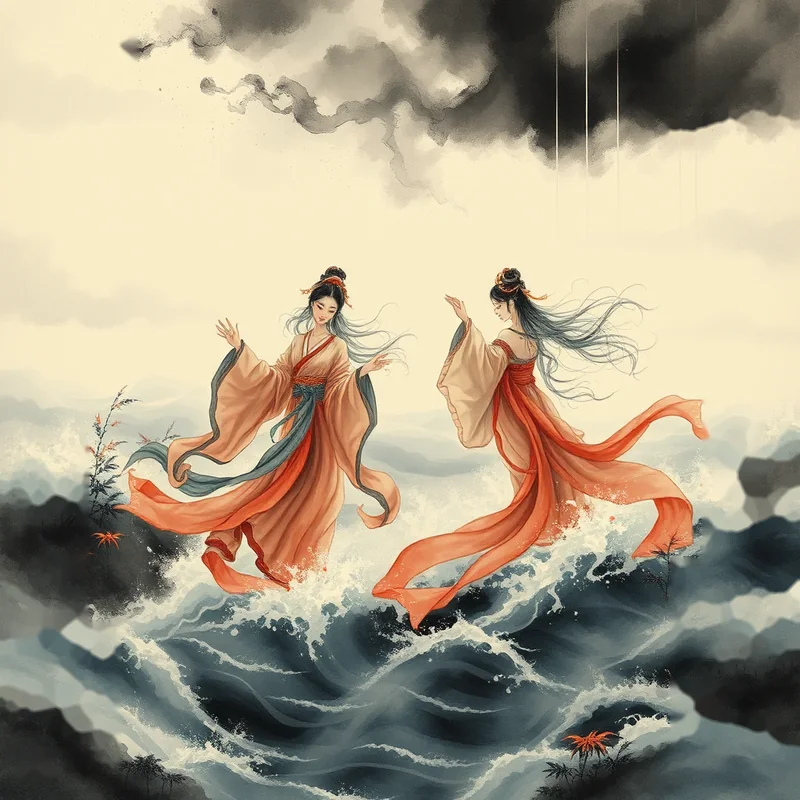
 帝之二女
中山经
《中山经》
帝之二女
The Two Daughters of the High God
4.861k中山经
DeityWaterRainLove
On Mount Dongting dwell the two daughters of the High God. They roam the deeps of the river. Winds from the Li and the Yuan meet over the Xiaoxiang; and wherever they go, they come and go with wild wind and driving rain.
Original & Translations
中山经曰:又东南一百十里,曰洞庭之山,其上多黄金,其下多银铁,其木多柤梨橘櫾,其草多葌、蘪芜芍药芎藭。帝之二女居之,是常游于江渊。澧沅之风,交潇湘之渊,是在九江之间,出入必以飘风暴雨。是多怪神,状如人而载蛇左右手操蛇。多怪鸟。
先读地理,这一段写得极好。
洞庭之山,山上出黄金,山下出银铁。树是柤、梨、橘、櫾——櫾是柚。草是葌、蘪芜、芍药、芎藭。这四样草,全都是香的:蘪芜(川芎苗)和芎藭是药材,芍药是花,葌是兰类。
一座山,上层是金属,下层是果木,中间全是香草。
然后才是神:帝之二女居之,常游于江渊。
帝,一般解作尧。二女,是娥皇和女英。她们嫁给舜,舜南巡死在苍梧,二女追到湘水,哭,泪洒在竹子上,成了斑竹,然后投水。
这个故事在《山海经》里没有展开,只留下"帝之二女"四个字,和一句"常游于江渊"。
"江渊"——江的深水。不是岸上,不是天上,是水底。两位女神住在湖底,偶尔浮上来。
接下来的句子是全篇最漂亮的一句:澧沅之风,交潇湘之渊,是在九江之间,出入必以飘风暴雨。
澧水、沅水,从西边来。潇水、湘水,从南边来。四水在洞庭湖汇合。而"风"在"渊"上交汇——风在水面上相遇。
这不是文学修辞,这是气象描述。
洞庭湖是中国第二大淡水湖,面积两千多平方公里,四周是山。夏天,湖面被太阳晒热,空气上升;周围山地凉,冷空气从山谷里下来,向湖心汇聚。四面的风在湖上撞在一起,抬升,成云,落雨。
这就是"交"。四股风在湖面上交汇。
而这种交汇产生的雨,是突发性的、局地的、带强风的。湖上的船最怕这个。洞庭湖至今有"风浪区"的说法,某些水域在特定风向下一分钟之内就能翻船。
所以"出入必以飘风暴雨"——她们一进一出,就是暴风骤雨。
这不是女神在发脾气。这是女神出现的时候,天气就是这样。或者说,天气变成这样的时候,人们说:她们出来了。
再看下一句:是多怪神,状如人而载蛇左右手操蛇。
这座山上还有很多怪神,人形,头上顶着蛇,左右手各握一条蛇。
操蛇之神在《山海经》里是一大类,多与山川、水域相关。蛇在手里,是权力的标志,也是"能控水"的象征——蛇形似水流的曲线,且蛇对气压变化敏感。
于是整座山的图景是:黄金、白银、橘子、柚子、香草、斑竹、湖底的两位女神、暴雨、以及一群手里拿着蛇的神。
这是中国神话里最"南方"的一个场景。潮湿、芳香、富庶、危险。
屈原后来写《湘君》《湘夫人》,写"帝子降兮北渚,目眇眇兮愁予",写"袅袅兮秋风,洞庭波兮木叶下"。他写的还是这两个人,还是这片湖。
从《山海经》的十七个字,到《九歌》的两篇长诗,中间隔了几百年。而湖还在那里,风还在交,雨还在下。
The Classic of Central Mountains: one hundred and ten li southeast is Mount Dongting. Gold above; silver and iron below. Among its trees, hawthorn, pear, orange, pomelo. Among its plants, orchid, lovage, peony, and chuanxiong. The two daughters of the High God dwell there, and they roam the deeps of the river. The winds of the Li and the Yuan meet over the deeps of the Xiaoxiang, there among the nine rivers; and they come and go only with wild wind and driving rain. Many strange gods are there, human in form, bearing snakes, holding snakes in their left and right hands. Many strange birds.
Read the geography first. This passage is superbly written.
Mount Dongting: gold on the heights, silver and iron below. The trees are hawthorn, pear, orange, pomelo. The plants are orchid, lovage, peony, chuanxiong. All four plants are aromatic — lovage and chuanxiong are medicines, peony is a flower, orchid speaks for itself.
A mountain with metal at the top, fruit trees at the bottom, and fragrance in between.
Only then the goddesses: the two daughters of the High God dwell there, and roam the deeps.
The High God is usually read as Yao. The two daughters are Ehuang and Nüying. They married Shun; Shun died on a southern progress at Cangwu; the sisters followed as far as the Xiang River, wept, and their tears spotted the bamboo — which is why mottled bamboo is called Xiang bamboo — and then they went into the water.
The Shanhaijing does not tell that story. It leaves four characters, "the two daughters of the High God," and one line: they roam the deeps of the river.
The deeps — not the bank, not the sky. The bottom of the water. Two goddesses living on the lake bed, surfacing now and then.
Then the finest sentence in the entry: the winds of the Li and the Yuan meet over the deeps of the Xiaoxiang, there among the nine rivers; and they come and go only with wild wind and driving rain.
The Li and the Yuan come from the west. The Xiao and the Xiang come from the south. Four rivers converge at Dongting. And the winds meet over the deeps — wind meeting wind, on the water.
This is not literary decoration. It is meteorology.
Dongting is China's second-largest freshwater lake, over two thousand square kilometres, ringed by hills. In summer the lake surface heats, air rises, and cooler air drains down out of the surrounding valleys toward the centre. Four winds collide over open water, are forced upward, condense, and rain.
That is the meeting. Four winds converging on the lake.
And the rain such convergence produces is sudden, local, and violent. Boatmen on Dongting still speak of wind zones where a change of direction can capsize a boat inside a minute.
So: they come and go only with wild wind and driving rain.
This is not a goddess losing her temper. It is that when the goddesses appear, the weather is like this. Or rather: when the weather becomes like this, people say the goddesses have come out.
Then the next line: many strange gods, human in form, bearing snakes, snakes in both hands.
Snake-holding gods are a large class in the Shanhaijing, mostly tied to mountains and waters. A snake in the hand marks authority, and also control of water — a snake's body is the curve of a current, and snakes are sensitive to changes in air pressure.
So the whole mountain reads: gold, silver, oranges, pomelo, fragrant herbs, mottled bamboo, two goddesses on the lake bed, driving rain, and a crowd of gods with snakes in their fists.
It is the most southern scene in Chinese myth. Wet, fragrant, wealthy, dangerous.
Centuries later Qu Yuan wrote the Xiang Jun and Xiang Furen — "the child of God has come down to the northern islet; my eyes strain, and I am sad" — and "the autumn wind sighs; Dongting ripples, and the leaves fall." The same two women. The same lake.
From seventeen characters in the Shanhaijing to two long poems in the Nine Songs is several hundred years. The lake was still there. The winds still met. The rain still fell.
เขาต้งถิง: ข้างบนทอง ข้างล่างเงินและเหล็ก ต้นไม้มี hawthorn สาลี่ ส้ม ส้มโอ พืชมีกล้วยไม้ เลิฟเวจ พีโอนี ชวนเซียง — หอมทั้งหมด
ที่นี่คือที่อยู่ของธิดาสององค์แห่งเทพสูงสุด (ง้อหวง-หนี่อิง) "ท่องไปในวังน้ำลึก"
"ลมจากหลี่และหยวนปะทะกันเหนือเซียวเซียง" — นี่คือคำอธิบายอุตุนิยมวิทยาจริง: ทะเลสาบใหญ่ อากาศร้อนลอยขึ้น ลมจากหุบเขารอบด้านไหลเข้าหาศูนย์กลาง ปะทะกัน กลายเป็นฝน
ดังนั้น "ออกมาทีไรก็พายุฝน" ไม่ใช่เทพโมโห แต่คือเมื่อฟ้าเป็นแบบนี้ คนก็บอกว่าเทพออกมา
บนเขายังมีเทพถืองูทั้งสองมือ — สัญลักษณ์แห่งอำนาจและน้ำ
Gunung Dongting: emas di atas, perak dan besi di bawah. Pokok: hawthorn, pear, oren, limau bali. Tumbuhan: anggerik, lovage, peony, chuanxiong — semuanya berbau harum.
Di sini tinggal dua puteri Dewa Agung (Ehuang dan Nüying). "Mereka merayau di lubuk sungai."
"Angin Li dan Yuan bertemu di Xiaoxiang" — ini meteorologi sebenar: tasik besar, udara panas naik, angin dari lembah sekeliling mengalir ke tengah, bertembung, jadi hujan.
Jadi "keluar masuk bawa ribut" bukan dewi merajuk, tetapi apabila cuaca jadi begini, orang kata dewa keluar.
Ada juga dewa memegang ular di kedua tangan — lambang kuasa dan air.
Núi Động Đình: trên vàng, dưới bạc và sắt. Cây: sơn tra, lê, cam, bưởi. Cỏ: lan, xuyên khung, thược dược — đều thơm.
Đây là nơi ở của hai người con gái Đế (Nga Hoàng, Nữ Anh). "Dạo chơi trong vực sâu."
"Gió Lễ và Nguyên gặp nhau trên Tiêu Tương" — đây là khí tượng thật: hồ lớn, không khí nóng bốc lên, gió từ các thung lũng quanh hồ dồn vào giữa, gặp nhau, thành mưa.
Nên "đi lại mang cuồng phong bạo vũ" không phải nữ thần nổi giận, mà khi trời như thế, người ta nói thần đã ra.
Trên núi còn có thần cầm rắn hai tay — biểu tượng quyền lực và nước.
Gunung Dongting: emas di atas, perak dan besi di bawah. Pohon: hawthorn, pir, jeruk, jeruk bali. Tumbuhan: anggrek, lovage, peony, chuanxiong — semuanya harum.
Di sini tinggal dua puteri Dewa Agung (Ehuang dan Nüying). "Mereka menjelajah lubuk sungai."
"Angin Li dan Yuan bertemu di Xiaoxiang" — ini meteorologi nyata: danau besar, udara panas naik, angin dari lembah sekeliling mengalir ke tengah, bertabrakan, jadi hujan.
Jadi "datang pergi membawa badai" bukan dewi merajuk, tetapi ketika cuaca jadi begini, orang berkata dewa keluar.
Ada juga dewa memegang ular di kedua tangan — lambang kuasa dan air.
Nearby Creatures