 长右
南山经
《南山经》
长右
Changyou
4.536k南山经
BeastFloodOmenPrimate
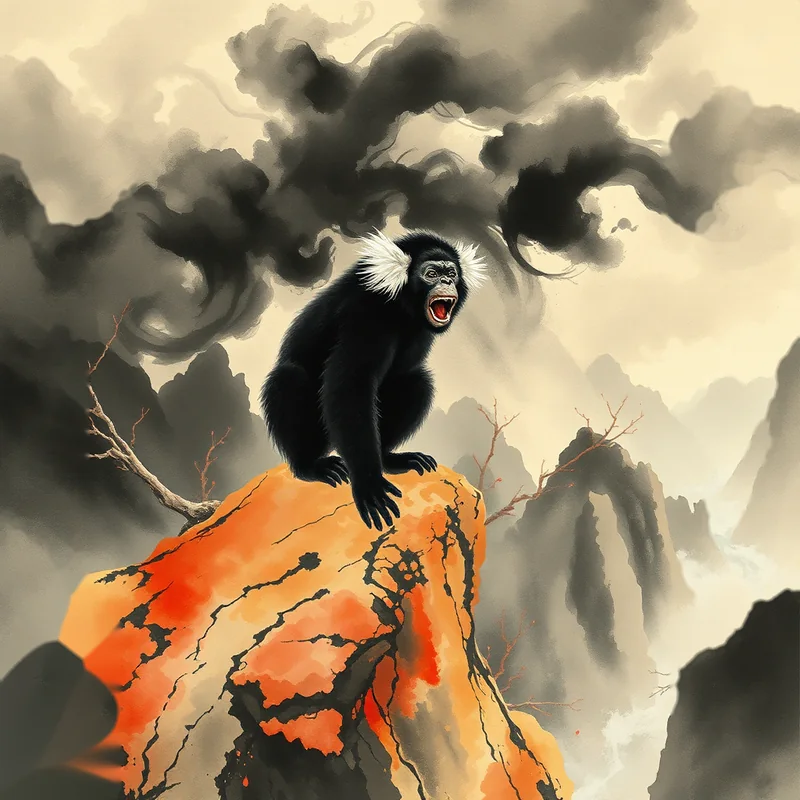
Mount Changyou has no grass or trees, only water. A beast lives there shaped like a monkey with four ears. Its name is Changyou, its voice is like chanting, and when it appears the district floods.
Original & Translations
南山经曰:东南四百五十里,曰长右之山,无草木,多水。有兽焉,其状如禺而四耳,其名长右,其音如吟,见则郡县大水。
长右之山,没草木,只有水。这个前提很重要——一座石头山,什么也不长,水从石头上直接流下来。
山上有一种兽。形状像禺,禺是猿猴。四条耳朵。
四条耳朵。这个描述,把范围缩到了中国的长臂猿。
长臂猿的耳朵,和别的灵长类不一样。它耳后有两簇很长的白毛,向上、向外张开,像两撮竖起的鬓。加上耳朵本身,从正面看,头两侧是四团白色的东西。
天行长臂猿,雄性是黑色的,脸颊两侧有白色的长毛,从耳后一直延伸到下巴,形成一大片白。雌性是金黄色的,头顶到后颈有一块黑。
海南长臂猿,全身黑,脸颊也是白的。
所以"四耳"不是真的有四个耳孔,是四个白色的听觉标记点:两只耳,两簇耳后毛。
在密林里,一个黑色的身影,头两侧四个白点。这是识别特征。
然后是"其音如吟"。
长臂猿的叫声,是所有灵长类里最像音乐的。
它有一套结构复杂的鸣唱:先是几声短促的、逐渐升高的音节,然后是长长的、带颤音的滑音,最后是断断续续的收尾。雄性和雌性会二重唱,一高一低,交替进行,能持续十几分钟。
声音能传三到五公里。
古人听到的是什么?是一个在山谷里回响的、有旋律的、像人在吟诗的声音。
"吟"这个字用得极准。吟不是喊,不是叫,是拉长的、有节奏的、带感情的诵读。长臂猿的鸣唱,正是这个。
最后一句:"见则郡县大水。"
长臂猿和大水,有什么关系?
关键在于,长臂猿是气压的敏感器。
灵长类的叫声,和天气有关系。晴天、气压高的时候,叫声短、少。气压下降、湿度上升、暴风雨要来的时候,叫声变得频繁、变长、音调变低。
这不是玄学。声波在湿空气里传播衰减更小,湿度大的时候,叫声传得更远,动物自己也更愿意叫。而且气压变化会影响中耳的压力平衡,很多动物在气压骤降时会不安、会叫。
长臂猿是树冠层的动物,活动范围固定,一家一群,每天早上定时鸣唱。一个村子听惯了这声音,就会知道:今天叫得比平常早、比平常长、比平常凶。
三天之后,雨来了。
而长右之山"无草木,多水"——一座秃山,多水。这个地形意味着什么?意味着集水区。石头山不吸水,雨水全部汇成溪流,几条溪同时涨,下游就是山洪。
所以长右的预报,是双重准确的:它住在一个容易发洪水的地方,它又对气压变化敏感。
古人不知道气压。他们知道:这山上的猴子一叫,三天后要发水。
于是把这句话记了下来:见则郡县大水。
而长右这个名字,"长右"——右是"佑"的本字,是帮助、是扶手。长右,可能是"长长的、能扶助人的东西"?还是"长臂"?
长臂猿的臂展,比身长还长。一只成年天行长臂猿,臂展一米二,身体只有五十厘米。它荡过树冠的时候,两条手臂像两条长长的绳子。
"长右"这两个字,也可能根本是音译——记录者听见它的叫声,用两个音节记了下来。
长右。长右。像不像一声长臂猿的鸣唱?
而今天,天行长臂猿在中国不足一百五十只,海南长臂猿不足四十只。它们每天还在叫,只是已经没有几个村子能听见了。
The Classic of Southern Mountains: four hundred and fifty li southeast is Mount Changyou. No grass, no trees, only water. A beast lives there shaped like a monkey with four ears. Its name is Changyou; its voice is like chanting; when it appears, the district floods.
Mount Changyou: nothing grows, and there is only water. The premise matters — a bare rock mountain, where rain runs straight off the stone.
On it lives a beast shaped like a yu, which is a monkey. With four ears.
Four ears narrows the field to the gibbons of China.
Gibbon ears are not like other primates'. Behind each ear are two long white tufts, flaring up and out like raised sideburns. Add the ear itself and the sides of the head present four white patches.
The skywalker hoolock gibbon: males black, with long white fur from behind the ear down to the chin, forming a broad white face-fringe. Females golden, with a black patch from crown to nape.
The Hainan gibbon: all black, white cheeks.
So "four ears" is not four ear canals. It is four white auditory markers: two ears, two tufts.
In dense forest, a black shape with four white points on either side of the head. That is the identification mark.
Then "its voice is like chanting."
Gibbon song is the most musical vocalization of any primate.
It has structure: a few short rising notes, then a long trilled glide, then a broken close. Male and female duet, high and low, alternating, for ten minutes or more.
It carries three to five kilometres.
What did the ancients hear? A sound echoing in a valley, melodic, rhythmic — like a person reciting poetry.
The word yin is exactly right. Yin is not a shout or a cry. It is a drawn-out, rhythmic, emotional recitation. That is what gibbon song is.
Then the last clause: "when it appears, the district floods."
What do gibbons have to do with floods?
The key: gibbons are barometers.
Primate calling is weather-linked. In clear weather and high pressure, calls are short and infrequent. As pressure falls and humidity rises, ahead of a storm, calling becomes frequent, longer, and lower in pitch.
This is not mysticism. Sound attenuates less in humid air, so calls carry further; animals are also more inclined to call. And pressure change disturbs middle-ear pressure balance, which makes many animals restless and vocal.
Gibbons are canopy animals with fixed ranges, one family per territory, singing on schedule every morning. A village used to the sound knows: today they started earlier, sang longer, sounded harsher.
Three days later, rain.
And Mount Changyou has "no grass or trees, only water" — a bare mountain with much water. What does that terrain mean? A catchment. Rock does not absorb rain; every drop becomes a stream; several streams rise at once; downstream, a flash flood.
So Changyou's forecast is doubly accurate: it lives where floods are made, and it is sensitive to pressure.
The ancients did not know about pressure. They knew: when the monkeys on that mountain call, water comes in three days.
So they wrote it down: when it appears, the district floods.
And the name. You in Changyou is the original graph for "aid," a handhold. Changyou might be "the long thing that helps"? Or "long arm"?
A gibbon's arm span exceeds its body length. An adult skywalker hoolock spans one metre twenty with a body of fifty centimetres. Swinging through the canopy, its arms are two long ropes.
Or the name may simply be transcription — the recorder heard the call and wrote two syllables down.
Changyou. Changyou. Does it not sound like a gibbon singing?
Today fewer than one hundred and fifty skywalker hoolocks remain in China, and fewer than forty Hainan gibbons. They still sing every morning. There are almost no villages left to hear them.
เขาฉางโหย่ว ไม่มีต้นไม้ มีแต่น้ำ — ภูเขาหินโล่ง ฝนตกลงมาก็ไหลลงหมด
มีสัตว์ "คล้ายลิง แต่มีสี่หู เสียงเหมือนคนร้องลำนำ เห็นเมื่อไรน้ำท่วม"
"สี่หู" = ชะนี (gibbon) ข้างหูมีขนขาวยาวสองกระจุก ชี้ขึ้น-ออก รวมกับหูจริงเป็น "สี่จุดขาว" สองข้างหัว
ชะนีเป็นสัตว์เลี้ยงลูกด้วยนมที่ร้องเพลงไพเราะที่สุด: ขึ้นเสียงสั้น ๆ แล้วลากเสียงยาวสั่น มีทั้งตัวผู้ตัวเมียร้องสลับกัน ดังไป 3–5 กิโลเมตร
"เสียงเหมือนคนร้องลำนำ" — ตรงที่สุด
"เห็นแล้วน้ำท่วม": ชะนีไวต่อความกดอากาศ ก่อนพายุความชื้นสูง ความกดต่ำ มันร้องถี่ขึ้น ยาวขึ้น เสียงต่ำลง
และภูเขานี้เป็นพื้นที่รับน้ำ ฝนตกลงมาก็รวมเป็นลำธารหลายสายพร้อมกัน → น้ำป่าไหลหลาก
วันนี้ชะนีในจีนเหลือไม่ถึง 150 ตัว (และชะนีไหหลำไม่ถึง 40)
Gunung Changyou: tanpa tumbuhan, hanya air — gunung batu kosong, hujan terus mengalir turun.
Ada binatang "seperti monyet tetapi empat telinga, bunyinya seperti dendangan; muncul, daerah banjir."
"Empat telinga" ialah agih (gibbon). Di belakang telinga ada dua jumbai bulu putih panjang mencengkam ke atas dan keluar; dengan telinga sekali jadi "empat titik putih" di dua sisi kepala.
Gibbon ialah primat paling bermuzik: nada pendek menaik, kemudian lengkung panjang bergetar, jantan dan betina bersahutan, kedengaran 3–5 kilometer.
"Bunyi seperti dendangan" — tepat sekali.
"Muncul, banjir": gibbon peka pada tekanan udara. Sebelum badai, kelembapan naik, tekanan turun, ia berbunyi lebih kerap, lebih panjang, lebih rendah.
Dan gunung ini kawasan tadahan: hujan turun terus menjadi beberapa anak sungai serentak, lalu banjir kilat.
Hari ini gibbon di China kurang 150 ekor (gibbon Hainan kurang 40).
Núi Trường Hữu: không cây, chỉ nước — núi đá trọc, mưa xuống là chảy hết.
Có thú "như vượn nhưng bốn tai, tiếng như ngâm; xuất hiện thì huyện lụt."
"Bốn tai" là vượn (gibbon). Sau mỗi tai có hai túm lông trắng dài xòe lên và ra ngoài; cộng với tai thật thành "bốn điểm trắng" hai bên đầu.
Vượn là loài linh trưởng hót như nhạc nhất: vài nốt ngắn lên cao, rồi một đoạn dài rung, trống mái đối đáp, vang 3–5 km.
"Tiếng như ngâm" — đúng nhất.
"Xuất hiện thì lụt": vượn nhạy với khí áp. Trước bão, ẩm tăng, áp giảm, nó kêu dày hơn, dài hơn, trầm hơn.
Và núi này là vùng thu nước: mưa thành nhiều suối cùng lúc, dưới là lũ quét.
Nay vượn ở Trung Quốc còn dưới 150 con (vượn Hải Nam dưới 40).
Gunung Changyou: tanpa tumbuhan, hanya air — gunung batu kosong, hujan langsung mengalir turun.
Ada binatang "seperti monyet tetapi empat telinga, bunyinya seperti dendangan; muncul, daerah banjir."
"Empat telinga" adalah owa (gibbon). Di belakang telinga ada dua jumbai bulu putih panjang yang menjulang ke atas dan ke luar; dengan telinga sekali jadi "empat titik putih" di dua sisi kepala.
Owa adalah primata paling bermusik: nada pendek menaik, lalu lengkung panjang bergetar, jantan dan betina bersahutan, terdengar 3–5 kilometer.
"Bunyi seperti dendangan" — paling tepat.
"Muncul, banjir": owa peka terhadap tekanan udara. Sebelum badai, kelembapan naik, tekanan turun, ia berbunyi lebih sering, lebih panjang, lebih rendah.
Dan gunung ini daerah tangkapan air: hujan menjadi beberapa anak sungai serentak, lalu banjir bandang.
Kini owa di Tiongkok tinggal kurang dari 150 ekor (owa Hainan kurang dari 40).
Nearby Creatures