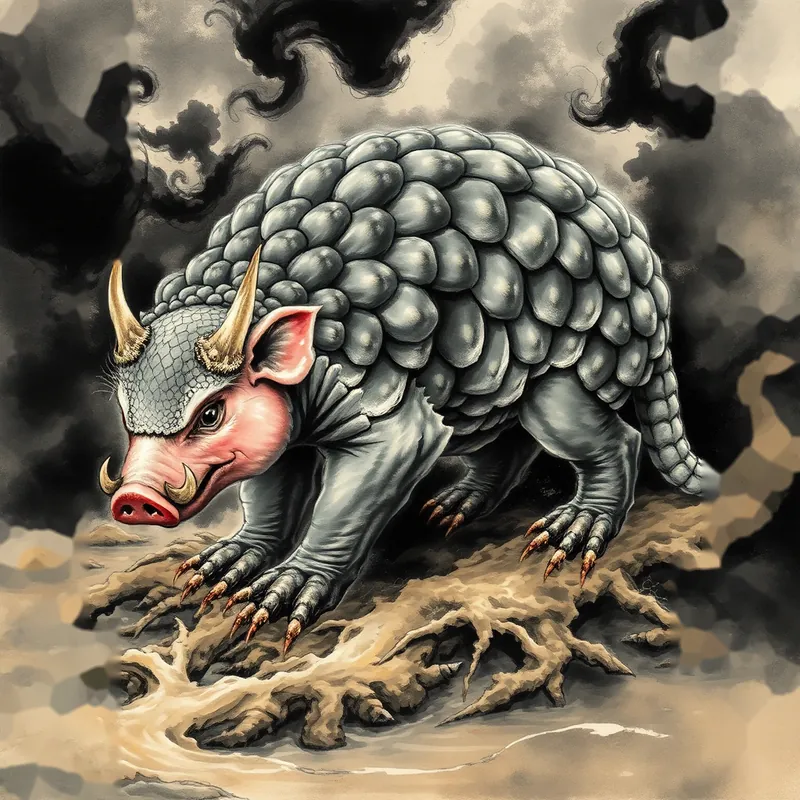
 狸力
南山经
《南山经》
狸力
Lili
4.329k南山经
BeastOmenLabor
On Mount Gui lives a beast shaped like a piglet with spurred heels, barking like a dog. Its name is Lili. When it appears, the county has much earthwork.
Original & Translations
南山经曰:南次二山之首,曰柜山,西临流黄,北望诸毗,东望长右。英水出焉,西南流注于赤水,其中多白玉,多丹粟。有兽焉,其状如豚,有距,其音如狗吠,其名曰狸力,见则其县多土功。
"其状如豚,有距"——像猪,但有距。
距是什么?公鸡脚后跟那根向后伸的尖刺,用来打斗。兽类有距的极少。
这个细节,把范围缩得很小。
中国南方有一种动物,身上披着覆瓦状的角质鳞片,吻尖,舌长,前爪极发达,走路时前爪反折,用爪背着地——它就是靠这个姿势保护挖土的爪。
穿山甲。
穿山甲的后足,确实有距。中华穿山甲的后肢内侧有一个明显的角质突起,解剖学上就叫"距"(calcaneal spur)。而且它的后爪比前爪长,站立时后爪撑地,那个距非常显眼。
所以"如豚而有距",是一句非常精确的描写:体型像小猪,后脚上有一根刺。
"其音如狗吠"——穿山甲会叫。它平时安静,但受惊或被抓住时会发出急促的喷气声和低吠,确实像小狗。
然后是重点:"见则其县多土功。"
土功,是土木工程。在古代,这个词基本等于徭役——修城、筑堤、开渠、修路、建陵。都是征发民夫,都是几个月不回家。
一只穿山甲出现,为什么意味着大工程?
因为穿山甲会挖洞。
一只穿山甲一年能挖几十个洞,洞深一到三米,洞口直径十几厘米。它挖洞的地方,是蚁巢旁边——它吃白蚁和蚂蚁,一顿能吃几百克。
关键在于它挖洞的位置:田埂、河堤、塘基、坟包、路基。
这些都是人工夯实的土体。穿山甲最喜欢在堤坝和塘基上打洞,因为那里的土松、蚁多。
一个洞,直径十几厘米,深两米,穿过堤身。
洪水一来,水从洞里进去,堤身内部被掏空,外面看着完好,里面已经空了。等到溃决的那一天,是一整段一起塌。
所以古人说"见则多土功"——不是穿山甲带来了工程,是穿山甲打洞,堤坝漏了,于是必须修。
这句记录的因果是倒的,但现象是准的。
还有一层。白蚁。
穿山甲吃白蚁,而白蚁本身就是堤坝最大的敌人。一座土坝,如果蚁巢做在坝体里,几年之内坝心就被掏成蜂窝。水利上有一个专门的词:蚁害。直到今天,水库大坝的日常巡查里,找白蚁巢仍然是必查项。
所以穿山甲出现在堤上,其实是一个信号:这里有白蚁,而白蚁已经把堤挖空了。穿山甲只是跟着食物来的。
它是个指示物种。它一出现,说明地下的问题已经很严重了。
古人观察了几百年,把这条链记成一句话:见到狸力,这个县就要动土。
不是迷信,是堤防巡检的经验,被写成了兆。
而穿山甲现在是什么状况?中华穿山甲,极危。IUCN 红色名录里,它从"低危"一路降到"极危",用了不到三十年。原因是吃——鳞片入药,肉被当成野味。
《山海经》记它的时候,它是"见则多土功"的麻烦。现在,很多人一辈子没见过一只活的。
The Classic of Southern Mountains, second section: its head is Mount Gui, facing west on the Liuhuang, looking north to Zhu Pi and east to Changyou. The Ying River issues from it and flows southwest into the Red Water; in it is much white jade and red cinnabar sand. A beast lives there, shaped like a piglet, with spurs, barking like a dog. Its name is Lili. When it appears, the county has much earthwork.
"Shaped like a piglet, with spurs." Spurs — like the backward spike on a rooster's heel, the one they fight with. Very few mammals have them.
That detail narrows the field sharply.
In southern China there is an animal covered in overlapping horny scales, with a pointed snout, a long tongue, and enormously developed foreclaws. It walks on the backs of its front claws, folded under, which is how it keeps the digging edges sharp.
The pangolin.
Pangolins do have a heel spur. In the Chinese pangolin there is a distinct horny projection on the inner side of the hind limb, and anatomically it is exactly a calcaneal spur. The hind claws are longer than the front ones, and the animal stands on them, so the spur is conspicuous.
So "like a piglet with spurs" is precise field description: a small-pig body with a spike on the hind foot.
"Its cry is like a dog's bark." Pangolins vocalize. Normally silent, when startled or handled they produce a sharp huff and a low bark that does sound like a small dog.
Then the point: "when it appears, the county has much earthwork."
Earthwork means construction. In the ancient world that meant conscription labour — city walls, dikes, canals, roads, tombs. Months away from home.
Why would a pangolin mean a big project?
Because pangolins dig.
One animal can dig dozens of burrows a year, a metre to three deep, mouths a dozen centimetres across. It digs beside ant nests, because it eats termites and ants by the several hundred grams a meal.
And where does it dig? Field bunds, river dikes, pond banks, grave mounds, road beds.
All of these are compacted人工 earthworks. Pangolins favour dikes and pond banks because the soil is loose and the termites are there.
One hole, twelve centimetres wide and two metres deep, straight through a dike body.
Then the flood comes. Water enters the hole, scours the interior, and the outside still looks intact while the inside is hollow. The day it fails, a whole section goes at once.
So "when it appears, much earthwork" is not the pangolin bringing a project. The pangolin dug; the dike leaks; now it must be repaired.
The causality in the entry runs backwards. The observation is exact.
There is a second layer. Termites.
Pangolins eat termites, and termites are a dike's worst enemy. A colony inside an earth dam hollows the core into a honeycomb within a few years. Water engineering has a term for it: ant damage. To this day, hunting for termite nests is a standard item on reservoir dam inspection.
So a pangolin on the dike is a signal: there are termites here, and the termites have already hollowed it out. The pangolin simply followed its food.
It is an indicator species. Its presence means the problem underground is already advanced.
Centuries of observation compressed into one sentence: see a Lili, and this county will be moving earth.
Not superstition. Dike inspection, written as an omen.
And the pangolin now? The Chinese pangolin is critically endangered. On the IUCN Red List it went from least concern to critically endangered in under thirty years. The cause is consumption — scales for medicine, meat as a delicacy.
When the Shanhaijing recorded it, it was a nuisance whose appearance meant repairs. Now many people will never see a living one.
เขากุ้ยมีสัตว์ "รูปร่างเหมือนหมู แต่มีเดือยที่ขา เห่าเหมือนหมา" ชื่อหลีลี่ "เห็นเมื่อไรอำเภอนั้นมีงานขุดดินมาก"
"หมูที่มีเดือย" = ตัวนิ่ม (pangolin) มันมีปุ่มแข็งที่ขาหลังจริง หลังเท้ายาวกว่าหน้า เดินโดยพับเล็บหน้าไว้
ตัวนิ่มขุดรูปีละหลายสิบรู ลึก 1–3 เมตร ชอบขุดที่คันนา คันดิน ริมบ่อ และเชิงถนน — ซึ่งล้วนเป็นดินที่มนุษย์บดอัดไว้
รูเดียวทะลุตัวคัน เมื่อน้ำมาจะเซาะภายใน คันยังดูดีแต่ข้างในกลวง วันหนึ่งก็ถล่มทั้งช่วง
ดังนั้น "เห็นแล้วมีงานขุดดิน" ไม่ใช่คำสาป แต่คือ: ตัวนิ่มขุดรู → คันรั่ว → ต้องซ่อม
อีกชั้น: ปลวก ตัวนิ่มกินปลวก ปลวกคือศัตรูอันดับหนึ่งของเขื่อนดิน รังปลวกในตัวเขื่อนทำให้แกนกลวงเป็นรังผึ้ง — งานตรวจเขื่อนทุกวันนี้ยังต้องห.Rang ปลวก
วันนี้ตัวนิ่มจีนอยู่ในขั้น "ใกล้สูญพันธุ์อย่างยิ่ง" เพราะถูกล่าเอาเกล็ดและเนื้อ
Gunung Gui ada binatang "bentuk anak babi, ada taji di kaki, salak seperti anjing", namanya Lili. "Muncul, daerah itu banyak kerja tanah."
"Babi bertaji" ialah tenggiling. Ia memang ada tonjolan tanduk pada kaki belakang; cakar belakang lebih panjang daripada depan, dan ia berjalan atas belakang cakar depan yang dilipat.
Tenggiling menggali berpuluh lubang setahun, dalam 1–3 meter, dan suka menggali di benteng sawah, tebing sungai, dan tepi jalan — semuanya tanah yang dipadatkan manusia.
Satu lubang menembusi benteng. Bila banjir, air mengikis dalam; luarnya nampak utuh, dalamnya kosong. Suatu hari runtuh sekaligus.
Jadi "muncul, banyak kerja tanah" bukan sumpahan: tenggiling gali, benteng bocor, lalu mesti dibaiki.
Lapisan kedua: anai-anai. Tenggiling makan anai-anai, dan anai-anai ialah musuh utama empangan tanah. Hari ini pun pemeriksaan empangan masih mencari sarang anai-anai.
Kini tenggiling China terancam kritikal kerana diburu untuk sisik dan daging.
Núi Quỹ có thú "hình lợn, có cựa ở chân, sủa như chó", tên Ly Lực. "Xuất hiện thì huyện ấy nhiều việc đất."
"Lợn có cựa" là tê tê. Nó thật sự có mấu sừng ở chân sau; móng sau dài hơn móng trước, và nó đi bằng mu bàn móng trước gập lại.
Tê tê đào hàng chục hang mỗi năm, sâu 1–3 mét, thích đào ở bờ ruộng, đê sông, bờ ao, lề đường — đều là đất người ta đã đầm nén.
Một hang xuyên qua thân đê. Khi lũ đến, nước xói bên trong; ngoài vẫn lành, trong đã rỗng. Một ngày nào đó cả đoạn sụp.
Nên "xuất hiện thì nhiều việc đất" không phải lời nguyền: tê tê đào → đê rò → phải sửa.
Tầng thứ hai: mối. Tê tê ăn mối, mà mối là kẻ thù số một của đập đất. Đến nay kiểm tra đập vẫn phải tìm tổ mối.
Ngày nay tê tê Trung Quốc cực kỳ nguy cấp vì bị săn lấy vảy và thịt.
Gunung Gui ada binatang "bentuk anak babi, ada taji di kaki, menyalak seperti anjing", namanya Lili. "Muncul, daerah itu banyak kerja tanah."
"Babi bertaji" adalah trenggiling. Ia memang punya tonjolan tanduk pada kaki belakang; cakar belakang lebih panjang dari depan, dan ia berjalan di atas punggung cakar depan yang terlipat.
Trenggiling menggali puluhan lubang setahun, dalam 1–3 meter, dan suka menggali di tanggul sawah, tebing sungai, dan tepi jalan — semuanya tanah yang dipadatkan manusia.
Satu lubang menembus tanggul. Saat banjir, air menggerus bagian dalam; luarnya tampak utuh, dalamnya kosong. Suatu hari runtuh sekaligus.
Jadi "muncul, banyak kerja tanah" bukan kutukan: trenggiling menggali, tanggul bocor, lalu harus diperbaiki.
Lapisan kedua: rayap. Trenggiling makan rayap, dan rayap adalah musuh utama bendungan tanah. Hingga kini pemeriksaan bendungan masih mencari sarang rayap.
Kini trenggiling Tiongkok sangat terancam karena diburu untuk sisik dan daging.
Nearby Creatures