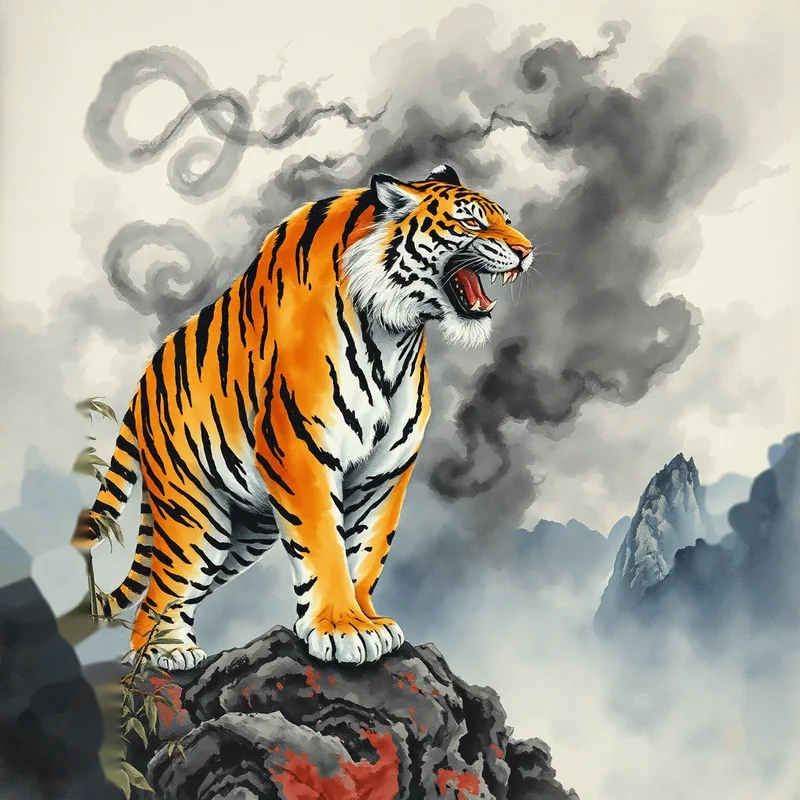
 彘
南山经
《南山经》
彘
Zhi
4.752k南山经
BeastMan-eaterTigerOmen
On Mount Fuyu, facing Lake Tai, lives a beast shaped like a tiger with an ox tail, barking like a dog. Its name is Zhi, and it eats people.
Original & Translations
南山经曰:又东五百里,曰浮玉之山,北望具区,东望诸毗。有兽焉,其状如虎而牛尾,其音如吠犬,其名曰彘,是食人。苕水出于其阴,北流至于具区。
彘,是猪。
但这条记录里的彘,形状像虎,尾巴像牛,叫声像狗,吃人。
一条记录里出现了四种动物:猪的名字、虎的身子、牛的尾巴、狗的叫声。没有一个字对得上"猪"。
先说地理。浮玉之山,北望具区——具区是太湖的古名。东望诸毗。苕水从山北流出,北流进太湖。苕水就是今天的苕溪,从浙江天目山北麓下来,经湖州入太湖。
所以浮玉之山就是天目山。这条记录的地理是精确的:站在天目山顶,北边是太湖,脚下是苕溪的源头。
那么天目山有没有一种"像虎、牛尾、犬吠、吃人"的动物?
有。华南虎。
"其状如虎",不用解释。
"牛尾",虎的尾巴长约一米,基部粗,末端没有簇毛,但虎在激动或准备扑击时,尾尖会向上卷起,整条尾巴看上去像一条鞭子。华南虎的尾巴比东北虎更细长,毛更短,在灌丛里只看见一条尾巴甩动的时候,确实像牛尾。
"其音如吠犬",虎会吠。这不是比喻。虎在受惊、示警、或者召唤幼崽时,会发出一声短促、低沉、爆破性的"汪",和大型犬的吠声几乎一样。生物声学上叫警告吠。虎没有专供咆哮的声带结构,它的长吼是低频的,但短促的警告声就是犬吠。
"是食人",天目山一带,人虎冲突的记录一直写到二十世纪。
然后说名字。
为什么把虎叫成猪?
因为"彘"在古书里不只是猪。它同时是一个地名——彘县,汉置,在今山西霍州;也用作人名的字。先秦两汉的文字里,同一个字常常是借来的:写的人听见当地人怎么叫,就找一个音近的字记下来。
"彘"的上古音,和今天"猪"的读音不是一回事。有一种可能是:当地人把这个吃人的东西叫成某个音节,记录者手上正好有"彘"这个字,就写下了。写完之后,两千年的人都以为那是一只猪。
这不是孤例。《山海经》里"其名曰某"的条目,很多字在后世都不再使用,注家只能注音,不能释义。名字是声音的化石。
还有一个可能:这不是误写,是忌讳。山里人不说"虎",说大虫、山君、老巴子。因为叫它的名字,它会听见。用一个完全不相干的字——猪——去指代它,是一种语言上的躲避。
两种解释都指向同一件事:名字错了,动物是真的。
最后是苕水。
苕溪从天目山北流,经余杭、德清、湖州入太湖。这条河至今还在,两岸是竹林、茶园、稻田。二十世纪五十年代,浙江的山里还有虎。此后,野外再没有确证的目击。
学界现在的判断是:华南虎在野外已经功能性灭绝。全世界的圈养个体不到两百只,全部来自二十世纪五十年代捕获的六只。
《山海经》说"是食人"。今天,我们更常说的是:人使它无处可去。
一座能看见太湖的山,一条还在流的河,一个被写成"猪"的名字。记录是真的,只是我们把名字读错了。
The Classic of Southern Mountains: five hundred li east is Mount Fuyu, facing north on Juqu and east on Zhu Pi. A beast lives there, shaped like a tiger with an ox's tail, its cry like a barking dog. Its name is Zhi, and it eats people. The Tiao River rises on its shady side and flows north into Juqu.
Zhi means pig.
But the zhi in this entry is shaped like a tiger, has an ox's tail, barks like a dog, and eats people.
Four animals in one line: a pig's name, a tiger's body, an ox's tail, a dog's voice. Not one character matches "pig."
Start with the geography. Mount Fuyu looks north on Juqu — the ancient name of Lake Tai — and east on Zhu Pi. The Tiao River leaves its northern face and runs into the lake. The Tiao is the modern Tiaoxi, coming down from the north slope of the Tianmu Mountains in Zhejiang, through Huzhou, into Lake Tai.
So Mount Fuyu is the Tianmu range. The geography in the entry is exact: from the summit you see Lake Tai to the north, and the headwaters of the Tiaoxi at your feet.
Does the Tianmu range hold an animal that is tiger-shaped, ox-tailed, dog-voiced, and man-eating?
Yes. The South China tiger.
"Shaped like a tiger" needs no explanation.
"Ox tail." A tiger's tail is about a metre long, thick at the base, without a tuft. But when a tiger is agitated or about to spring, the tip curls upward and the whole tail reads as a whip. The South China tiger's tail is longer and thinner than the Amur tiger's, with shorter hair; seen thrashing through scrub, with only the tail visible, it does look like an ox's.
"Its cry is like a barking dog." Tigers bark. This is not a metaphor. Startled, warning, or calling cubs, a tiger produces a short, low, explosive "wuff" that is almost indistinguishable from a large dog's bark. Bioacoustics calls it the alarm bark. Tigers have no special roaring structure; their long call is low-frequency, but the short warning is a bark.
"And it eats people." In the Tianmu country, records of tiger attacks run right up into the twentieth century.
Now the name.
Why call a tiger a pig?
Because zhi was not only a pig. It was also a place name — Zhi County, established under the Han, in modern Huozhou, Shanxi — and a character used in personal names. In early Chinese writing, a single graph was often borrowed for its sound: the recorder heard what the locals called the thing and wrote down a character that sounded close.
The Old Chinese pronunciation of zhi was not the modern word for pig. One possibility: the locals had some syllable for this man-eater, the recorder had the graph zhi to hand, and wrote it. After which, for two thousand years, everyone assumed it was a pig.
This is not an isolated case. Many of the naming characters in the Shanhaijing had fallen out of use by later centuries, and commentators could only gloss the sound, not the meaning. Names are fossils of sound.
There is another possibility: not error, but taboo. Mountain people did not say "tiger." They said great worm, lord of the mountain, old uncle. Because if you say its name, it hears you. Using a completely unrelated character — pig — to point at it is a form of verbal evasion.
Both explanations point the same way: the name is wrong, the animal is real.
Finally, the Tiao.
The Tiaoxi runs north from Tianmu through Yuhang, Deqing, and Huzhou into Lake Tai. The river is still there, with bamboo, tea, and rice on both banks. In the 1950s there were still tigers in the Zhejiang hills. After that, no confirmed sighting in the wild.
The scholarly consensus now is that the South China tiger is functionally extinct in the wild. Fewer than two hundred survive in captivity worldwide, all descended from six animals caught in the 1950s.
The Shanhaijing says: it eats people. Today we are more likely to say: we left it nowhere to go.
A mountain that sees Lake Tai, a river still running, a name written as "pig." The record is true. We are the ones who read the name wrong.
เขาฝูอวี้ มองเห็นทะเลสาบไท่หู มีแม่น้ำเถียวไหลลงทะเลสาบ
มีสัตว์ "รูปร่างเหมือนเสือ หางเหมือนวัว เห่าเหมือนหมา ชื่อจื้อ มันกินคน"
ชื่อ "จื้อ" แปลว่าหมู แต่ตัวที่บรรยายไม่ใช่หมูเลย
"หางเหมือนวัว" คือหางเสือที่ปลายม้วนขึ้นเวลาเตรียมกระโจน
"เห่าเหมือนหมา" จริง เสือส่งเสียงสั้น ๆ ทุ้ม ๆ เหมือนหมาใหญ่เวลาเตือนภัย
"กินคน" — ภูเขาหมิ่นมู่ (เทียนมู่) เคยมีเสือโคร่งจีนใต้ชุกชุม
เหตุที่เรียกเสือว่าหมู: ในภาษาจีนโบราณ "จื้อ" เป็นทั้งชื่อเมืองและอักษรที่ยืมเสียงมาใช้ คนบันทึกได้ยินเสียงเรียกจากคนท้องถิ่น แล้วหยิบอักษรที่เสียงใกล้มาเขียน
หรืออาจเป็นความเชื่อเรื่องห้ามเอ่ยชื่อ — ชาวเขาจะไม่เรียก "เสือ" ตรง ๆ เพราะกลัวเสือได้ยิน จึงใช้คำอื่นแทน
วันนี้เสือโคร่งจีนใต้ในป่าถือว่าสูญพันธุ์เชิงหน้าที่แล้ว เหลือในกรงทั่วโลกไม่ถึงสองร้อยตัว
Gunung Fuyu menghadap Tasik Tai, dan Sungai Tiao mengalir ke tasik itu.
Ada binatang "seperti harimau, ekor lembu, menyalak seperti anjing, namanya Zhi, ia makan orang."
Nama "Zhi" bermakna babi, tetapi yang digambarkan sama sekali bukan babi.
"Ekor lembu": hujung ekor harimau melengkung ke atas ketika hendak menerkam.
"Menyalak seperti anjing": benar — harimau mengeluarkan bunyi pendek dan rendah seperti anjing besar ketika memberi amaran.
"Makan orang": kawasan Gunung Tianmu memang pernah padat dengan harimau China selatan.
Mengapa harimau dipanggil babi? Dalam bahasa Cina kuno, "zhi" juga nama tempat dan aksara pinjaman bunyi. Pencatat mendengar sebutan tempatan lalu menulis aksara yang bunyinya dekat.
Atau kerana pantang menyebut nama: orang gunung tidak menyebut "harimau" terus, takut harimau mendengarnya.
Hari ini harimau China selatan di alam liar dianggap pupus secara fungsi; di dalam kurungan seluruh dunia kurang dua ratus ekor.
Núi Phù Ngọc nhìn ra Thái Hồ, sông Thiều từ sườn bắc chảy vào hồ.
Có thú "như hổ, đuôi trâu, sủa như chó, tên Trệ, nó ăn thịt người."
"Trệ" nghĩa là lợn, nhưng con được miêu tả hoàn toàn không phải lợn.
"Đuôi trâu": chóp đuôi hổ cong lên khi sắp vồ.
"Sủa như chó": đúng — hổ phát ra tiếng ngắn, trầm như chó lớn khi cảnh báo.
"Ăn thịt người": vùng núi Thiên Mục xưa vốn nhiều hổ Hoa Nam.
Vì sao gọi hổ là lợn? Trong Hán ngữ cổ, "trệ" còn là tên đất và là chữ mượn âm. Người ghi chép nghe cách gọi địa phương rồi chọn chữ gần âm.
Hoặc vì kiêng tên: người miền núi không gọi thẳng "hổ", sợ hổ nghe thấy.
Ngày nay hổ Hoa Nam ngoài tự nhiên được coi là tuyệt chủng về chức năng; trong điều kiện nuôi nhốt toàn cầu chưa tới hai trăm con.
Gunung Fuyu menghadap Danau Tai, dan Sungai Tiao mengalir ke danau itu.
Ada binatang "seperti harimau, ekor sapi, menyalak seperti anjing, namanya Zhi, ia makan orang."
Nama "Zhi" berarti babi, tetapi yang digambarkan sama sekali bukan babi.
"Ekor sapi": ujung ekor harimau melengkung ke atas saat hendak menerkam.
"Menyalak seperti anjing": benar — harimau mengeluarkan bunyi pendek dan rendah seperti anjing besar saat memberi peringatan.
"Makan orang": kawasan Gunung Tianmu memang pernah padat harimau China selatan.
Mengapa harimau disebut babi? Dalam bahasa Cina kuno, "zhi" juga nama tempat dan aksara pinjaman bunyi. Pencatat mendengar sebutan setempat lalu menulis aksara yang bunyinya dekat.
Atau karena pantang menyebut nama: orang gunung tidak menyebut "harimau" langsung, takut harimau mendengarnya.
Kini harimau China selatan di alam liar dianggap punah secara fungsi; di penangkaran seluruh dunia kurang dari dua ratus ekor.
Nearby Creatures