 应龙
北山经
《大荒东经》
应龙
Yinglong
4.871k北山经
DeityDragonRainWar
In the northeast of the Great Wilderness stands Mount Xiongli. Yinglong dwelt at the southern pole; he killed Chiyou and Kuafu and could not return to heaven. Therefore the world suffers drought, and in drought people make an image of Yinglong, and then the rain comes.
Original & Translations
大荒东经曰:大荒东北隅中,有山名曰凶犁土丘。应龙处南极,杀蚩尤与夸父,不得复上。故下数旱,旱而为应龙之状,乃得大雨。
大荒北经又说:应龙已杀蚩尤,又杀夸父,乃去南方处之,故南方多雨。
两条记录合起来,是一个完整的故事,也是一个完整的技术。
先说故事。
黄帝与蚩尤战于冀州之野。应龙蓄水,蚩尤请来风伯雨师,纵大风雨。黄帝于是降下天女魃,雨止,杀蚩尤。应龙又杀夸父。
战争赢了。然后呢?
"不得复上。"
回不去了。
为什么回不去?古注的说法是:应龙杀的人太多,沾了不洁,不能重返天庭。也有人说,是因为它用了水攻,伤了天地之气。
不管哪一种,结果是一样的:一个立了头功的战将,被留在了人间。
它去了南方。所以南方多雨。
这句话很有意思。南方多雨,是一个气象事实。古人需要一个解释,于是说:因为应龙住在那里。一条会蓄水的龙住在南方,南方当然多雨。
这是一个把地理事实倒推成神话原因的典型句子。先有"南方多雨",后有"应龙处南方"。因果是反的,但描述是准的。
然后是技术。
"旱而为应龙之状,乃得大雨。"
天旱的时候,做一个应龙的形状,就能求来大雨。
这句话,是中国祈雨史上最重要的一句话。
因为它给出了一个可操作的方案:不是祈祷,不是献祭,是"为应龙之状"——做出它的样子。
土龙。
《淮南子·说山训》说:"圣人用物,若用朱丝约刍狗,若为土龙以求雨。" 刍狗是草扎的狗,土龙是土塑的龙。这两样东西,都是"做一个形状",然后对它行礼。
汉代的董仲舒,在《春秋繁露》里把这件事写成了一套完整的国家仪轨。
春旱求雨:以甲乙日为苍龙一条,长八丈,居中央;小龙七条,各长四丈,置于东方,皆东向,间距八尺。服青衣的巫八人,先再拜,乃起。田啬夫亦斋三日,服青衣而立之。凿社通之于闾外之沟,取五虾蟆,错置社之中池,池方八尺,深一尺,置水虾蟆焉。具清酒、膊脯。祝斋三日,服苍衣,拜跪陈祝如初。取三岁雄鸡与三岁豭猪,皆燔之于四通神宇。令民阖邑里南门,置水其外,开邑里北门,具老豭猪一,置之于里北门之外。市中亦置豭猪一。闻鼓声,皆烧豭猪尾。取死人骨埋之,开山渊,积薪而燔之。通道桥之壅塞不行者,决渎之。
这段文字很长,但你会发现一件事。
里面有龙,有巫,有祝辞,有虾蟆,有猪,有鼓——这些是仪式。
但里面还有:凿社通沟、开山渊、通道桥之壅塞、决渎。
这些是工程。
求雨的同时,在疏通水道,在清理桥洞,在挖开淤塞的沟渠。
为什么?
因为在一个农业社会里,旱灾的真正杀手不是"没有雨",是"雨来了也留不住"。沟渠堵了,桥洞塞了,水来了也流不进田里。所以抗旱的第一件事,是清淤。
而清淤需要动员几百上千人,需要让人相信这件事必须做,需要有一个理由让大家放下自家的活去挖沟。
仪式就是这个理由。
一条八丈长的土龙立在中央,七条四丈的小龙排在东边,穿青衣的巫在拜,鼓在响,猪尾巴在烧。全村的人都来了。然后官吏说:沟要挖,渠要通,大家动手。
这就是"为应龙之状,乃得大雨"的真正机制。
不是土龙招来了雨,是土龙把人招来了;人来了,沟挖了,雨来了,水就留住了。
所以应龙在中国神话里的位置很特殊:它是唯一一个"可以被制造"的神。
别的神,你要去找它,拜它,求它。应龙不用。你拿土,塑一条龙,它就在那里了。
这也是它"不得复上"的另一层意思:一个可以被复制的神,就不需要待在天上了。
最后说它的样子。
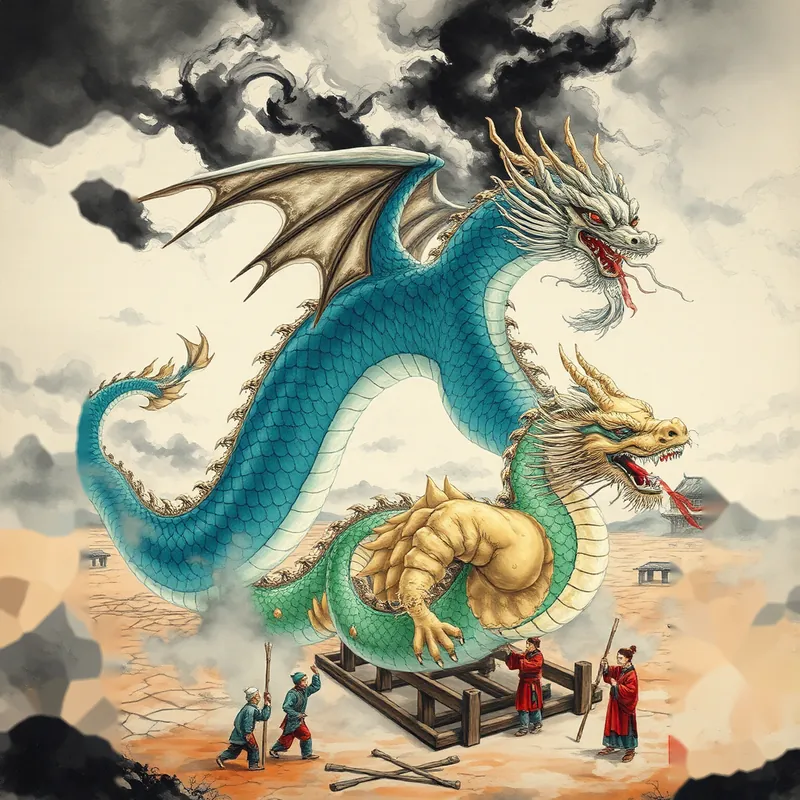
应龙是有翅膀的龙。
中国龙绝大多数没有翅膀。汉画像石里的龙,靠云气飞,靠身体扭动。但应龙不同:从汉代开始,应龙就被画成肩生双翼。马王堆帛画、南阳汉画像石、卜千秋墓壁画,都有带翼的龙。
为什么只有它长翅膀?
因为它要"蓄水",要"致雨",要从一个地方快速到另一个地方。翅膀是速度的符号。
也可能是因为它被留在了地上。一个不能回天的神,需要自己的飞行器官。
后来,应龙的形象往两个方向走。一个进了皇家祈雨的正祀,土龙成了国家典礼的一部分,一直用到清代。另一个进了民间,变成了"龙抬头"、二月二、龙王庙。
而南方依然多雨。
每年梅雨,长江中下游一片水汽。没有人再说是应龙住在那里了。但那句"故南方多雨",还留在书里。
The Classic of the Great Wilderness, East: in the northeast corner of the Great Wilderness stands a mountain called Xiongli. Yinglong dwelt at the southern pole. He killed Chiyou and Kuafu, and could not go back up. Therefore the world below suffers drought again and again; and in drought, people make an image of Yinglong, and then the great rain comes.
The northern chapter adds: Yinglong killed Chiyou, then killed Kuafu, and went south to live. That is why the south has much rain.
Together the two entries give a complete story, and a complete technology.
The story first.
The Yellow Emperor fought Chiyou on the plain of Jizhou. Yinglong gathered water. Chiyou summoned the Lord of Wind and the Master of Rain, who loosed a great storm. The Emperor then sent down the heavenly woman Ba; the rain stopped; Chiyou was killed. Yinglong also killed Kuafu.
The war was won. And then?
"He could not go back up."
He could not return.
Why not? The old commentaries say he had killed too many and was stained, and could not re-enter heaven. Others say his water attack had injured the qi of heaven and earth.
Either way the result is the same: the commander who won the war was left on earth.
He went south. That is why the south is wet.
The line is interesting. That the south is wet is a meteorological fact. The ancients needed an explanation, so: because Yinglong lives there. A water-gathering dragon lives in the south; of course the south is wet.
This is the classic move of reading a geographical fact backwards into a mythical cause. First "the south is wet," then "Yinglong lives in the south." The causality is inverted. The description is accurate.
Then the technology.
"In drought, make an image of Yinglong, and then the great rain comes."
That sentence is the most important line in the history of Chinese rainmaking.
Because it gives an operational procedure. Not prayer. Not sacrifice. "Make an image of him."
A clay dragon.
The Huainanzi says: the sage uses things as he uses a straw dog bound with red silk, as he makes a clay dragon to seek rain. The straw dog and the clay dragon are both "making a shape," and then bowing to it.
Dong Zhongshu, in the Han, turned this into a full state liturgy in the Luxuriant Dew of the Spring and Autumn Annals.
For spring drought: on a jia or yi day, make one azure dragon eight zhang long and set it in the centre; make seven small dragons four zhang long and set them in the east, all facing east, eight chi apart. Eight shamans in azure robes bow twice and rise. The grain officer fasts three days, wears azure, and stands by. Cut a channel from the altar out to the ditch beyond the gate; take five toads and place them in a square pool eight chi across and one chi deep at the altar, with water. Offer clear wine and dried meat. The invocator fasts three days, wears azure, and kneels with the same words. Take a three-year-old cock and a three-year-old boar and burn them at the shrine open on four sides. Order the people to shut the south gate of the ward and put water outside it, and open the north gate, and set an old boar outside the north gate. Set another boar in the market. When the drum sounds, burn the boars' tails. Take the bones of the dead and bury them. Open the mountain springs, pile brushwood and burn it. Clear the roads and bridges where they are blocked, and open the blocked channels.
It is a long passage. But notice one thing.
There are dragons, shamans, invocations, toads, pigs, drums — the ritual.
And there is also: cut the channel from the altar, open the springs, clear the blocked roads and bridges, open the blocked channels.
That is engineering.
While praying for rain, they were dredging channels, clearing bridge arches, opening silted ditches.
Why?
Because in an agricultural society the real killer in a drought is not "no rain." It is "when the rain comes, it cannot be held." Blocked ditches, choked culverts — the water arrives and never reaches the field. The first task of drought relief is dredging.
And dredging needs hundreds or thousands of men. It needs people to believe it must be done. It needs a reason for every household to put down its own work and dig.
The ritual is the reason.
An eight-zhang dragon in the centre, seven four-zhang dragons in the east, shamans in azure bowing, drums, burning pig tails. The whole village is there. Then the official says: the ditches must be dug, the channels cleared, everybody take a tool.
That is the actual mechanism of "make an image of Yinglong, and the great rain comes."
The clay dragon did not summon the rain. The clay dragon summoned the people. The people came, the ditches were dug, the rain came, and the water stayed.
So Yinglong holds a peculiar place among Chinese gods: he is the only one that can be manufactured.
Other gods must be found, approached, petitioned. Yinglong does not. You take clay, you shape a dragon, and there he is.
Which is the other meaning of "he could not go back up": a god who can be copied does not need to stay in heaven.
Finally, his shape.
Yinglong has wings.
Almost no Chinese dragon has wings. The dragons on Han reliefs fly on cloud vapour, on the twisting of the body. Yinglong is different: from the Han onward he is drawn with wings at the shoulders. The Mawangdui silk, the Nanyang reliefs, the Bu Qianqiu tomb murals — all show a winged dragon.
Why only him?
Because he must gather water, bring rain, and move fast from place to place. Wings are the sign of speed.
Or because he was left on the ground. A god who cannot return to heaven needs his own means of flight.
Later the image split two ways. One went into the imperial rain rite, where the clay dragon remained part of state ceremony into the Qing. The other went into folk practice — the Dragon Raises Its Head, the second day of the second month, the Dragon King temples.
And the south is still wet.
Every plum-rain season the middle Yangtze disappears into vapour. Nobody says anymore that Yinglong lives there. But the sentence — "that is why the south has much rain" — is still in the book.
มุมตะวันออกเฉียงเหนือของแดนร้างมีเขาซงหลี
"อิ้งหลงอยู่ขั้วใต้ สังหารชื่อโหยวและขัวฟู่ จึงกลับสวรรค์ไม่ได้ โลกจึงแล้งบ่อย ครั้นแล้งคนทำรูปอิ้งหลง ฝนก็ตกหนัก"
และอีกบทว่า "อิ้งหลงอยู่ทางใต้ ทางใต้จึงฝนมาก"
เรื่องคือ: สงครามกับชื่อโหยว อิ้งหลงกักน้ำ ศัตรูเช่าลมฝนมา เหลืองอี้ส่งนางฟ้าป้า (ป้า) ลงมาหยุดฝน สังหารชื่อโหยวได้ แต่ผู้ชนะกลับสวรรค์ไม่ได้ ถูกทิ้งไว้บนดิน
ประโยคสำคัญคือ "ทำรูปอิ้งหลงแล้วฝนตก" — นี่คือจุดกำเนิดพิธีขอมังกรดิน
ในสมัยราชวงศ์ฮั่น ตงจ้งซูเขียนพิธีระดับชาติไว้ละเอียด: ปั้นมังกรเขียวใหญ่หนึ่งตัวยาวแปดจ้าง มังกรเล็กเจ็ดตัวยาวสี่จ้าง หมอผีใส่เสื้อเขียว แท่นบูชา กบห้าตัวในสระเล็ก ฆ่าหมูและไก่ ฯลฯ
แต่ในพิธีเดียวกันยังมีคำสั่ง: ขุดคูจากแท่นบูชา เปิดตาน้ำ เคลียร์สะพานและทางน้ำที่ตัน
นั่นคืองานวิศวกรรม
ในสังคมเกษตร ภัยแล้งที่ฆ่าคนจริง ๆ ไม่ใช่ "ฝนไม่ตก" แต่คือ "ฝนมาแล้วเก็บไว้ไม่ได้" คูตื้น ท่อตัน น้ำไหลเข้าทุ่งไม่ได้
การขุดคูต้องใช้คนหลายร้อยคน ต้องมีเหตุให้ทุกบ้านวางงานตัวเองลงมาขุด
พิธีคือเหตุนั้น
มังกรดินไม่ได้เรียกฝน แต่มังกรดินเรียกคน คนมา คูถูกขุด ฝนมา น้ำก็อยู่
อิ้งหลงจึงเป็นเทพองค์เดียวที่ "ผลิตได้" — เอาดินมาปั้น ก็ได้แล้ว
และนี่คืออีกความหมายของ "กลับสวรรค์ไม่ได้": เทพที่ทำซ้ำได้ ไม่จำเป็นต้องอยู่บนฟ้า
Di timur laut padang liar ada Gunung Xiongli.
"Yinglong tinggal di kutub selatan; membunuh Chiyou dan Kuafu, lalu tidak dapat kembali ke langit. Sebab itu dunia sering kemarau; bila kemarau, orang membuat rupa Yinglong, lalu hujan turun lebat."
Bab lain menambah: "Yinglong pergi ke selatan, sebab itu selatan banyak hujan."
Kisahnya: perang melawan Chiyou. Yinglong mengumpulkan air; musuh memanggil dewa angin dan hujan; Huangdi menurunkan dewi Ba untuk menghentikan hujan; Chiyou terbunuh. Tetapi pemenang tidak boleh pulang ke langit; ia ditinggalkan di bumi.
Ayat terpenting: "buat rupa Yinglong, maka hujan turun" — inilah asal upacara naga tanah.
Pada dinasti Han, Dong Zhongshu menulis liturgi negara: satu naga biru besar sepanjang lapan zhang, tujuh naga kecil empat zhang, dukun berpakaian biru, lima katak dalam kolam kecil, korban babi dan ayam.
Tetapi dalam upacara yang sama ada perintah: gali saluran dari altar, buka mata air, bersihkan jambatan dan saluran yang tersumbat.
Itu kerja kejuruteraan.
Dalam masyarakat tani, pembunuh sebenar semasa kemarau bukan "hujan tidak turun", tetapi "hujan datang tidak dapat ditahan": parit cetek, culvert tersumbat, air tidak sampai ke sawah.
Menggali parit memerlukan ratusan orang. Perlu sebab untuk setiap rumah berhenti kerja dan menggali.
Upacara itulah sebabnya.
Naga tanah tidak memanggil hujan; naga tanah memanggil orang. Orang datang, parit digali, hujan turun, air kekal.
Yinglong satu-satunya dewa yang "boleh dibuat". Ambil tanah, bentuk naga, dan ia ada di situ.
Itulah makna kedua "tidak dapat kembali ke langit": dewa yang boleh disalin tidak perlu tinggal di langit.
Đông bắc hoang dã có núi Hung Lê.
"Ứng Long ở cực nam, giết Xi Vưu và Khoa Phụ, không về trời được. Vì thế hạ giới hay hạn; gặp hạn, người ta làm hình Ứng Long thì mưa lớn."
Chương khác thêm: "Ứng Long đi về nam, nên nam nhiều mưa."
Chuyện là: chiến tranh với Xi Vưu. Ứng Long trữ nước; địch gọi thần gió mưa; Hoàng Đế sai thiên nữ Bạt xuống ngừng mưa; Xi Vưu bị giết. Nhưng người thắng không về trời được, bị bỏ lại dưới đất.
Câu quan trọng nhất: "làm hình Ứng Long thì mưa lớn" — đây là khởi đầu lễ rồng đất cầu mưa.
Đời Hán, Đổng Trọng Thư ghi nghi thức cấp quốc gia: một rồng xanh lớn dài tám trượng, bảy rồng nhỏ bốn trượng, thầy đồng mặc áo xanh, năm con cóc trong ao nhỏ, tế lợn và gà.
Nhưng trong cùng nghi lễ có lệnh: đào mương từ đàn tế, mở mạch nước, khơi cầu và chỗ tắc.
Đó là công trình thủy lợi.
Trong xã hội nông nghiệp, kẻ giết người thật sự khi hạn không phải "trời không mưa", mà là "mưa đến không giữ được": mương cạn, cống tắc, nước không vào ruộng.
Đào mương cần hàng trăm người. Cần lý do để mỗi nhà bỏ việc mình mà đi đào.
Nghi lễ là lý do đó.
Rồng đất không gọi mưa; rồng đất gọi người. Người đến, mương được đào, mưa đến, nước ở lại.
Ứng Long là vị thần duy nhất "có thể chế tạo". Lấy đất, nặn rồng, là có ngay.
Đó là nghĩa thứ hai của "không về trời được": một vị thần có thể sao chép thì không cần ở trên trời.
Di timur laut padang liar ada Gunung Xiongli.
"Yinglong tinggal di kutub selatan; membunuh Chiyou dan Kuafu, lalu tidak dapat kembali ke langit. Sebab itu dunia sering kemarau; saat kemarau, orang membuat rupa Yinglong, lalu hujan turun lebat."
Bab lain menambah: "Yinglong pergi ke selatan, sebab itu selatan banyak hujan."
Kisahnya: perang melawan Chiyou. Yinglong mengumpulkan air; musuh memanggil dewa angin dan hujan; Huangdi menurunkan dewi Ba untuk menghentikan hujan; Chiyou terbunuh. Tetapi pemenang tidak boleh pulang ke langit; ia ditinggalkan di bumi.
Ayat terpenting: "buat rupa Yinglong, maka hujan turun" — inilah asal upacara naga tanah.
Pada dinasti Han, Dong Zhongshu menulis liturgi negara: satu naga biru besar sepanjang delapan zhang, tujuh naga kecil empat zhang, dukun berpakaian biru, lima katak dalam kolam kecil, korban babi dan ayam.
Tetapi dalam upacara yang sama ada perintah: gali saluran dari altar, buka mata air, bersihkan jembatan dan saluran yang tersumbat.
Itu kerja teknik.
Dalam masyarakat tani, pembunuh sebenarnya saat kemarau bukan "hujan tidak turun", tetapi "hujan datang tidak dapat ditahan": parit dangkal, gorong-gorong tersumbat, air tidak sampai ke sawah.
Menggali parit perlu ratusan orang. Perlu alasan bagi setiap rumah berhenti bekerja dan menggali.
Upacara itulah alasannya.
Naga tanah tidak memanggil hujan; naga tanah memanggil orang. Orang datang, parit digali, hujan turun, air bertahan.
Yinglong satu-satunya dewa yang "bisa dibuat". Ambil tanah, bentuk naga, dan ia ada di situ.
Itulah makna kedua "tidak dapat kembali ke langit": dewa yang bisa disalin tidak perlu tinggal di langit.
Nearby Creatures