 鬿雀
东山经
《东山经》
鬿雀
Qique
4.327k东山经
Divine BirdMan-eaterEvil Beast
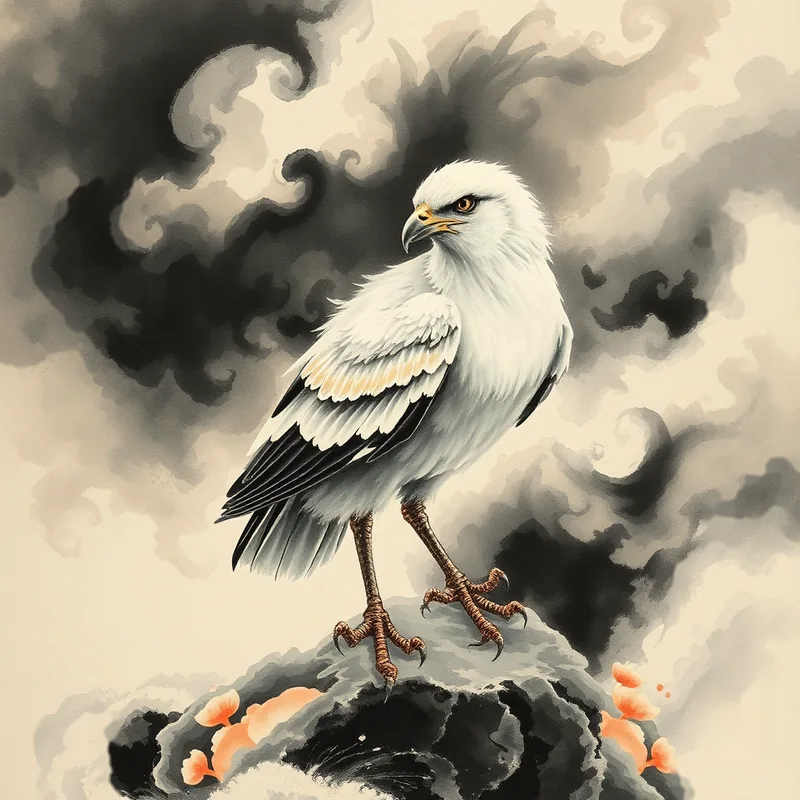
Mount Beihao stands on the North Sea. There is a bird like a chicken with a white head, rat's feet and tiger's claws. Its name is Qique, and it too eats people.
Original & Translations
东山经曰:又东次四经之首,曰北号之山,临于北海。有木焉,其状如杨,赤华,其实如枣而无核,其味酸甘,食之不疟。食水出焉,而东北流注于海。有兽焉,其状如狼,赤首鼠目,其音如豚,名曰獦狚,是食人。有鸟焉,其状如鸡而白首,鼠足而虎爪,其名曰鬿雀,亦食人。
北号之山,临于北海。
北海,是渤海。北号之山在渤海岸边,可能是今天河北、辽宁沿海的某一座。
这一段记录里有两样吃人的东西,一兽一鸟。兽是獦狚(狼形,赤首鼠目,声如猪),鸟是鬿雀。
先看鬿雀的描述:状如鸡,白首,鼠足,虎爪。
"状如鸡"——体型像鸡。这是第一个尺度:不大。
"白首"——头是白的。白头猛禽,中国有白头鹞、白头鹗(鹗的头部有白羽),还有白尾海雕的浅色头。
"鼠足"——脚像老鼠。这个描述很奇怪,因为鸟的脚和鼠的脚差得很远。但如果看的是"细长的、裸露的、有鳞片的跗跖",确实像鼠尾或鼠足。鹰类的腿就是这样的:细长,无羽(或部分无羽),覆盖角质鳞片。
"虎爪"——爪子像老虎。鹰爪:弯曲,尖锐,能刺穿皮肉。三个前趾一个后趾,后趾的爪最长,用来穿刺。
所以"鼠足而虎爪"这五个字,其实是精确的:细长的腿(像鼠),致命的爪(像虎)。
现在的问题是:"其状如鸡"。
鸡那么大的一只鸟,白脑袋,细长的腿,老虎一样的爪子。
这个组合,在现实里对应什么?
白头鹞。体长约五十厘米,比鸡略大。雄鸟头颈灰白,背部褐色。腿长而细,爪锐。它飞得很低,贴着芦苇荡掠过,捕食水鸟幼雏、鼠类、蛙。
白头鹞的分布区,正好包括渤海沿岸的湿地。而渤海沿岸(黄河三角洲、辽河口、双台河口)是中国东部最重要的候鸟迁徙通道之一,每年春秋有数百万只水鸟经过。
一个在海边生活的人,看见一只白头、长腿、利爪的鸟,从芦苇里抓起一只鸭子飞走——他会怎么记?
"像鸡,白头,鼠足,虎爪。"
至于"食人",这是另一回事。
大型猛禽攻击人的记录,在世界各地都有。白尾海雕、金雕都曾有攻击人类幼童的案例(欧洲阿尔卑斯山区有金雕袭童的记载)。但更常见的,是猛禽吃尸体。
渤海沿岸是古战场。战国、秦汉、三国,这一带打过很多仗。战场上留下的尸体,会被鸟兽清理。一只白头大鸟站在尸体上,这个画面,对一个普通村民来说,就是"吃人的鸟"。
而同一段记录里,前面还有一只吃人的兽。两样吃人的东西,住在同一座临海的山上。
这不是偶然。这是把一个"死亡高发地"的所有证据,集中记在了一起。
渤海,海边,山,沼泽,候鸟,战场。
鬿雀住在那里。它不需要是怪物。它只需要是一只足够大的、白头、长腿、有虎爪的鸟,出现在一个足够多尸体的地方。
The Classic of Eastern Mountains, fourth eastern section: its head is Mount Beihao, standing on the North Sea. There is a tree there like a poplar, red-flowered, fruiting like a jujube without a stone, sour-sweet, and eating it prevents malaria. The Shi River issues from the mountain and flows northeast into the sea. A beast lives there like a wolf with a red head and rat's eyes, crying like a pig — its name is Geda, and it eats people. And a bird, shaped like a chicken with a white head, rat's feet, and tiger's claws. Its name is Qique, and it too eats people.
Mount Beihao, on the North Sea.
The North Sea here is the Bohai. Mount Beihao stood on the Bohai coast, somewhere in modern Hebei or Liaoning.
This passage contains two man-eaters, one beast and one bird. The beast is Geda — wolf-shaped, red-headed, rat-eyed, squealing like a pig. The bird is Qique.
Take the description: shaped like a chicken, white head, rat's feet, tiger's claws.
"Shaped like a chicken" sets the scale first. Not large.
"White head." White-headed raptors in China include the Pallid Harrier, the Osprey (pale-crowned), and the white-tailed eagle with its pale head.
"Rat's feet." An odd comparison, since a bird's foot is nothing like a rat's. But if what you are looking at is the tarsus — long, bare, scaled — it does read as a rat's leg or tail. That is exactly what a hawk's leg looks like: long, thin, unfledged or partly bare, covered in horny scales.
"Tiger's claws." Curved, sharp, capable of puncturing flesh. Three toes forward, one back, the hind claw longest, built for piercing.
So the five characters "rat's feet, tiger's claws" are precise: a long thin leg, and a lethal claw.
The puzzle is "shaped like a chicken."
A bird the size of a chicken, white-headed, long-legged, with tiger's claws.
What does that correspond to?
The Pallid Harrier. Around fifty centimetres, slightly larger than a chicken. The male has a pale grey-white head and neck over a brown back. Legs long and thin, claws sharp. It hunts low, skimming the reeds, taking young waterbirds, rodents, frogs.
Its range includes precisely the wetlands of the Bohai coast. And the Bohai shore — the Yellow River delta, the Liao River mouth, the Shuangtai estuary — is one of the most important migratory corridors in eastern China. Millions of waterbirds pass through each spring and autumn.
A person living on that coast sees a white-headed, long-legged, sharp-clawed bird lift a duck out of the reeds and fly off. How would he write it down?
"Like a chicken, white head, rat's feet, tiger's claws."
As for eating people — that is another matter.
Large raptors attacking humans are recorded worldwide. White-tailed eagles and golden eagles have both been documented attacking small children; there are Alpine accounts of golden eagles taking infants. But the commoner reality is that raptors eat corpses.
The Bohai coast was a battlefield. The Warring States, Qin, Han, and Three Kingdoms all fought here. What the battles left behind was cleared by birds and animals. A big white-headed bird standing on a body — to a villager, that is a bird that eats people.
And in the same passage, before it, there is already a man-eating beast. Two man-eaters, on one coastal mountain.
That is not coincidence. It is the evidence of a place where people died, gathered in one entry.
Bohai. Shore. Mountain. Marsh. Migratory birds. Battlefield.
Qique lives there. It does not need to be a monster. It only needs to be a sufficiently large bird with a white head, long legs and tiger's claws, in a place with a sufficient number of bodies.
เขาเป่ยหาวติดทะเลเหนือ (โป๋ไห่) ทางชายฝั่งเหอเป่ย/เหลียวหนิง
ในบันทึกเดียวกันมีสัตว์กินคนสองอย่าง: สัตว์คล้ายหมาป่า และนกฉีเชวี่ย
"รูปร่างเหมือนไก่ หัวขาว เท้าหนู เล็บเสือ" — "เท้าหนู" คือขาแบบนกเหยี่ยว: ยาว เปลือย มีเกล็ด "เล็บเสือ" คือกรงเล็บโค้งแหลม
น่าจะเป็นนกเหยี่ยวหัวขาว เช่น เหยี่ยวทุ่งหัวซีด (Pallid Harrier) ตัวราว 50 ซม. ใหญ่กว่าไก่เล็กน้อย
ชายฝั่งโป๋ไห่เป็นเส้นทางอพยพนกน้ำที่สำคัญที่สุดแห่งหนึ่งของจีนตะวันออก มีนกหลายล้านตัวผ่านทุกปี
"กินคน" อาจมาจาก: นกใหญ่ทำร้ายคน (มีบันทึกจริง) หรือนกกินซากศพ — ชายฝั่งนี้เคยเป็นสมรภูมิหลายยุค
Gunung Beihao di tepi Laut Utara (Bohai), sekitar Hebei/Liaoning hari ini.
Dalam catatan sama ada dua pemakan manusia: binatang seperti serigala, dan burung Qique.
"Bentuk macam ayam, kepala putih, kaki tikus, cakar harimau" — "kaki tikus" ialah kaki burung pemangsa: panjang, botak, bersisik. "Cakar harimau" ialah kuku bengkok tajam.
Mungkin helang/rawi berkepala pucat seperti Pallid Harrier, sekitar 50 cm, sedikit lebih besar daripada ayam.
Pesisir Bohai ialah salah satu lorong penghijrahan burung air terpenting di timur China; berjuta burung melaluinya setiap tahun.
"Makan orang" mungkin: burung besar menyerang manusia (ada rekod), atau memakan bangkai — pesisir ini medan perang beberapa zaman.
Núi Bắc Hào ven Bắc Hải (Bột Hải), vùng Hà Bắc/Liêu Ninh ngày nay.
Trong cùng ghi chép có hai kẻ ăn thịt người: một thú giống sói, và chim Kỳ Tước.
"Hình như gà, đầu trắng, chân chuột, vuốt hổ" — "chân chuột" là chân chim săn: dài, trần, có vảy. "Vuốt hổ" là móng cong nhọn.
Có lẽ là chim săn đầu nhạt như Pallid Harrier, dài khoảng 50 cm, hơi lớn hơn gà.
Bờ Bột Hải là một trong những hành lang di cư chim nước quan trọng nhất đông Trung Quốc; hàng triệu con qua mỗi năm.
"Ăn thịt người" có thể do: chim lớn tấn công người (có ghi chép), hoặc ăn xác — bờ biển này từng là chiến trường nhiều triều đại.
Gunung Beihao di tepi Laut Utara (Bohai), sekitar Hebei/Liaoning sekarang.
Dalam catatan yang sama ada dua pemakan manusia: hewan mirip serigala, dan burung Qique.
"Bentuk seperti ayam, kepala putih, kaki tikus, cakar harimau" — "kaki tikus" adalah kaki burung pemangsa: panjang, gundul, bersisik. "Cakar harimau" adalah kuku bengkok tajam.
Mungkin elang/harrier berkepala pucat seperti Pallid Harrier, sekitar 50 cm, sedikit lebih besar dari ayam.
Pesisir Bohai adalah salah satu koridor migrasi burung air terpenting di timur Tiongkok; jutaan burung melintas setiap tahun.
"Makan orang" mungkin: burung besar menyerang manusia (ada catatan), atau memakan bangkai — pesisir ini medan perang beberapa zaman.
Nearby Creatures