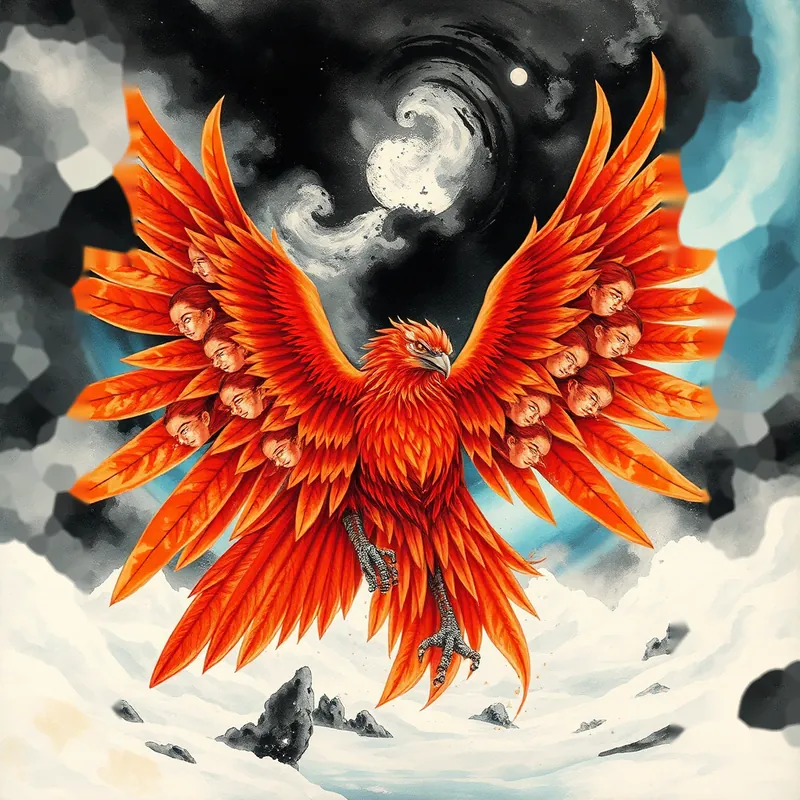
 九凤
北山经
《大荒北经》
九凤
Nine-Phoenix
4.873k北山经
DeityDivine BirdMultiplicityOmen
In the Great Wilderness stands Mount Beiji Tiangui, where the sea pours north. A god lives there: nine heads, human faces, a bird's body. Its name is Nine-Phoenix.
Original & Translations
大荒北经曰:大荒之中,有山名曰北极天柜,海水北注焉。有神,九首人面鸟身,名曰九凤。
二十七个字。
九凤在《山海经》里只出现这一次。它是神,不是妖。
九个头,人面,鸟身。
先说"九首人面鸟身"这个组合。
在《山海经》里,九头的神和兽有好几个:相柳是九首蛇身,开明兽是九首皆人面,天吴是八首人面虎身十尾,九凤是九首人面鸟身。
九,是极数。九个头,意思是"所有的方向"。
鸟身,是能飞的。人面,是能看、能说、能懂。
一个能飞、能看、能懂所有方向的東西。
这是神的标准配置:全知,全能,无处不在。
然后说"北极天柜"。
大荒之中,海水北注。
这是一个地理描述:一座山,在极北,海水往北流。
中国的地势是西高东低,河流大多东流。海水往北流,只有一种可能:这是一条海峡,或者一个海沟。
渤海海峡?台湾海峡?还是白令海峡?
从"大荒北经"的位置看,它在最北。中国古代的"北极",不是地理北极,是"最北的地方"。天柜,是天上的柜子,或者天区的柜子。
所以九凤住在一个极北的山上,山下海水往北灌。
一个寒冷、遥远、有海流的地方。
再看九凤后来的命运。
这是整个故事里最值得说的一部分。
九凤是楚人的神。
楚文化里,凤是最高贵的鸟。楚墓出土的帛画、漆器、刺绣,到处都是凤。楚辞里,凤是凤凰,是神鸟,是"吾令凤鸟飞腾兮,继之以日夜"。
而"九",是楚人最喜欢的数字。《九歌》《九章》《九辩》,都是九。
九凤,可能是楚人的祖神,或者楚地的最高神鸟。
但后来,九凤变成了"九头鸟"。
九头鸟,在中国民间是一个坏名字。
宋代的《齐东野语》记载:九头鸟,又叫鬼车鸟,夜里飞,叫声像车子在走。它本来有十个头,被狗咬掉了一个,所以现在有九个头。被咬断的地方一直在滴血,血滴到谁家,谁家就有灾。
所以九头鸟是一个"凶鸟":夜里出现,滴血,带来灾祸。
"天上九头鸟,地上湖北佬。"
这句俗语,把九头鸟和湖北人绑在了一起。湖北是楚地,九头鸟是楚神的变形。这句俗语原本是骂湖北人狡猾、难缠。
但最近几十年,这句话被湖北人自己接过来了,变成了"湖北人聪明、能干"的意思。
一个骂人的词,被被骂的人拿去当了招牌。
这是民间语言里常见的事,但它背后是一个更长的过程:一个神,被降级成妖,再被降级成一句地域歧视的话,最后被这句话的受害者重新定义。
三千年的降级,最后变成了一句自我介绍。
为什么会降级?
因为九凤是楚神。楚被秦灭。一个被灭的国家的神,会被胜利者的文化改写。
屈原投江,楚辞变成了一种"地方文学"。楚的神,变成了"淫祀"。《汉书·地理志》说楚地"信巫鬼,重淫祀"。
一个神,一旦被归入"淫祀",它就只剩两条路:被遗忘,或者被妖魔化。
九凤被妖魔化了。
它从"九首人面鸟身"的神,变成了"十头被狗咬掉一个"的妖。
这个转变里,有一个细节很有意思:十个头被咬掉一个。
为什么是十个?
因为十是太阳的数。十日。九凤本来是九个,后来被说成"本来是十个"。
也可能是:九凤和"十日"的记忆混在了一起。十个太阳,一个被射掉,剩九个。十个头,一个被咬掉,剩九个。
中国的神话里,"十减一等于九"是一个反复出现的算式。
后羿射日,十日剩一日。但有些版本说,射掉了九个,剩一个。九凤的"十头剩九头",是同一个算式的另一个版本。
所以九凤的降级,不只是政治的,也是数字的:它被卷进了"十日"的系统里,从一个独立的神,变成了一个"被减过的数"。
最后说那个地方。
北极天柜,海水北注。
今天中国最北的地方是漠河。漠河的北面是黑龙江,黑龙江往东流入鄂霍次克海。
如果"海水北注"指的是鄂霍次克海的海流,那么北极天柜可能在黑龙江以北,外兴安岭一带。
那里冬天零下四十度,有极光,有寒流。
一个九头的神鸟,站在那样的地方。
它不需要被看见。它只是在那里,看着所有的方向。
The Classic of the Great Wilderness, North: in the Great Wilderness stands a mountain called Beiji Tiangui, and the sea pours north there. A god lives there: nine heads, human faces, a bird's body. Its name is Nine-Phoenix.
Twenty-seven characters.
Nine-Phoenix appears once in the whole Shanhaijing. It is a god, not a demon.
Nine heads, human faces, bird body.
Start with the combination.
The book has several nine-headed gods and beasts: Xiangliu is nine-headed with a serpent body; the Kaiming beast is nine-headed, all human-faced; Tianwu is eight-headed, human-faced, tiger-bodied, ten-tailed; Nine-Phoenix is nine-headed, human-faced, bird-bodied.
Nine is the number of completion. Nine heads means "all directions."
A bird body means it can fly. A human face means it can see, speak, and understand.
A thing that can fly, see, and understand in every direction.
That is the standard specification for a god: omniscient, omnipotent, ubiquitous.
Then Beiji Tiangui.
In the Great Wilderness, the sea pours north.
It is a geographical description: a mountain at the far north, with seawater flowing north.
China tilts from west to east; most rivers run east. Seawater flowing north is possible only in a strait or a trench.
The Bohai Strait? The Taiwan Strait? The Bering Strait?
In the northern Great Wilderness chapter it is at the extreme north. "North pole" in ancient Chinese is not the geographic pole; it is "the furthest north." Tiangui means the cabinet of heaven, or a lodge of the sky.
So Nine-Phoenix lives on a far northern mountain, with sea current pouring north below it.
A cold, remote place with a current.
Now its later fate.
This is the part worth telling.
Nine-Phoenix is a Chu god.
In Chu culture the phoenix is the noblest bird. Chu tombs yield phoenixes on silk, lacquer, and embroidery. In the Chu elegies the phoenix is the divine bird, the one that flies on and on, day and night.
And nine is the Chu number. Nine Songs, Nine Chapters, Nine Arguments.
Nine-Phoenix may be the ancestor god of Chu, or the highest divine bird of the region.
But later, Nine-Phoenix became the Nine-Headed Bird.
The nine-headed bird is a bad name in Chinese folklore.
A Song dynasty miscellany records: the nine-headed bird, also called the ghost cart bird, flies at night, and its call sounds like a cart moving. It once had ten heads; a dog bit one off, so now it has nine. The wound still drips blood, and wherever the blood falls, disaster follows.
So the nine-headed bird is an ill omen: night-flying, bleeding, bringing calamity.
"Heaven has the nine-headed bird; earth has the Hubei man."
The proverb ties the bird to the people of Hubei. Hubei is Chu country; the nine-headed bird is the Chu god deformed. The saying was originally an insult: Hubei people are sly and difficult.
In recent decades, Hubei people have taken the phrase over and turned it into "Hubei people are clever and capable."
An insult adopted by the insulted as a badge.
That happens in folk language all the time, but behind it is a longer process: a god demoted to a demon, demoted to a regional slur, and finally redefined by the people the slur was aimed at.
Three thousand years of demotion, ending as a self-introduction.
Why the demotion?
Because Nine-Phoenix is a Chu god. Chu was destroyed by Qin. The gods of a destroyed state get rewritten by the victors.
Qu Yuan drowned himself; the Chu elegies became "local literature." The Chu gods became "excessive sacrifices." The Han geography treatise says Chu "believed in shaman-ghosts and valued excessive sacrifice."
Once a god is filed under excessive sacrifice, only two paths remain: oblivion, or demonisation.
Nine-Phoenix was demonised.
From "nine heads, human faces, bird body" to "ten heads, one bitten off by a dog."
One detail in that shift is interesting: ten heads, one bitten off.
Why ten?
Because ten is the number of the suns. Ten suns. Nine-Phoenix was nine; later it was said to have been ten.
Or: the memory of Nine-Phoenix merged with the memory of the ten suns. Ten suns, one shot down, nine left. Ten heads, one bitten off, nine left.
In Chinese myth, "ten minus one equals nine" is a recurring formula.
Hou Yi shoots the suns; ten become one, or nine are shot and one remains, depending on the version. The nine-headed bird's "ten heads, nine left" is the same formula in another key.
So the demotion was not only political but numerical: it was pulled into the ten-suns system, and turned from an independent god into "a number that has been subtracted from."
Finally, the place.
Beiji Tiangui, where the sea pours north.
The northernmost point of China today is Mohe. North of Mohe is the Heilongjiang, which flows east into the Sea of Okhotsk.
If "the sea pours north" means the Okhotsk current, then Beiji Tiangui may lie north of the Heilongjiang, in the Stanovoy range.
Winter there is minus forty. There is aurora. There is a cold current.
A nine-headed divine bird, standing in a place like that.
It does not need to be seen. It is simply there, looking in all directions.
ในแดนร้างมีเขเป่ยจีเทียนกุ้ย น้ำทะเลไหลขึ้นเหนือ
"มีเทพ เก้าหัว หน้าเป็นคน ตัวเป็นนก ชื่อเก้าฟีนิกซ์"
เก้าเป็นเลขสูงสุด เก้าหัว = ทุกทิศทาง ตัวเป็นนก = บินได้ หน้าเป็นคน = เห็น พูด เข้าใจได้
นี่คือคุณสมบัติมาตรฐานของเทพ: รู้ทุกสิ่ง เห็นทุกที่
ในซานไห่จิงยังมีเทพหลายหัวอื่น ๆ เช่น เซียงหลิวเก้าหัวตัวเป็นงู ไคหมิงเก้าหัวหน้าเป็นคน เทียนอู๋แปดหัว
เก้าฟีนิกซ์เป็นเทพของรัฐฉู่ ในวัฒนธรรมฉู่ นกฟีนิกซ์คือสัตว์สูงสุด และ "เก้า" คือเลขโปรดของฉู่ (เก้าบท เก้าบทกวี)
แต่ต่อมา เก้าฟีนิกซ์กลายเป็น "นกเก้าหัว" ปีศาจในความเชื่อพื้นบ้าน
บันทึกสมัยซ่งเล่าว่า เดิมมันมีสิบหัว ถูกหมากัดขาดไปหนึ่ง จึงเหลือเก้า รอยแผลยังมีเลือดหยด ใครถูกเลือดหยดใส่ผู้นั้นประสบภัย
สุภาษิต "บนฟ้ามีนกเก้าหัว บนดินมีคนหูเป่ย์" เดิมเป็นคำด่า ต่อมาคนหูเป่ย์รับมาใช้เป็นคำชมว่าเฉลียวฉลาด
เพราะฉู่ถูกฉินทำลาย เทพของรัฐที่พ่ายแพ้จึงถูกเขียนใหม่เป็น "ปีศาจ"
และ "สิบหัวเหลือเก้า" คือสูตรเดียวกับ "สิบดวงอาทิตย์ เหลือเก้า" ในตำนานโฮ่วอี้
จากเทพ สู่ปีศาจ สู่คำด่าภูมิภาค สู่คำแนะนำตัว — สามพันปีของการลดชั้น
Di padang liar ada Gunung Beiji Tiangui, tempat laut mencurah ke utara.
"Ada dewa: sembilan kepala, muka manusia, tubuh burung. Namanya Sembilan Phoenix."
Sembilan ialah angka tertinggi; sembilan kepala bermakna "segala arah". Tubuh burung bermakna boleh terbang. Muka manusia bermakna boleh melihat, bercakap, memahami.
Itulah spesifikasi biasa dewa: maha tahu, maha hadir.
Kitab ini juga mempunyai dewa berkepala banyak lain: Xiangliu sembilan kepala bertubuh ular, Kaiming sembilan kepala bermuka manusia, Tianwu lapan kepala.
Sembilan Phoenix ialah dewa negeri Chu. Dalam budaya Chu, phoenix ialah burung tertinggi, dan "sembilan" angka kegemaran Chu (Sembilan Nyanyian, Sembilan Bab).
Tetapi kemudian ia menjadi "burung sembilan kepala", sejenis roh jahat dalam kepercayaan rakyat.
Catatan dinasti Song: asalnya sepuluh kepala, seekor anjing menggigit satu, jadi tinggal sembilan. Luka itu masih menitiskan darah; siapa terkena darahnya ditimpa bencana.
Peribahasa "di langit burung sembilan kepala, di bumi orang Hubei" asalnya penghinaan; kemudian orang Hubei mengambilnya sebagai pujian kepintaran.
Kerana Chu dihancurkan Qin, dewa negeri yang kalah ditulis semula sebagai "roh jahat".
Dan "sepuluh kepala tinggal sembilan" ialah formula yang sama dengan "sepuluh matahari tinggal sembilan" dalam mitos Hou Yi.
Dari dewa, ke roh jahat, ke penghinaan wilayah, ke ungkapan memperkenalkan diri — tiga ribu tahun penurunan darjat.
Trong hoang dã có núi Bắc Cực Thiên Quỹ, nước biển đổ về bắc.
"Có thần: chín đầu, mặt người, mình chim. Tên Cửu Phượng."
Chín là số tận cùng; chín đầu nghĩa là "mọi hướng". Mình chim nghĩa là bay được. Mặt người nghĩa là thấy, nói, hiểu.
Đó là cấu hình chuẩn của thần: toàn tri, toàn tại.
Kinh còn có nhiều thần nhiều đầu khác: Tương Liễu chín đầu mình rắn, Khai Minh chín đầu mặt người, Thiên Ngô tám đầu.
Cửu Phượng là thần của nước Sở. Trong văn hóa Sở, phượng là chim cao quý nhất, và "chín" là số ưa thích của Sở (Cửu Ca, Cửu Chương).
Nhưng về sau nó thành "chim chín đầu", một loài yêu quái trong tín ngưỡng dân gian.
Ghi chép đời Tống: xưa có mười đầu, một con chó cắn mất một, nên còn chín. Vết thương vẫn nhỏ máu; ai bị máu rơi trúng thì gặp tai họa.
Tục ngữ "trên trời có chim chín đầu, dưới đất có người Hồ Bắc" vốn là lời chửi; sau người Hồ Bắc nhận lấy thành lời khen sự thông minh.
Vì Sở bị Tần diệt, thần của nước bại trận bị viết lại thành "yêu".
Và "mười đầu còn chín" là cùng một công thức với "mười mặt trời còn chín" trong truyện Hậu Nghệ.
Từ thần, thành yêu, thành lời miệt thị vùng miền, thành câu tự giới thiệu — ba nghìn năm bị hạ cấp.
Di padang liar ada Gunung Beiji Tiangui, tempat laut mencurah ke utara.
"Ada dewa: sembilan kepala, wajah manusia, tubuh burung. Namanya Sembilan Phoenix."
Sembilan adalah angka tertinggi; sembilan kepala berarti "segala arah". Tubuh burung berarti bisa terbang. Wajah manusia berarti bisa melihat, berbicara, memahami.
Itulah spesifikasi biasa dewa: maha tahu, maha hadir.
Kitab ini juga punya dewa berkepala banyak lain: Xiangliu sembilan kepala bertubuh ular, Kaiming sembilan kepala berwajah manusia, Tianwu delapan kepala.
Sembilan Phoenix adalah dewa negeri Chu. Dalam budaya Chu, phoenix adalah burung tertinggi, dan "sembilan" angka favorit Chu (Sembilan Nyanyian, Sembilan Bab).
Tetapi kemudian ia menjadi "burung sembilan kepala", sejenis roh jahat dalam kepercayaan rakyat.
Catatan dinasti Song: asalnya sepuluh kepala, seekor anjing menggigit satu, jadi tinggal sembilan. Luka itu masih meneteskan darah; siapa terkena darahnya ditimpa bencana.
Peribahasa "di langit burung sembilan kepala, di bumi orang Hubei" awalnya penghinaan; kemudian orang Hubei mengambilnya sebagai pujian kecerdasan.
Karena Chu dihancurkan Qin, dewa negeri yang kalah ditulis ulang sebagai "roh jahat".
Dan "sepuluh kepala tinggal sembilan" adalah formula yang sama dengan "sepuluh matahari tinggal sembilan" dalam mitos Hou Yi.
Dari dewa, ke roh jahat, ke penghinaan wilayah, ke ungkapan memperkenalkan diri — tiga ribu tahun penurunan derajat.
Nearby Creatures