 妴胡
东山经
《东山经》
妴胡
Yuanhu
417k东山经
BeastDeerCuriosity
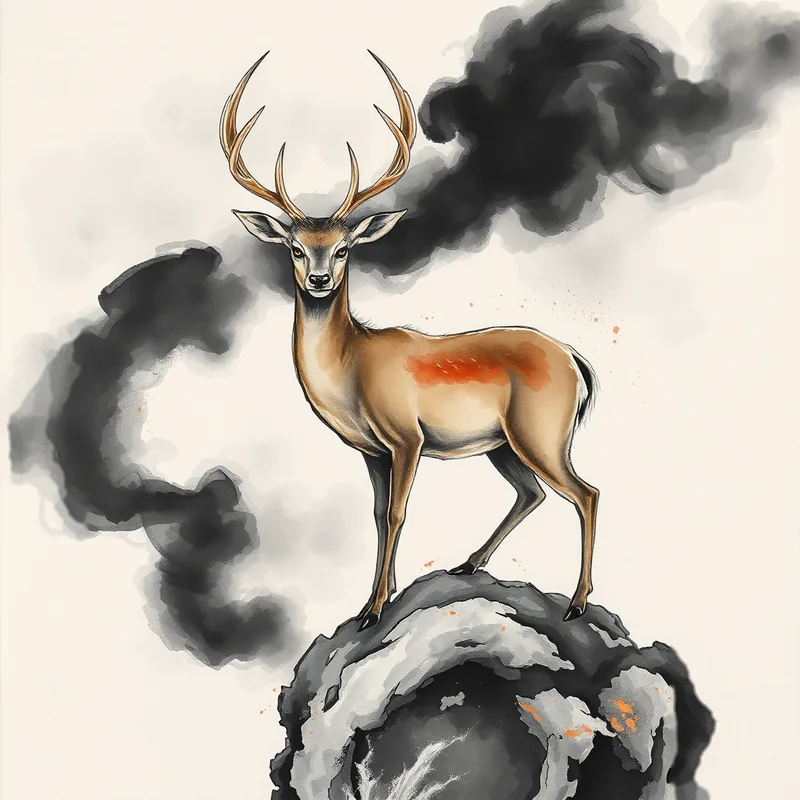
On Mount Shihu lives a beast shaped like a milu deer with fish eyes. Its name is Yuanhu, and its call is its own name.
Original & Translations
东山经曰:又东次三经之首,曰尸胡之山,北望𦍙山,其上多金玉,其下多棘。有兽焉,其状如麋而鱼目,名曰妴胡,其鸣自詨。
先注意一件事:东山经的第三段,走法很怪。
前面两段都是"又南三百里""又南四百里",一步一步在陆上走。到了第三段,突然变成"又南水行八百里""又南水行七百里""又东水行千里"。
水行。坐船。
而且距离动辄七八百里。这不是沿河走,这是跨海。
东次三经的路线,从尸胡之山开始,一路南下再东折,经过岐山、诸钩之山、中父之山、胡射之山、孟子之山,中间夹着"流沙"和"深泽",最后到无皋之山,"南望幼海,东望榑木"。
幼海,是日本海方向。榑木,是神话里的扶桑。
所以这一段的记录者,是在描述一条从山东半岛出发、沿海岸线、跨过渤海或黄海、一直望到日本方向的航线。
尸胡之山,是这条航线的起点。
"尸"这个字,在古代有"主持""代表死者受祭"的意思。尸胡,可能是一个部族的名字,也可能就是"尸水边的胡人"。
在这座山上,有妴胡。形状像麋,眼睛像鱼。
麋,是麋鹿。中国特有,角像鹿、脸像马、蹄像牛、尾像驴,俗称"四不像"。它喜欢沼泽,善游泳,曾经遍布长江黄河流域。
"鱼目"是什么?
鱼的眼睛有三个特征:没有眼睑,不会眨眼;眼球大而外凸;晶状体是圆的。
麋鹿的眼睛不大,但它有一个特点:眼周有很明显的眶下腺(也叫眼下腺),开口在眼睛前下方,是一个深色的裂缝状开口。发情期这个腺体会分泌气味强烈的液体,用来标记领地。
从侧面看,一只麋鹿的眼睛加上那个深色的眶下腺裂缝,会显得眼睛很长,像鱼那样没有边界的圆。
也可能更简单:麋鹿常在水里,眼睛湿,反光。鱼眼也是湿的,也反光。
还有一种可能:"鱼目"不是形状,是"不会闭"。麋鹿睡觉时眼睛是半开的——这是鹿科动物的普遍特征,为了随时警觉捕食者。
无论如何,"状如麋而鱼目"这六个字,把一只沼泽鹿的两个最显著特征抓出来了:整体像麋,眼睛不像鹿。
然后是名字。妴胡。
"妴",从女从冤。冤,是屈、是曲。妴,可能是"柔顺""委屈"的意思。
"胡",在古汉语里指北方或西方的异族,也指"老""大",还指兽类颈下的垂肉。
妴胡,可能是"柔顺的大兽",也可能是"像胡人一样的兽"。
考虑到这条航线指向东方海上,我倾向于后者:这是一只"来自海那边的、长相奇怪的鹿"。
而尸胡之山,就在海边上。
所以整条记录可能是这样的:一个航海的人,在辽东或者朝鲜半岛的岸边,看见了一种鹿。它比中原的鹿大,眼睛的样子很怪,叫声也听不懂。
他问当地人,当地人说了一个词。他记下了那个词的音:妴胡。
然后他写:其状如麋而鱼目,名曰妴胡,其鸣自詨。
"其鸣自詨"——叫声就是名字。这句话在《山海经》里,往往是"我听不懂,就照着声音记"的意思。
妴胡。听起来像一声鹿鸣。
The Classic of Eastern Mountains: the head of the third eastern section is Mount Shihu, looking north to Mount Yan. Gold and jade above; thorny scrub below. A beast lives there shaped like a milu deer with fish eyes. Its name is Yuanhu, and its call is its own name.
Note something first: the third eastern section travels strangely.
The first two sections go "three hundred li south," "four hundred li south," step by step overland. The third suddenly turns to "eight hundred li south by water," "seven hundred li south by water," "a thousand li east by water."
By water. In boats.
And the distances run to seven or eight hundred li at a stretch. This is not following a river. This is crossing seas.
The route of the third eastern section starts at Mount Shihu, runs south, then bends east, passing Mount Qi, Mount Zhugou, Mount Zhongfu, Mount Hushe, Mount Mengzi, with "shifting sands" and a "deep marsh" in between, and ends at Mount Wugao, which "looks south to the Young Sea and east to the Fusang tree."
The Young Sea points toward the Sea of Japan. Fusang is the mythic tree of the sunrise.
So whoever recorded this section was describing a sea route: out from the Shandong peninsula, along the coast, across the Bohai or the Yellow Sea, with a sightline toward Japan.
Mount Shihu is the start of that route.
The character shi in classical usage means to preside, or to personate the dead in sacrifice. Shihu may be a tribal name; it may simply mean "the Hu people by the Shi waters."
On this mountain is Yuanhu. Shaped like a milu, eyes like a fish.
The milu is Pere David's deer, endemic to China: antlers of a deer, face of a horse, hooves of a cow, tail of a donkey — the "four不像," the four-unlike. It loves marsh, swims well, and once ranged across the Yangtze and Yellow River basins.
What are fish eyes?
A fish eye has three properties: no lids, no blinking; a large, protruding globe; a round lens.
A milu's eyes are not large, but it has a striking feature: a well-developed preorbital gland, an opening in front of and below the eye, a dark slit. In rut it secretes a strongly scented fluid used to mark territory.
In profile, the eye plus that dark slit reads as very long — as lidless and round-edged as a fish's.
Or simpler: milu stand in water. Their eyes are wet, and they catch light. So do fishes'.
Or: "fish eyes" means they do not close. Deer sleep with eyes half open, alert for predators.
However it is read, the six characters — shaped like a milu, eyes like a fish — catch the two most conspicuous features of a marsh deer: the overall milu form, and eyes that are not a deer's.
Then the name. Yuanhu.
Yuan is written with the woman radical over yuan, "wronged," "bent." It may carry the sense of pliant, yielding.
Hu in classical Chinese means a northern or western foreign people; it also means old, great; it also means the dewlap of a beast.
Yuanhu could be "the pliant great beast," or "the beast like the Hu."
Given that this route points east across water, I lean to the second: a strange-looking deer from the far side of the sea.
And Mount Shihu is on the coast.
So the record may run like this. A sailor, ashore in Liaodong or on the Korean coast, saw a kind of deer. Bigger than the deer at home. Eyes wrong. Call unintelligible.
He asked the locals. A local said a word. He wrote down the sound: Yuanhu.
Then he wrote: shaped like a milu with fish eyes, named Yuanhu, and its call is its own name.
"Its call is its own name" in this book usually means: I could not understand it, so I recorded the sound.
Yuanhu. It sounds like a deer calling.
ส่วนที่สามของ "ตงซานจิง" เดินทางแปลกมาก: จาก "ลงใต้สามร้อยลี้" เปลี่ยนเป็น "โดยน้ำ แปดร้อยลี้" "โดยน้ำ เจ็ดร้อยลี้" — นี่คือการเดินเรือข้ามทะเล
เส้นทางเริ่มจากเขาซือหู ลงใต้แล้วเลี้ยวตะวันออก ผ่านเกาะ/เขา ต่าง ๆ จนถึงเขาอูเกา "มองใต้เห็นทะเลน้อย มองตะวันออกเห็นต้นฝูซัง" — ทิศญี่ปุ่น
บนเขาซือหูมีหยวนหู: รูปร่างเหมือนกวางหมี่ (milu สี่ไม่เหมือน) ตาเป็นตาปลา
กวางหมี่ชอบอยู่ในบึง ว่ายน้ำเก่ง ตาของมันมีต่อมน้ำมันใต้ตาเป็นร่องดำ ในภาพด้านข้างดูยาวเหมือนตาไม่มีเปลือกแบบปลา
"ร้องเป็นชื่อตัวเอง" ในซานไห่จิงมักหมายถึง "ฟังไม่ออก ก็จดเสียงไว้" — หยวนหู อาจเป็นเสียงร้องของกวาง
Bahagian ketiga "Dong Shan Jing" bergerak pelik: daripada "tiga ratus li ke selatan" bertukar jadi "lapan ratus li melalui air", "tujuh ratus li melalui air" — ini pelayaran laut.
Laluan bermula di Gunung Shihu, ke selatan lalu membelok timur, melalui beberapa gunung, berakhir di Gunung Wugao yang "melihat ke selatan Laut Muda, ke timur pokok Fusang" — arah Jepun.
Di Gunung Shihu ada Yuanhu: bentuk seperti rusa milu, mata ikan.
Rusa milu suka paya, pandai berenang. Matanya ada kelenjar pra-orbit berupa celah gelap; dari sisi nampak panjang seperti mata ikan tanpa kelopak.
"Bunyinya namanya sendiri" dalam Shanhaijing selalunya bermaksud "aku tak faham, jadi aku catat bunyinya." Yuanhu mungkin bunyi rusa.
Phần thứ ba "Đông Sơn Kinh" di chuyển rất lạ: từ "ba trăm dặm về nam" đổi thành "tám trăm dặm đường thủy", "bảy trăm dặm đường thủy" — đây là hải trình.
Lộ trình bắt đầu từ núi Thi Hồ, xuống nam rồi rẽ đông, qua nhiều núi, kết ở núi Vô Cao "nhìn nam thấy biển nhỏ, nhìn đông thấy cây Phù Tang" — hướng Nhật Bản.
Trên núi Thi Hồ có Uyên Hồ: hình như hươu milu, mắt cá.
Hươu milu ưa đầm lầy, bơi giỏi. Mắt nó có tuyến trước ổ mắt là một khe đen; nhìn nghiêng thấy dài như mắt cá không mí.
"Kêu là tên mình" trong Sơn Hải Kinh thường nghĩa là "nghe không hiểu, ghi lại âm." Uyên Hồ có lẽ là tiếng hươu kêu.
Bagian ketiga "Dong Shan Jing" bergerak aneh: dari "tiga ratus li ke selatan" berubah jadi "delapan ratus li lewat air", "tujuh ratus li lewat air" — ini pelayaran laut.
Rute dimulai di Gunung Shihu, ke selatan lalu membelok timur, melewati beberapa gunung, berakhir di Gunung Wugao yang "melihat ke selatan Laut Muda, ke timur pohon Fusang" — arah Jepang.
Di Gunung Shihu ada Yuanhu: bentuk seperti rusa milu, mata ikan.
Rusa milu suka rawa, pandai berenang. Matanya punya kelenjar pra-orbit berupa celah gelap; dari samping tampak panjang seperti mata ikan tanpa kelopak.
"Bunyinya namanya sendiri" dalam Shanhaijing biasanya berarti "aku tidak paham, jadi kucatat bunyinya." Yuanhu mungkin bunyi rusa.
Nearby Creatures