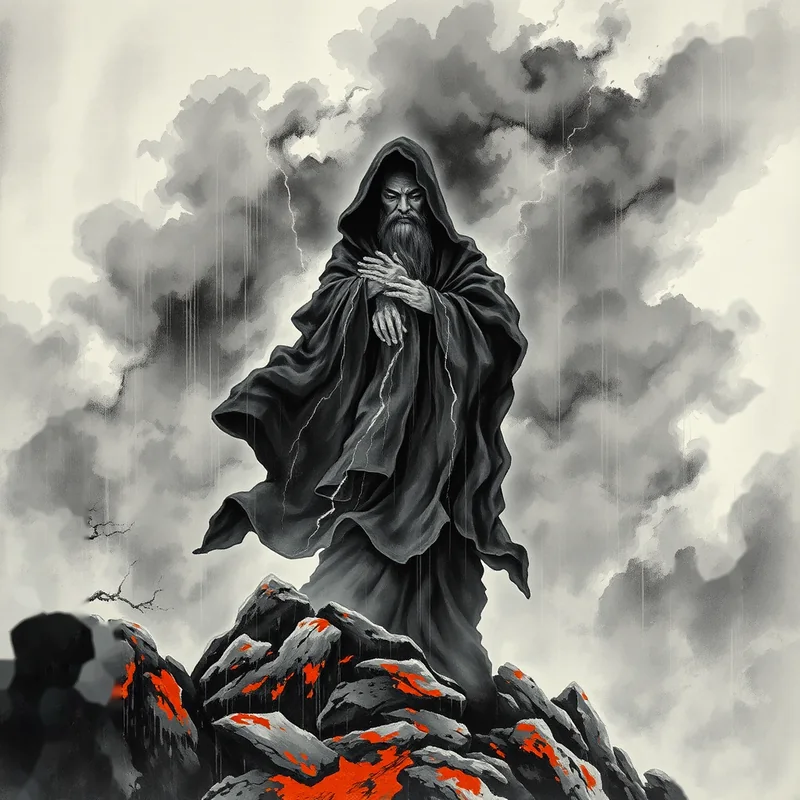
 天愚
中山经
《中山经》
天愚
Tianyu
4.121k中山经
DeityRainChaos
On Mount Du dwells the god Tianyu — "Heaven's Fool." From that mountain come strange winds and bizarre storms.
Original & Translations
中山经曰:又东二十七里,曰堵山。神天愚居之,是多怪风雨。其上有木焉,名曰天楄,方茎而葵状。服者不㖶。
十七个字,是《山海经》里最短的几条之一。
堵山。神叫天愚。这座山多"怪风雨"。
先说"堵"这个字。堵,是墙,是塞。一座叫"堵"的山,意思是它挡在那里,把什么挡住了。挡住的可能是水,可能是风,可能是一条路。
然后神的名字:天愚。
天,是上天。愚,是愚笨、迟钝、不讲道理。
给一位神起名叫"天愚",这是很重的话。
古人不是不敢议天。恰恰相反,他们对天的态度从来是双向的:敬,也怨。《诗经》里有"昊天不佣,降此鞠讻",有"天降丧乱,饥馑荐臻"。天不是永远对的。天会不公平,会聋,会看不见。
"天愚"就是这一路的极致:把天叫做傻子。
但注意,这个"愚"不是骂人式的愚,更像是"不可理喻"。天的行为没有规律,你种了地,它不下雨;你收了粮,它下雹子。你按规矩祭祀,它照样翻脸。这不是恶,恶是有目的的;这是愚,愚是没有道理的。
而"多怪风雨"这四个字,正好配这个名。
"怪风雨"不是普通的风雨。普通的风雨有季节,有征兆,可以预判。"怪"的风雨是局地的、突发的、没头没脑的:晴天上山,半山腰起一团黑云,走两步,鸡蛋大的冰雹砸下来,走十步,出太阳了。
在山地,这种现象有个名字:对流性天气。山谷地形抬升气流,水汽在山脊上凝结,形成孤立的小尺度积雨云,几十分钟生成,几十分钟消散,落区只有几平方公里。
对这种天气,你没办法预测,也没办法祭祀——你不知道该在哪一天、对着哪一块云烧香。
所以只能给它一个名字:天愚。天在这里不讲道理。
这条记录还有一句附带的:山上有一种树,叫天楄,方茎,像葵。吃了它,不㖶——"㖶"是噎住、咽不下去。
天楄,名字里也有个"天"。方茎的植物不多,方茎+葵状叶,很可能指的是某种薄荷类(唇形科植物茎是方的)。唇形科植物多含挥发油,能缓解食道痉挛、帮助消化。
所以这座山是这样的:山顶上长着治噎住的方茎草,山腰上住着一位名叫"天愚"的神,山里随时可能下一场没头没脑的冰雹。
一棵有用的草,一个不讲理的神,一场突如其来的灾。三样东西长在一起。
这就是古人对一座山的完整认识:我知道它能给我什么,我也知道它会怎么害我,而我不知道它什么时候害我。
最后这一点,他们命名为"天愚"。
The Classic of Central Mountains: twenty-seven li east is Mount Du. The god Tianyu dwells there, and there are many strange winds and storms. On the mountain grows a tree called tianpian, square-stemmed, with mallow-like leaves. Eat it and you will not choke.
Seventeen characters. One of the shortest entries in the book.
Mount Du. The god is called Tianyu — Heaven's Fool. The mountain has much "strange wind and rain."
Start with du. Du is a wall, a blockage. A mountain named "Block" is a mountain that stands in the way and stops something: water, wind, a road.
Then the god's name: tian — heaven; yu — stupid, dull, unreasonable.
Naming a god "Heaven's Fool" is a heavy thing to say.
The ancients were not afraid to argue with heaven. Their attitude was always double: reverence, and grievance. The Book of Songs has lines like "Great Heaven is not fair, it sends down this extremity," and "Heaven sends down death and disorder, famine upon famine." Heaven is not always right. Heaven can be unjust, deaf, blind.
Tianyu is the extreme of that line of thought: calling heaven a fool.
But note that yu here is not the insult of an idiot. It is closer to "cannot be reasoned with." Heaven's behaviour has no pattern. You plant, and it withholds rain. You harvest, and it hails. You sacrifice correctly, and it turns on you anyway. This is not malice — malice has intent. This is folly: it has no reason at all.
And "much strange wind and rain" fits the name exactly.
Strange is the operative word. Ordinary wind and rain are seasonal, preceded by signs, predictable. Strange weather is local, sudden, senseless: a clear sky as you start up the mountain, a black cloud at mid-slope, two steps further and hail the size of eggs, ten steps more and the sun is out.
In mountain country this has a name: convective weather. Terrain lifts the air; moisture condenses along the ridge; an isolated small cumulonimbus forms, lives forty minutes, dies, and drops its load over a few square kilometres.
You cannot forecast it, and you cannot sacrifice against it, because you do not know which day, or which cloud, to address.
So you give it a name: Heaven's Fool. Heaven, here, is not reasonable.
The entry adds one more thing. On the mountain is a plant called tianpian, square-stemmed, mallow-leaved. Eat it and you will not choke — the character means to stick in the throat, to be unable to swallow.
Tianpian also carries tian, heaven, in its name. Square stems are uncommon. Square stem plus mallow-like leaf points to the mint family, Lamiaceae, whose stems are square. Mints are rich in volatile oils that relax oesophageal spasm and aid swallowing.
So the mountain is this: on the summit, a square-stemmed herb for choking; at mid-slope, a god named Heaven's Fool; and at any moment, hail out of a clear sky.
A useful plant, an unreasonable god, a sudden disaster, all growing together.
That is a complete account of a mountain: I know what it gives me, I know how it hurts me, and I do not know when.
The last part, they named Tianyu.
เขาตู่ มีเทพชื่อ "เทียนอวี๋" = "ฟ้าผู้โง่" ภูเขานี้มี "ลมฝนประหลาด"
การตั้งชื่อเทพว่าคนโง่ เป็นคำหนัก คนโบราณไม่ได้กลัวที่จะต่อว่าฟ้า ในซือจิงมีบทที่บ่นว่าฟ้าไม่ยุติธรรม
"ประหลาด" คือคำสำคัญ ฝนปกติมีฤดู มีลางบอก แต่ฝนประหลาดมาแบบโลคอล ฉับพลัน — กลางแดดขึ้นเขา เจอลูกเห็บ แล้วก็แดดออก
นี่คือ "พายุ convection" ตามสันเขา พยากรณ์ไม่ได้ ก็เลยตั้งชื่อว่า ฟ้าโง่
Gunung Du. Dewa bernama "Tianyu" = "Si Bodoh Langit". Gunung ini banyak "angin dan hujan aneh".
Menamakan dewa "bodoh" itu berat. Orang dahulu tidak takut membantah langit; dalam Shijing ada yang merungut langit tidak adil.
"Aneh" kata kuncinya. Hujan biasa ada musim dan tanda. Hujan aneh datang setempat dan tiba-tiba — naik gunung langit cerah, kena hujan batu, kemudian panas balik.
Itu cuaca konvektif di rabung. Tidak boleh diramal, jadi diberi nama: Langit Bodoh.
Núi Đỗ. Thần tên "Thiên Ngu" = "Kẻ Ngốc Của Trời". Núi này nhiều "gió mưa quái dị".
Đặt tên thần là "ngốc" là lời nặng. Người xưa không ngại trách trời; Kinh Thi có câu oán trời không công bằng.
"Quái dị" là mấu chốt. Mưa thường có mùa, có điềm. Mưa quái dị đến cục bộ, đột ngột — đang nắng lên núi, gặp mưa đá, rồi lại nắng.
Đó là thời tiết đối lưu theo sườn núi. Không dự báo được, nên đặt tên: Trời Ngốc.
Gunung Du. Dewa bernama "Tianyu" = "Si Bodoh Langit". Gunung ini banyak "angin dan hujan aneh".
Menamai dewa "bodoh" itu berat. Orang dahulu tidak takut membantah langit; dalam Shijing ada yang mengeluh langit tidak adil.
"Aneh" kata kuncinya. Hujan biasa punya musim dan tanda. Hujan aneh datang setempat dan mendadak — naik gunung langit cerah, kena hujan es, lalu panas lagi.
Itu cuaca konvektif di punggung gunung. Tidak bisa diramal, jadi diberi nama: Langit Bodoh.
Nearby Creatures