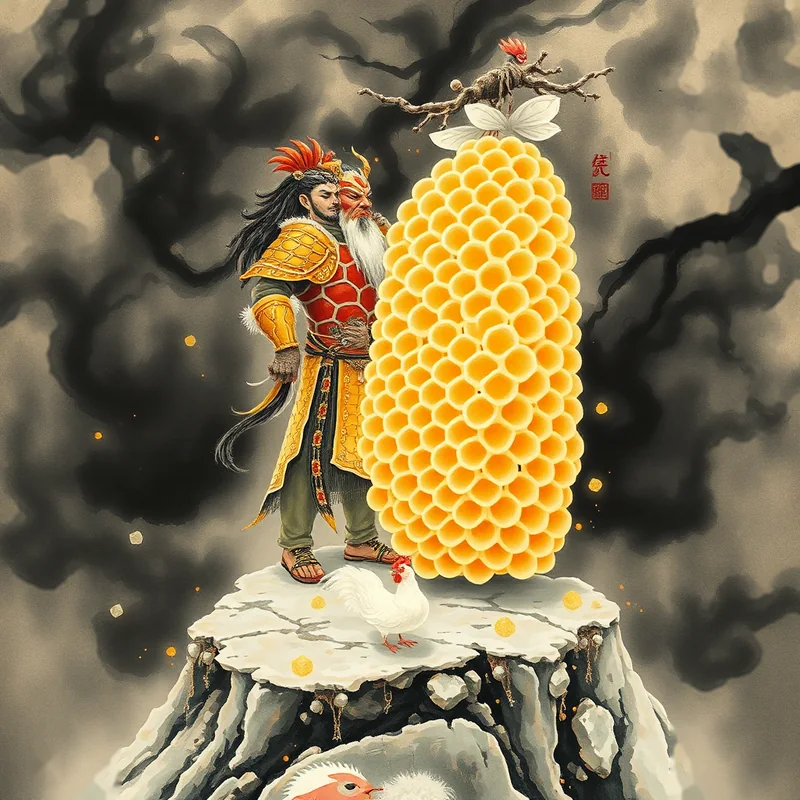
 骄虫
中山经
《中山经》
骄虫
Jiaochong
4.642k中山经
DeityHealingProtection
On Mount Pingfeng lives a god with a human body and two heads, named Jiaochong — lord of the stinging insects, keeper of the honeycomb. To sacrifice: one rooster, and let it live.
Original & Translations
中山经曰:《中次六经》缟羝山之首,曰平缝之山。南望伊、洛,东望榖城之山。无草木,无水,多沙石。有神焉,其状如人而二首,名曰骄虫,是为螫虫,实惟蜂蜜之庐,其祠之:用一雄鸡,禳而勿杀。
平缝之山,在伊水与洛水之间。没草木,没水,多沙石。一座荒山。
山上住着骄虫。人形,两个头。
"是为螫虫"——螫虫就是会蜇人的虫,蜂、蝎、蚁之类。"实惟蜂蜜之庐"——它是蜂蜜的房屋,也就是蜂巢。
所以骄虫是蜂神。或者更准确地说,是蜂群本身被神格化了。
两个头怎么解释?看蜂。蜂的身体分头、胸、腹三节,中间收得很细。一只蜂停在花上,如果你只看见它的头和腹部,中间那一段细腰在视线里消失,看上去就是"两团"——两个头。古代图像里对昆虫的表现,常有这种"按体节数"的画法。
还有一层:蜂巢里的蜂,分工是"两套"。一套在外面采蜜,一套在里面育幼、守卫。一个巢,两种生活,从外面看,像是两个头的生物在同一个身体里。
然后是这句最特别的:祠之,用一雄鸡,禳而勿杀。
"禳"是驱除灾祸的祭。"勿杀"——不杀。
《山海经》里祭祀的规矩,绝大多数是"用一羊""用一犬""用一鸡",意思都是宰了献上。血食。这里偏偏加了一句"勿杀":把公鸡献上去,然后放它走。
整部《山海经》,这样的条款极少。
为什么对蜂神不杀生?
因为蜂会死。一个蜂巢,蜂群几万只,看起来兴旺,实际上非常脆弱。农药、寒潮、缺蜜、蜂螨,任何一样都能让整巢在几天内崩溃。蜂群崩溃的时候,蜂尸堆在巢门口,一层一层。
养蜂人最怕的就是这个。而对付蜂群崩溃,古人的办法是——不动它。不扰动巢,不杀蜂,不砍巢所在的树。
所以"禳而勿杀",很可能不是慈悲,是技术。是对着一个你完全无法控制、又极其重要的东西,采取的最小干预原则。
蜜是当时唯一的甜。蜡是当时唯一的塑形材料。蜂群的健康,直接关系到一年的日子。
一座荒山,一个双头的蜂神,一条不杀生的祭规。三者之间隔着的,其实是一整套关于蜜蜂的经验。
而"骄虫"这个名字,"骄"是骄纵、骄横。蜂群确实骄横——你碰它一下,它倾巢而出。
古人给它起这个名字,起得很准。
The Classic of Central Mountains, sixth section: the head of Mount Gaodi is Mount Pingfeng. South you see the Yi and the Luo; east you see Mount Gucheng. No grass, no trees, no water — sand and stone. A barren mountain.
On it lives Jiaochong. Human form, two heads.
"He is the stinging insect" — the class of things that sting: bees, scorpions, ants. "He is truly the house of honey" — the hive.
So Jiaochong is the god of bees. More precisely, the colony itself, made into a god.
Why two heads? Look at a bee. Head, thorax, abdomen, with a waist pinched between. A bee on a flower, seen at the wrong angle, loses that waist; what remains is two masses. In ancient depiction, insects were often drawn segment by segment — two lobes read as two heads.
There is a second layer. Inside a hive the population runs two lives at once: foragers outside, nurses and guards within. One nest, two modes of existence, which from outside looks like two-headed creatures sharing one body.
Then comes the strangest line in the entry: to sacrifice, take one rooster, avert the ill, and do not kill it.
Avert — rang — is the rite of driving off disaster. Do not kill.
Almost every sacrificial rule in the Shanhaijing says "one sheep," "one dog," "one fowl," and means: slaughter it and present it. Blood offering. Here, exceptionally, the text adds: and do not kill. Bring the rooster, then let it go.
Such clauses are rare in the whole book.
Why spare the bee god's offering?
Because bees die. A colony of tens of thousands looks thriving and is extremely fragile. Pesticide, a cold snap, a dearth of nectar, a mite — any one of these can collapse a hive in days. When a colony collapses, the dead pile up at the entrance in layers.
Beekeepers fear exactly this. And the ancient response to collapse was: do not disturb it. Do not open the nest, do not kill bees, do not cut the tree the nest hangs in.
So "avert and do not kill" is probably not mercy. It is technique. It is the principle of minimum intervention, applied to something you cannot control and cannot do without.
Honey was the only sweetness available. Wax was the only mouldable material. The health of the hives bore directly on how the year would go.
A barren mountain, a two-headed bee god, a rule against killing. What sits between those three things is an entire body of apicultural experience.
And the name: jiao means arrogant, overbearing. A colony is overbearing. Touch it once and the whole nest comes out.
The ancients named it well.
เขาผิงเฟิง (ระหว่างแม่น้ำอี๋กับลั่ว) เป็นภูเขาว่างเปล่า ไม่มีต้นไม้ ไม่มีน้ำ มีแต่ทรายกับหิน
บนนั้นมีเทพชื่อเจียวฉง ร่างเป็นคน สองหัว "เป็นเจ้าแห่งแมลงต่อย รังผึ้งคือเรือนของเขา"
สองหัวอาจมาจากการมองผึ้ง: หัว-อก-ท้อง แต่เอวบางจนมองไม่เห็น เหลือเป็นสองก้อน
ที่น่าสนใจที่สุดคือพิธี: ถวายไก่ตัวผู้หนึ่งตัว "แล้วปล่อย ไม่ฆ่า" — กฎแบบนี้หายากมากในซานไห่จิง
เหตุผลอาจไม่ใช่เมตตา แต่เป็นเทคนิค: รังผึ้งพังง่ายมาก อย่าไปยุ่ง อย่าเปิด อย่าฆ่า น้ำผึ้งคือความหวานเดียวในยุคนั้น
Gunung Pingfeng (antara Sungai Yi dan Luo) — gunung kosong: tiada pokok, tiada air, hanya pasir dan batu.
Di situ ada dewa bernama Jiaochong. Tubuh manusia, dua kepala. "Raja serangga penyengat, sarang madu ialah rumahnya."
Dua kepala mungkin dari cara melihat lebah: kepala-dada-perut, tetapi pinggang terlalu halus untuk dilihat, jadi nampak dua gumpalan.
Yang paling menarik ialah upacara: seekor ayam jantan, "lepas, jangan sembelih" — syarat begini sangat jarang dalam Shanhaijing.
Sebabnya mungkin bukan belas kasihan, tetapi teknik: sarang lebah mudah runtuh. Jangan ganggu, jangan buka, jangan bunuh. Madu satu-satunya manisan masa itu.
Núi Bình Phùng (giữa sông Y và Lạc) — núi trống: không cây, không nước, chỉ cát đá.
Trên đó có thần Kiêu Trùng. Mình người, hai đầu. "Chúa loài côn trùng chích, tổ ong là nhà của nó."
Hai đầu có thể do cách nhìn con ong: đầu-ngực-bụng, nhưng eo quá nhỏ nên mắt chỉ thấy hai khối.
Đáng chú nhất là lễ: dâng một gà trống, "rồi thả, không giết" — điều khoản này cực hiếm trong Sơn Hải Kinh.
Có lẽ không phải lòng nhân, mà là kỹ thuật: tổ ong rất dễ sụp. Đừng động, đừng mở, đừng giết. Mật ong là vị ngọt duy nhất thời đó.
Gunung Pingfeng (antara Sungai Yi dan Luo) — gunung kosong: tanpa pohon, tanpa air, hanya pasir dan batu.
Di situ ada dewa bernama Jiaochong. Tubuh manusia, dua kepala. "Raja serangga penyengat, sarang madu adalah rumahnya."
Dua kepala mungkin dari cara melihat lebah: kepala-dada-perut, tetapi pinggang terlalu halus untuk terlihat, jadi tampak dua gumpalan.
Yang paling menarik adalah upacaranya: seekor ayam jantan, "lepas, jangan sembelih" — syarat seperti ini sangat jarang dalam Shanhaijing.
Sebabnya mungkin bukan belas kasih, melainkan teknik: sarang lebah mudah runtuh. Jangan ganggu, jangan buka, jangan bunuh. Madu satu-satunya manisan saat itu.
Nearby Creatures