 烛龙
北山经
《大荒北经》
烛龙
Zhulong
4.988k北山经
DeityPrimordialLightDragon
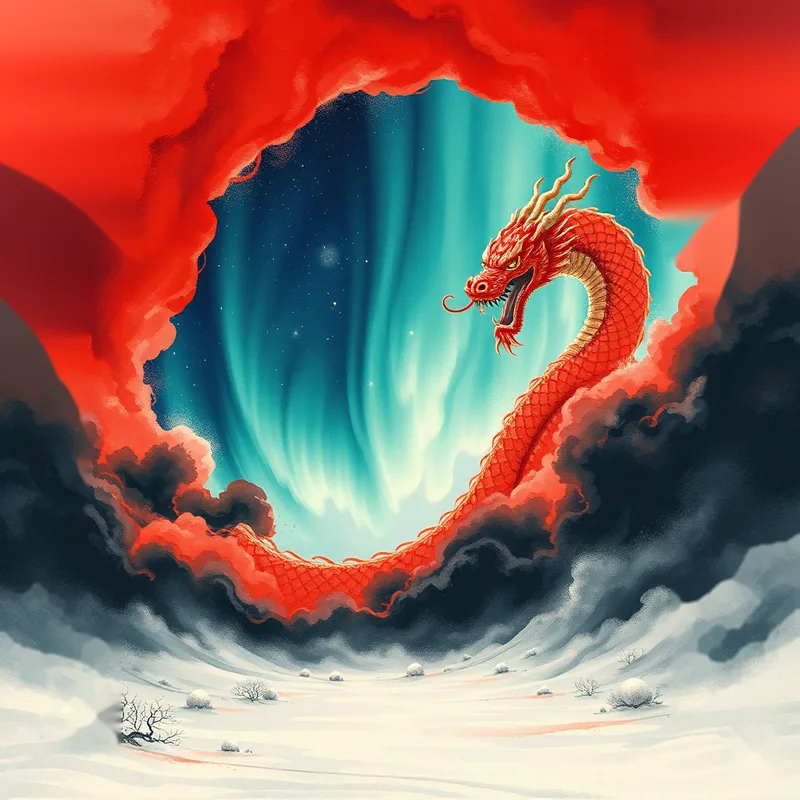
On Mount Zhangwei is a god: human face, red serpent body, eyes set vertically. He closes his eyes and it is dark; he opens them and it is light. He does not eat, sleep, or breathe. He summons wind and rain. He lights the nine darknesses: Zhulong.
Original & Translations
大荒北经曰:西北海之外,赤水之北,有章尾山。有神,人面蛇身而赤,直目正乘,其瞑乃晦,其视乃明,不食不寝不息,风雨是谒。是烛九阴,是谓烛龙。
先把它拆成六个特征。
一,人面蛇身而赤。脸是人的,身体是蛇的,颜色是红的。
二,直目。眼睛竖着长。
三,正乘。这两个字历来难解,一说是"正戴",戴着什么;一说是"正立",端端正正地横在那里。
四,其瞑乃晦,其视乃明。闭眼就是黑夜,睁眼就是白天。
五,不食不寝不息。不吃,不睡,不呼吸。
六,风雨是谒。风雨来朝见它。
把这六条放在一起,你会发现它们不指向一只动物,指向一样东西。
一样横贯天空的、红色的、有竖直条纹的、会明灭的、不需要进食和呼吸的、出现时伴随风暴的东西。
极光。
"蛇身而赤"。极光最典型的形态是极光带——一条横跨整个天穹的弧,然后扭曲、折叠、散开成帘幕。红色来自高空氧原子,在两百到四百公里的高度发出 630 纳米的红光。低处的绿色是 557.7 纳米,也是氧。人眼在暗处对红色不敏感,所以最亮的极光看起来是绿的;但当活动足够强,红色会盖过一切,整条天弧变成血一样的颜色。
一条红色的蛇,横在天上,会动。
"直目"。极光帘幕的结构是竖直的。从地平线往上,一条一条平行的光柱,像梳齿,像帘子的褶。古人没有"光柱"这个词,他们看见的是竖直的条纹——竖着的眼睛。
"其瞑乃晦,其视乃明"。这是极光的脉动。有一种极光叫脉动极光,成片的光斑会以几秒到几十秒的周期亮起、暗下,像呼吸,像眨眼。站在雪原上看,整个天顶在开合。
但这句话还有另一个尺度:极昼和极夜。
在北极圈以内,冬天有几十天太阳不升起,夏天有几十天太阳不落下。对一个刚到这里的人来说,世界就是被一只眼睛控制的:它闭上,长夜开始;它睁开,白昼回来。
"不食不寝不息"。太阳不需要吃饭,不需要睡觉,不需要呼吸。这条描述在生物学上是荒谬的,在天文学上是精确的。写这句话的人,已经在用"天体"的方式思考了。
"风雨是谒"。极光最盛的时候,往往就是地磁暴最烈的时候。地磁暴由太阳风引起,太阳风扰动电离层,也扰动大气环流。北极的暴风雪,常常和极光一起来。
"是烛九阴"。照亮九重幽冥。在极夜的长夜里,唯一的光就是它。
所以烛龙不是一个想象出来的神,是一个被看见的现象,加上了人的解释。
中国有极光记录吗?
有。《竹书纪年》记周昭王末年"夜清,五色光贯紫微"。此后两千年,正史里的极光记录有三百条左右。中纬度地区在强地磁暴时能看到红色极光——赤壁、开封、杭州都见过。
但烛龙的位置在"西北海之外,赤水之北",比这些地方都北。写这条记录的人,或者听来的那个人,见过的不是一次偶然的红色天光,是北极圈里的日常。
还有一件事。
"烛龙"这个名字,后来变成了"烛九阴",再后来,有些学者认为它就是盘古神话的前身:一个不开不闭、不食不息、以眼为昼夜的原始神。盘古死后化生万物,烛龙活着照亮幽冥。一个把身体交出去,一个把眼睛借出去。
而极光今天还在。太阳活动每十一年一个周期,下一个峰年在 2025 到 2026 之间。黑龙江漠河、新疆阿勒泰,冬天偶尔能看见红色的天光。
那不是神。但那确实是同一条蛇。
The Classic of the Great Wilderness, North: beyond the northwest sea, north of the Red Water, stands Mount Zhangwei. On it is a god: human face, serpent body, red. Eyes set vertically, standing square. He closes his eyes and it is dark; he opens them and it is light. He does not eat, does not sleep, does not breathe. Wind and rain come to pay him court. He lights the nine darknesses. He is called Zhulong, the Candle Dragon.
Take the six features apart.
One: human face, serpent body, red.
Two: vertical eyes.
Three: "standing square" — the two characters are disputed; one reading is "wearing straight," another "erect and level, stretched across."
Four: eyes closed, dark; eyes open, light.
Five: does not eat, does not sleep, does not breathe.
Six: wind and rain come to court him.
Put the six together and they do not point at an animal. They point at a thing.
Something that stretches across the sky, is red, has vertical striations, pulses, needs no food and no breath, and arrives with storms.
Aurora.
"Serpent body, red." The classic auroral form is the auroral oval — an arc spanning the whole sky, then twisting, folding, breaking into curtains. The red comes from atomic oxygen at two hundred to four hundred kilometres, emitting at 630 nanometres. The green below is 557.7, also oxygen. The dark-adapted eye is insensitive to red, so the brightest aurora looks green; but when activity is strong enough, red overwhelms everything and the whole arc turns the colour of blood.
A red serpent, across the sky, moving.
"Vertical eyes." The structure of an auroral curtain is vertical. From the horizon upward, parallel rays, like the teeth of a comb, like the pleats of a curtain. The ancients had no word for "ray." What they saw was vertical striation — a vertical eye.
"Closes, and it is dark; opens, and it is light." This is auroral pulsation. There is a form called pulsating aurora, in which patches brighten and dim on periods of seconds to tens of seconds, like breathing, like blinking. Standing on the ice, the whole zenith opens and closes.
But the sentence has a second scale: polar day and polar night.
Inside the Arctic Circle the sun does not rise for weeks in winter and does not set for weeks in summer. To someone newly arrived, the world is run by an eye: it closes, the long night begins; it opens, day comes back.
"Does not eat, does not sleep, does not breathe." The sun does not eat, does not sleep, does not breathe. Biologically the line is absurd. Astronomically it is exact. Whoever wrote it was already thinking in terms of a celestial body.
"Wind and rain come to court him." The strongest aurora usually coincides with the strongest geomagnetic storm. Storms are driven by solar wind, which disturbs the ionosphere and the circulation of the upper atmosphere. Arctic blizzards often arrive with the lights.
"He lights the nine darknesses." In the long night of polar winter, this is the only light there is.
So Zhulong is not an invented god. It is an observed phenomenon plus a human explanation.
Does China have auroral records?
Yes. The Bamboo Annals record that at the end of King Zhao of Zhou's reign, "the night was clear, and five-coloured light pierced the Purple Forbidden enclosure." Over the next two thousand years the dynastic histories hold roughly three hundred auroral entries. At mid-latitudes, red aurora appears during strong geomagnetic storms — it has been seen from Chibi, Kaifeng, and Hangzhou.
But Zhulong's position is "beyond the northwest sea, north of the Red Water," further north than any of those. Whoever wrote the entry, or whoever told them, was not describing an occasional red glow. They were describing the ordinary sky inside the Arctic Circle.
One more thing.
The name later became "candle of the nine darknesses," and some scholars see in Zhulong a predecessor of Pangu: a primal god who never opens or closes, never eats or rests, whose eyes are day and night. Pangu dies and his body becomes the world. Zhulong lives and lends his eyes to it. One gives the body away; the other lends out the light.
And the aurora is still running. Solar activity cycles every eleven years, with the next maximum between 2025 and 2026. In Mohe in Heilongjiang, in Altay in Xinjiang, on winter nights, the sky occasionally turns red.
It is not a god. But it is the same serpent.
เขาจางเหวย อยู่เหนือน้ำแดง ใกล้อาร์กติก
มีเทพ "หน้าเป็นคน ตัวเป็นงูแดง ตาตั้งตรง หลับตาก็มืด ลืมตาก็สว่าง ไม่กิน ไม่นอน ไม่หายใจ ลมและฝนมาเข้าเฝ้า ชื่อจู๋หลง ผู้ส่องความมืดทั้งเก้า"
รวมลักษณะทั้งหกแล้ว ชี้ไปที่สิ่งเดียว: แสงเหนือ (ออโรรา)
"ตัวเป็นงูแดง" = แถบแสงเหนือที่พาดข้ามฟ้า สีแดงมาจากออกซิเจนที่ระดับ 200–400 กิโลเมตร
"ตาตั้งตรง" = โครงสร้างของม่านแสงเป็นเส้นตั้งขนานกัน
"หลับตาก็มืด ลืมตาก็สว่าง" = ออโรราที่กะพริบเป็นจังหวะทุกไม่กี่วินาที และยังหมายถึงกลางวัน-กลางคืนขั้วโลกที่ยาวนานหลายสิบวัน
"ไม่กิน ไม่นอน ไม่หายใจ" = ดวงอาทิตย์
"ลมและฝนมาเข้าเฝ้า" = พายุแม่เหล็กโลกมักมาพร้อมพายุหิมะ
จีนมีบันทึกแสงเหนือจริง ประวัติศาสตร์ราชวงศ์รวมกันราวสามร้อยครั้ง ตัวอย่างเช่นบันทึกสมัยราชวงศ์โจวว่า "กลางคืนฟ้าใส มีแสงห้าสีพุ่งผ่านดาวเหนือ"
ทุกวันนี้แสงเหนือยังมีอยู่ รอบสุริยะประมาณสิบเอ็ดปี รอบถัดไปถึงจุดสูงสุดราวปี 2025–2026
Gunung Zhangwei, di utara Air Merah, dekat Artik.
Ada dewa: "muka manusia, tubuh ular merah, mata tegak. Pejam mata gelap, buka mata terang. Tidak makan, tidak tidur, tidak bernafas. Angin dan hujan datang menghadap. Namanya Zhulong, menerangi sembilan kegelapan."
Gabungkan keenam ciri itu, dan semuanya menunjuk pada satu benda: cahaya utara (aurora).
"Tubuh ular merah" ialah lengkung aurora yang melintang di langit; merah datang dari oksigen atom pada ketinggian 200–400 kilometer.
"Mata tegak" ialah struktur tirai aurora yang berjalur menegak.
"Pejam gelap, buka terang" ialah aurora berdenyut setiap beberapa saat, dan juga siang-malam kutub yang berlangsung puluhan hari.
"Tidak makan, tidak tidur, tidak bernafas" ialah matahari.
"Angin dan hujan datang menghadap" kerana badai geomagnet sering datang bersama badai salji.
China memang mempunyai rekod aurora: kira-kira tiga ratus catatan dalam sejarah dinasti. Contohnya catatan zaman Zhou: "malam cerah, cahaya lima warna menembusi bintang utara."
Aurora masih berlaku; kitaran suria kira-kira sebelas tahun, puncak berikutnya sekitar 2025–2026.
Núi Chương Vĩ, phía bắc sông Xích Thủy, gần vòng cực Bắc.
Có thần: "mặt người, mình rắn đỏ, mắt dọc. Nhắm mắt thì tối, mở mắt thì sáng. Không ăn, không ngủ, không thở. Gió mưa đến chầu. Tên Chúc Long, soi chín tầng tối."
Gộp sáu đặc điểm lại, chúng không chỉ một con vật mà chỉ một thứ: cực quang.
"Mình rắn đỏ" là dải cực quang vắt ngang trời; màu đỏ từ oxy nguyên tử ở độ cao 200–400 km.
"Mắt dọc" là cấu trúc rèm cực quang gồm các vệt thẳng đứng song song.
"Nhắm tối, mở sáng" là cực quang nhấp nháy theo chu kỳ vài giây, và cũng là ngày-đêm cực kéo dài hàng chục ngày.
"Không ăn, không ngủ, không thở" là mặt trời.
"Gió mưa đến chầu" vì bão địa từ thường đến cùng bão tuyết.
Trung Quốc có ghi chép cực quang: khoảng ba trăm lần trong chính sử các triều đại, ví dụ thời Chu "đêm trong, ánh sáng năm màu xuyên qua Tử Vi."
Cực quang vẫn còn; chu kỳ mặt trời khoảng mười một năm, đỉnh tiếp theo vào 2025–2026.
Gunung Zhangwei, di utara Sungai Merah, dekat Lingkaran Arktik.
Ada dewa: "wajah manusia, tubuh ular merah, mata tegak. Pejam mata gelap, buka mata terang. Tidak makan, tidak tidur, tidak bernapas. Angin dan hujan datang menghadap. Namanya Zhulong, menerangi sembilan kegelapan."
Gabungkan keenam ciri itu, semuanya menunjuk pada satu benda: aurora.
"Tubuh ular merah" adalah lengkung aurora yang melintang di langit; merah berasal dari oksigen atom pada ketinggian 200–400 kilometer.
"Mata tegak" adalah struktur tirai aurora yang bergaris vertikal.
"Pejam gelap, buka terang" adalah aurora berdenyut setiap beberapa detik, dan juga siang-malam kutub yang berlangsung puluhan hari.
"Tidak makan, tidak tidur, tidak bernapas" adalah matahari.
"Angin dan hujan datang menghadap" karena badai geomagnetik sering datang bersama badai salju.
Tiongkok memang punya catatan aurora: sekitar tiga ratus catatan dalam sejarah dinasti. Contohnya catatan zaman Zhou: "malam cerah, cahaya lima warna menembus bintang utara."
Aurora masih terjadi; siklus matahari sekitar sebelas tahun, puncak berikutnya sekitar 2025–2026.
Nearby Creatures