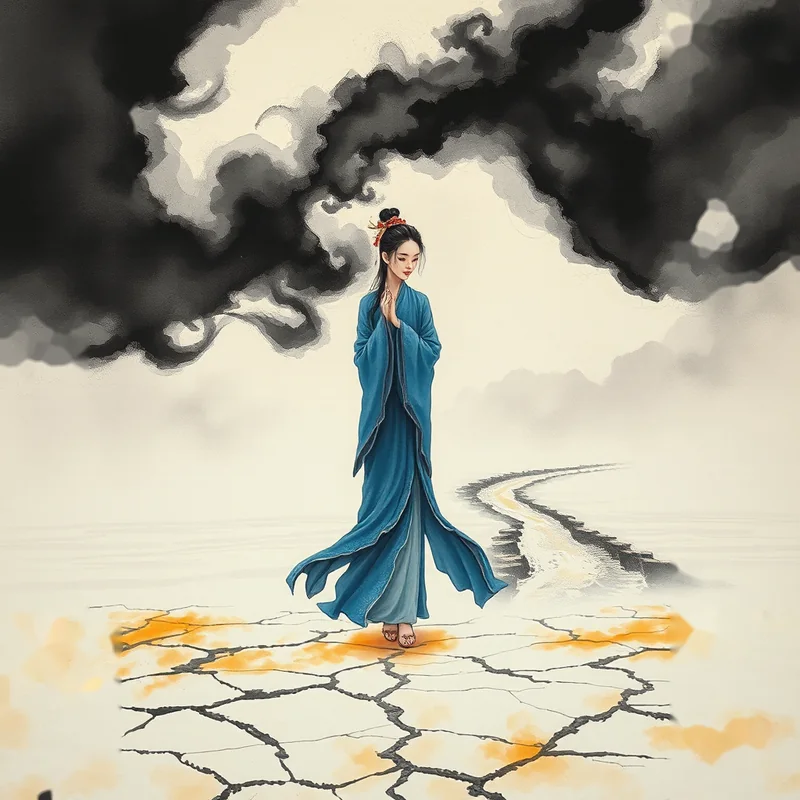
 女魃
北山经
《大荒北经》
女魃
Nüba
4.764k北山经
DeityDroughtWarPunishment
One wears blue, named Nüba, daughter of the Yellow Emperor. She could not return to heaven, and where she dwells no rain falls. To drive her out, they command: Spirit, go north! First clear the channels, open the ditches.
Original & Translations
大荒北经曰:有人衣青衣,名曰黄帝女魃。蚩尤作兵伐黄帝,黄帝乃令应龙攻之冀州之野。应龙畜水,蚩尤请风伯雨师,纵大风雨。黄帝乃下天女曰魃,雨止,遂杀蚩尤。魃不得复上,所居不雨。叔均言之帝,后置之赤水之北。叔均乃为田祖。魃时亡之,所欲逐之者,令曰:神北行!先除水道,决通沟渎。
这段文字,前半是一个战争故事,后半是一条技术指令。
先说故事。
蚩尤造兵器,攻黄帝。黄帝派应龙在冀州之野迎战。应龙蓄水,蚩尤请来风伯雨师,刮起大风雨。黄帝于是降下天女魃,雨停了,蚩尤被杀。
魃是黄帝的女儿。她穿青衣。
她做了一件事:止雨。
在战场上,止雨是决定性的。应龙蓄的水被暴雨冲散,弓弦被雨泡软,火攻用不了,士兵在泥里走不动。雨一停,战局就翻了。
所以她赢了这场战争。
然后:"魃不得复上。"
她回不去了。
为什么?因为她的能力是"止雨"。一个止雨的神,身上带着旱。她走到哪里,哪里就不下雨。天上不能有一个会让天不下雨的神。
于是她被留在人间。
"所居不雨。"她住的地方,不下雨。
接下来的四个字,是整段文字里最冷的一笔:"叔均言之帝。"
叔均,是后稷的侄子,周人的先祖,后来被奉为田祖——农神。他去跟黄帝说了一句话。
说什么?原文没写。但下一句是"后置之赤水之北"。
把她挪走。
挪到赤水以北。那是一个更远、更荒的地方。
一个父亲,听了农神的一句话,把女儿迁到了荒原上。
然后是最后一句,也是最难懂的一句:
"魃时亡之,所欲逐之者,令曰:神北行!先除水道,决通沟渎。"
魃有时会逃走,离开她被安置的地方。想赶走她的人,就下令说:神,往北走!
然后:先除水道,决通沟渎。
先清理水道,疏通沟渠。
这两句话放在一起,看起来像是两件事。但如果它们是一件事呢?
如果"神北行"和"除水道"是同一条命令的两个部分呢?
那就意味着:驱赶旱魃的仪式,实际上是一次抗旱工程的动员。
想象一个旱年的村子。井干了,田裂了,人心慌了。巫师说:魃来了,要把她赶走。全村人都来。然后巫师喊:神北行!
大家跟着喊。喊完之后,巫师或者官吏说:现在,去挖沟。
为什么?因为"神北行"的意思是"旱往北走"——而旱要往北走,得先有水路让它走。沟渠不通,水就留不住;水留不住,旱就赶不走。
这是一套非常聪明的动员术。
在一个大多数人不能读写的社群里,你不能贴一张告示说"请各位村民于明日辰时携带工具至村东清理沟渠"。但你可以说"旱魃来了,我们要赶她走"。
人会来。人会带工具。人会挖。
而挖完之后,如果碰上下雨,水就留住了;如果没下雨,至少沟是通的,下一场雨能留住。
这就是"先除水道,决通沟渎"这八个字的分量。它不是咒语的装饰,它是咒语的目的。
再往后,女魃的命运越来越坏。
汉代以后,旱魃的形象开始变形。她从一个穿青衣的天女,变成了一个怪物:有的说她三尺高,赤裸,眼睛长在头顶;有的说她走得像风,所过之处赤地千里。
到了明清,"旱魃"变成了僵尸。
袁枚《子不语》里写:旱魃是新葬的尸体,坟上不长草,坟头有火光。打旱魃的方法,是挖开坟,把尸体烧掉。
从黄帝的女儿,到一具要被烧掉的尸体,中间隔了两千多年。
这两千多年里,人们一直在做同一件事:把旱灾的原因,从"天气"换成"某个人"。
因为天气没有形状,抓不住,杀不掉。而一个人有形状。
所以每一次大旱,都要有一个人被指认。她可能是外乡人,可能是寡妇,可能是一个穿着青衣的姑娘。
"神北行"。
喊了三千年。
而真正让旱灾结束的,从来不是那句话,是后面那八个字。
The Classic of the Great Wilderness, North: there is one who wears blue, named Nüba, daughter of the Yellow Emperor. Chiyou made weapons and attacked the Yellow Emperor; the Emperor ordered Yinglong to strike him on the plain of Jizhou. Yinglong gathered water; Chiyou summoned the Lord of Wind and the Master of Rain, and loosed a great storm. The Emperor then sent down the heavenly woman Ba, and the rain stopped, and Chiyou was killed. Ba could not go back up. Where she dwells, no rain falls. Shujun spoke to the Emperor, and afterwards she was settled north of the Red Water. Shujun became the Ancestor of Fields. Ba sometimes flees; those who wish to drive her out command: Spirit, go north! First clear the channels, open the ditches.
The first half is a war story. The second half is a technical instruction.
The story first.
Chiyou forged weapons and attacked. The Emperor sent Yinglong to meet him on the Jizhou plain. Yinglong gathered water; Chiyou called the wind and rain gods and brought down a storm. The Emperor then sent down the heavenly woman Ba. The rain stopped. Chiyou was killed.
Ba is the Emperor's daughter. She wears blue.
She did one thing: she stopped the rain.
On a battlefield that is decisive. Yinglong's stored water is scattered by the downpour, bowstrings go soft, fire cannot be used, soldiers cannot move in mud. The moment the rain stops, the battle turns.
So she won the war.
And then: "Ba could not go back up."
She could not return.
Why? Because her power is stopping rain. A goddess who stops rain carries drought in her body. Wherever she goes, no rain falls. Heaven cannot hold a deity who makes heaven dry.
So she was left among men.
"Where she dwells, no rain falls."
The next four characters are the coldest in the passage: "Shujun spoke to the Emperor."
Shujun is the nephew of Houji, ancestor of the Zhou, later worshipped as the Ancestor of Fields — a farming god. He went to the Emperor and said something.
What he said is not recorded. The next line is: "afterwards she was settled north of the Red Water."
Move her.
North of the Red Water: further out, emptier.
A father, on the word of a farming god, moved his daughter onto a wasteland.
Then the last sentence, the hardest one:
"Ba sometimes flees. Those who wish to drive her out command: Spirit, go north! First clear the channels, open the ditches."
Ba sometimes runs away from where she was placed. Those who want her gone give the order: Spirit, go north.
And then: first clear the channels, open the ditches.
Read together, they look like two things. But what if they are one?
What if "spirit, go north" and "clear the channels" are two halves of a single command?
Then the ritual of driving out the drought demon is, in practice, the mobilisation of a drought-relief works project.
Picture a village in a dry year. The well is down, the fields are cracked, people are frightened. The shaman says: Ba has come. We must drive her out. The whole village turns out. Then the shaman shouts: Spirit, go north!
Everyone shouts it back. And when the shouting is done, the shaman or the clerk says: now go dig.
Why? Because "spirit, go north" means "let the drought go north" — and for drought to go north, there must be a channel for it to travel in. If the ditches are blocked, water cannot be held; if water cannot be held, the drought will not leave.
It is a remarkably efficient piece of mobilisation.
In a community where most people cannot read, you cannot post a notice saying: all villagers will assemble at dawn tomorrow with tools at the east end of the village to clear the ditch. But you can say: the drought demon has come, and we are going to drive her out.
People come. People bring tools. People dig.
And afterwards, if rain comes, the water is held. If it does not, at least the ditches are open, and the next rain will be held.
That is the weight of those eight characters. They are not decoration on the spell. They are the purpose of the spell.
After that, Nüba's fortune gets worse.
From the Han onward the figure deforms. The blue-robed heaven-sent woman becomes a monster: three feet tall, naked, eyes on top of her head; or she moves like wind and leaves a thousand li of red earth behind her.
By the Ming and Qing, the drought demon has become a zombie.
Yuan Mei's ghost stories describe her as a newly buried corpse, with no grass on the grave and firelight on the mound. The cure is to dig up the grave and burn the body.
From the Yellow Emperor's daughter to a corpse that must be burned: two thousand years.
And through all of it people were doing the same thing — replacing "the weather" as the cause of drought with "some person."
Because weather has no shape. You cannot seize it. You cannot kill it. A person has a shape.
So every great drought required someone to be named. A stranger. A widow. A girl in a blue robe.
"Spirit, go north."
Three thousand years of shouting it.
And what actually ended the droughts was never the shouting. It was the eight characters after it.
หนี่ป้า ธิดาของจักรพรรดิเหลือง สวมเสื้อสีน้ำเงิน
ในสงครามกับชื่อโหยว อิ้งหลงกักน้ำ ศัตรูเรียกพายุฝน เหลืองอี้จึงส่งหนี่ป้าลงมา ฝนหยุด ชื่อโหยวถูกสังหาร
แต่นางกลับสวรรค์ไม่ได้ เพราะพลังของนางคือ "หยุดฝน" เทพที่นางอยู่ที่ไหนที่นั่นแล้ง สวรรค์รับไว้ไม่ได้
นางจึงถูกทิ้งไว้บนดิน แล้วถูกย้ายไปเหนือน้ำแดง หลังเทพการเกษตรทูลขอ
ประโยคสุดท้ายสำคัญที่สุด: "ผู้จะไล่นาง สั่งว่า เทพจงไปทางเหนือ! ก่อนอื่นจงล้างทางน้ำ ขุดคูให้โล่ง"
สองประโยคนี้คือสิ่งเดียวกัน: พิธีไล่ปีศาจแห้งแล้ง คือการระดมคนขุดคู
ในหมู่บ้านที่คนอ่านไม่ออก คุณประกาศเป็นลายลักษณ์ไม่ได้ว่า "พรุ่งนี้เช้าให้ทุกคนเอาพรัวมาขุดคู" แต่คุณพูดได้ว่า "ปีศาจแห้งแล้งมาแล้ว เราจะไล่มัน"
คนจะมา คนจะเอาพรัวมา คนจะขุด
หลังราชวงศ์ฮั่น หนี่ป้ากลายเป็นปีศาจตัวเตี้ย ผิวเปลือย ตาอยู่บนหัว ถึงสมัยหมิง-ชิงกลายเป็นผีดิบที่ต้องขุดศพขึ้นมาเผา
จากธิดาจักรพรรดิ์ สู่ศพที่ต้องเผา ห่างกันสองพันปี
สิ่งที่ยุติภัยแล้งจริง ๆ ไม่เคยเป็นคำสวด แต่เป็นแปดตัวอักษรที่ตามมา
Nüba, anak Huangdi, berpakaian biru.
Dalam perang melawan Chiyou, Yinglong mengumpulkan air; musuh memanggil badai; Huangdi menurunkan Nüba; hujan berhenti; Chiyou terbunuh.
Tetapi ia tidak dapat kembali ke langit, kerana kuasanya ialah "menghentikan hujan". Dewa yang menyebabkan kemarau di mana ia berada tidak boleh tinggal di langit.
Ia ditinggalkan di bumi, kemudian dipindahkan ke utara Air Merah atas permintaan dewa pertanian.
Ayat terakhir paling penting: "Sesiapa yang mahu menghalaunya memerintahkan: Pergilah ke utara! Dahulu bersihkan saluran, buka parit."
Dua ayat itu satu perkara: upacara menghalau roh kemarau ialah penggerakan orang untuk menggali parit.
Dalam kampung yang tidak boleh membaca, anda tidak boleh mengumumkan secara bertulis: "esok semua bawa cangkul ke hujung timur untuk bersihkan parit." Tetapi anda boleh berkata: "roh kemarau sudah datang, kita halau."
Orang akan datang. Orang akan bawa cangkul. Orang akan menggali.
Selepas dinasti Han, Nüba menjadi raksasa pendek, bogel, mata di atas kepala; menjelang Ming-Qing ia menjadi zombi yang kuburnya mesti digali dan mayatnya dibakar.
Dari anak seorang maharaja kepada mayat yang mesti dibakar: dua ribu tahun.
Yang benar-benar menamatkan kemarau tidak pernah ayat itu, tetapi lapan aksara selepasnya.
Nữ Bạt, con gái Hoàng Đế, mặc áo xanh.
Trong chiến tranh với Xi Vưu, Ứng Long trữ nước; địch gọi bão mưa; Hoàng Đế sai Nữ Bạt xuống; mưa tạnh; Xi Vưu bị giết.
Nhưng nàng không về trời được, vì năng lực của nàng là "làm tạnh mưa". Một vị thần khiến nơi mình ở thành hạn hán thì trời không thể giữ.
Nàng bị bỏ lại dưới đất, rồi bị dời lên phía bắc sông Xích Thủy theo lời một thần nông nghiệp.
Câu cuối quan trọng nhất: "Ai muốn đuổi nàng thì hô: Thần hãy đi về bắc! Trước hết khơi đường nước, thông mương rãnh."
Hai câu ấy là một việc: lễ trừ tà hạn hán chính là việc động viên người đi đào mương.
Trong làng mà đa số không biết chữ, bạn không thể yết thị: "mai mọi người mang cuốc ra đầu đông khơi mương." Nhưng bạn có thể nói: "con ma hạn đã đến, chúng ta đuổi nó."
Người sẽ đến. Người sẽ mang cuốc. Người sẽ đào.
Sau đời Hán, Nữ Bạt thành quái vật lùn, trần truồng, mắt trên đỉnh đầu; đến Minh-Thanh thành cương thi phải đào mộ lên thiêu.
Từ con gái hoàng đế đến cái xác phải thiêu: hai nghìn năm.
Thứ thật sự chấm dứt hạn hán chưa bao giờ là câu hô, mà là tám chữ theo sau.
Nüba, anak Huangdi, berpakaian biru.
Dalam perang melawan Chiyou, Yinglong mengumpulkan air; musuh memanggil badai; Huangdi menurunkan Nüba; hujan berhenti; Chiyou terbunuh.
Tetapi ia tidak dapat kembali ke langit, karena kekuatannya adalah "menghentikan hujan". Dewa yang menyebabkan kemarau di mana ia berada tidak boleh tinggal di langit.
Ia ditinggalkan di bumi, lalu dipindahkan ke utara Sungai Merah atas permintaan dewa pertanian.
Ayat terakhir paling penting: "Siapa yang ingin mengusirnya memerintahkan: Pergilah ke utara! Dahulu bersihkan saluran, buka parit."
Dua ayat itu satu hal: upacara mengusir roh kemarau adalah penggerakan orang untuk menggali parit.
Di kampung yang tidak bisa membaca, Anda tidak bisa mengumumkan secara tertulis: "besok semua bawa cangkul ke ujung timur untuk membersihkan parit." Tetapi Anda bisa berkata: "roh kemarau sudah datang, kita usir."
Orang akan datang. Orang akan membawa cangkul. Orang akan menggali.
Setelah dinasti Han, Nüba menjadi raksasa pendek, telanjang, mata di atas kepala; menjelang Ming-Qing ia menjadi zombi yang kuburnya harus digali dan mayatnya dibakar.
Dari anak seorang kaisar menjadi mayat yang harus dibakar: dua ribu tahun.
Yang benar-benar mengakhiri kemarau tidak pernah ayat itu, melainkan delapan aksara sesudahnya.
Nearby Creatures