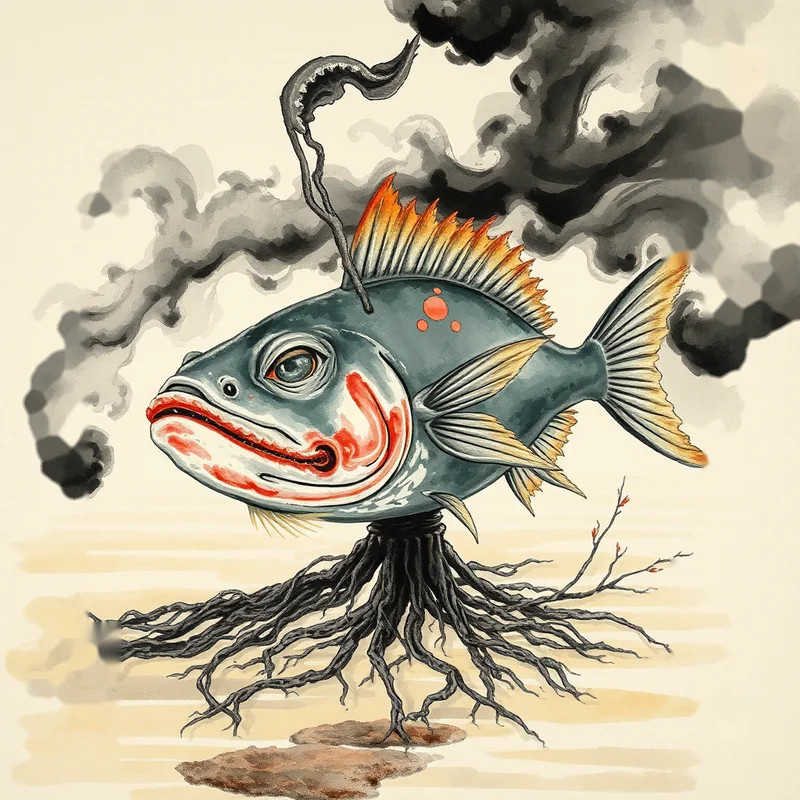
 陵鱼
东山经
《海内北经》
陵鱼
Ling Fish
4.649k东山经
Divine FishWaterCuriosityFish
The Ling fish has a human face, hands and feet, and a fish's body. It lives in the sea.
Original & Translations
海内北经曰:陵鱼人面,手足,鱼身,在海中。
十三个字。
人面,手足,鱼身。
这是《山海经》里唯一一条"有手有脚"的鱼。
别的鱼,要么是鱼身人面(赤鱬),要么是鱼身蛇尾(虎蛟),要么是鱼身鸟翼(文鳐鱼)。只有陵鱼,明确地有手,有脚。
先说"陵"这个字。
陵,是大土山。引申为"登、上升"——陵驾,陵云。
所以"陵鱼",字面的意思可以是"上岸的鱼"。
这个名字本身,就是一个描述。
那么,有没有一种鱼,真的能上岸,而且有"手"有"脚"?
有。弹涂鱼。
弹涂鱼,鲈形目,虾虎鱼科。中国东南沿海的泥滩上,到处都是。
它有多大?十到二十厘米。
它的胸鳍,长得像两条胳膊。鳍条粗壮,有肌肉,可以支撑身体。它用这两条"胳膊"在泥地上爬,一撑一撑地往前挪。
它的腹鳍,愈合成一个吸盘,贴在泥上,防止被浪冲走。这个吸盘,看起来像一只脚。
它的眼睛,长在头顶,突出,可以各自转动。一只眼睛看左边,一只看右边。
它的皮肤,可以呼吸。它把水含在嘴里,用鳃呼吸;同时皮肤和口腔黏膜直接从空气里吸氧。
所以它能离开水,在泥滩上待很久。退潮的时候,成千上万条弹涂鱼在泥上跳,那是一片"会走的泥"。
现在把弹涂鱼的特征,和"人面、手足、鱼身"对一遍。
鱼身:是。
手足:胸鳍像手,腹鳍吸盘像脚。
人面:这一条最关键。
弹涂鱼的脸,从正面看是什么样?
两只眼睛突出在头顶,靠得很近,像两只望远镜。眼睛下面是一张宽大的嘴,嘴唇厚。两颊鼓起来,因为嘴里含着水。
一张脸:两只突出的眼睛,一张宽嘴,两个鼓起的腮。
这张脸,在泥滩上,正对着你。
古人看见的是什么?
一条鱼,从泥里爬出来,用两只"手"撑着,抬起头,两只眼睛直直地看你。
"人面。"
然后是"在海中"。
海内北经说它在海中。弹涂鱼在潮间带——涨潮时在海里,退潮时在泥上。它确实"在海中",也确实"在岸上"。
一个记录者,在退潮的泥滩上看见它,会怎么写?
他会写:有一种鱼,有人的脸,有手有脚,身体是鱼。
十三个字,够了。
再说一层。
陵鱼在中国文化里,后来变成了"人鱼"的一种。
《太平广记》里引《洽闻记》:东海有陵鱼,人面手足,鱼身,在海中。又说,陵鱼即人鱼。
所以陵鱼、人鱼、鲛人,在后世混成了一团。
但《山海经》里的陵鱼,和"人鱼"有一个根本的区别:人鱼是"半人半鱼",是神话;陵鱼是"一条真的会上岸的鱼",是观察。
区别在"手足"。
半人半鱼的神话,不会给鱼"手"和"脚",因为神话里的人鱼是"上身人、下身鱼",它不需要手,它只需要一张脸和一条尾巴。
而"手足"这个描述,是解剖学的:这个动物有四肢,四肢用来在陆地上移动。
写这句话的人,看见的不是一个"人",是一个"四足动物"。
而它确实是鱼。
这就是弹涂鱼给人的震撼:它是鱼,但它有四肢,它上岸。
从演化上说,弹涂鱼不是我们的祖先。我们的祖先,是泥盆纪的肉鳍鱼,比如提塔利克鱼。那条鱼用鳍内的骨骼支撑身体,爬上了岸,后来变成了所有的四足动物。
弹涂鱼走的是另一条路:它没有演化出内骨骼四肢,它用鳍条和肌肉,做到了同样的事。
这叫"趋同演化":不同的起点,相同的解法。
所以"陵鱼"这条记录,实际上记下了两件事。
一件是:有一种鱼,已经半只脚上了岸。
另一件是:人看见它的时候,第一反应是"它有手有脚,它有脸"。
第二件事,比第一件更有意思。
因为人看见一个东西,第一件事是找它像不像自己。
一条鱼,眼睛在头顶,嘴很宽,用鳍撑着站起来。人看见它,说:人面,手足。
人不是在描述它。人是在描述自己看见它时的感觉。
这就是《山海经》最了不起的地方:它记录的不是动物,是人与动物相遇的那一瞬间。
而那一瞬间,往往比动物本身更真实。
The Classic of the Regions Within the Seas, North: the Ling fish has a human face, hands and feet, and a fish's body. It lives in the sea.
Thirteen characters.
Human face, hands and feet, fish body.
It is the only fish in the whole book with hands and feet.
Other fish are fish-bodied with human faces, or fish-bodied with serpent tails, or fish-bodied with bird wings. Only the Ling fish explicitly has hands, and feet.
Start with the name.
Ling means a great mound of earth. By extension it means to climb, to rise — to mount, to overtop the clouds.
So "Ling fish" can literally mean "the fish that comes ashore."
The name is a description.
Is there a fish that really does come ashore, with "hands" and "feet"?
Yes. The mudskipper.
Mudskippers are gobies, in the perciform order. They are all over the mudflats of the southeast China coast.
How big? Ten to twenty centimetres.
Their pectoral fins are built like arms. The fin rays are stout and muscled and can support the body. They walk on these two "arms" across the mud, propping and hauling.
Their pelvic fins are fused into a suction disc that holds them to the mud against the wash of the tide. The disc looks like a foot.
Their eyes sit on top of the head, protruding, and move independently. One looks left, one looks right.
Their skin breathes. They hold water in the mouth and respire through the gills, while skin and mouth lining take oxygen straight from the air.
So they can leave the water and stay out for a long time. At low tide, thousands of mudskippers hop across the flats — a sheet of walking mud.
Now match the features to "human face, hands and feet, fish body."
Fish body: yes.
Hands and feet: pectorals like hands, pelvic disc like a foot.
Human face: this is the crucial one.
What does a mudskipper's face look like from the front?
Two eyes protruding from the top of the head, set close, like two periscopes. Below them a wide mouth with thick lips. The cheeks bulge, because the mouth is full of water.
A face: two bulging eyes, a wide mouth, two swollen cheeks.
That face, on a mudflat, pointed at you.
What did the ancients see?
A fish, climbing out of the mud, propped on two "hands," lifting its head, two eyes staring straight at you.
"Human face."
Then "in the sea."
The chapter says it lives in the sea. Mudskippers live in the intertidal — in the sea at high tide, on the mud at low. It is genuinely "in the sea," and genuinely "on shore."
A recorder standing on the flat at low tide would write:
There is a fish with a human face, hands and feet, and a fish's body.
Thirteen characters. Enough.
One more layer.
In later Chinese culture the Ling fish became a kind of mermaid.
The Taiping Guangji quotes a Tang miscellany: in the eastern sea there is a Ling fish, human face, hands and feet, fish body, in the sea. And it adds: the Ling fish is the mermaid.
So Ling fish, mermaid, and sea-person blur together downstream.
But the Shanhaijing Ling fish differs from the mermaid in one fundamental way. The mermaid is half-human, half-fish — myth. The Ling fish is a real fish that comes ashore — observation.
The difference is in "hands and feet."
Mermaid myth never gives the fish hands and feet, because the mermaid is human above and fish below. It does not need hands; it needs a face and a tail.
"Hands and feet" is anatomical. This animal has four limbs, and the limbs are for moving on land.
Whoever wrote the line was not looking at a person. They were looking at a quadruped.
And it really is a fish.
That is the shock of the mudskipper: a fish, with limbs, out of the water.
Evolutionarily, the mudskipper is not our ancestor. Ours was a Devonian lobe-finned fish, something like Tiktaalik, which used the bones inside its fins to prop itself up and crawl ashore, and became every tetrapod alive.
The mudskipper took another road: no internal limb skeleton, but fin rays and muscle doing the same job.
Convergent evolution: different starting points, same solution.
So the Ling fish entry records two things.
One: there is a fish that already has half a foot on land.
Two: when a person saw it, the first thing they said was "it has hands and feet, it has a face."
The second is more interesting than the first.
Because when a person sees a thing, the first thing they do is check whether it resembles themselves.
A fish with eyes on top, a wide mouth, standing up on its fins. A person looks at it and says: human face, hands and feet.
The person is not describing the fish. The person is describing the feeling of seeing it.
That is the great thing about the Shanhaijing: it does not record animals. It records the moment a person met an animal.
And that moment is often truer than the animal.
"ปลาหลิงหน้าเป็นคน มีมือมีเท้า ตัวเป็นปลา อยู่ในทะเล"
สิบสามตัวอักษร — ปลาเพียงชนิดเดียวในซานไห่จิงที่มีทั้งมือและเท้า
"หลิง" แปลว่าเนินดินใหญ่ หรือ "ขึ้น" — ชื่อจึงหมายถึง "ปลาที่ขึ้นบก"
มีปลาที่ขึ้นบกจริงหรือ? มี — ปลาตีน พบทั่วไปตามหาดโคลนชายฝั่งจีนตะวันออกเฉียงใต้
ครีบอกของมันแข็งแรงมีกล้ามเนื้อ ใช้ยันตัวเดินบนโคลนเหมือนแขนสองข้าง ครีบท้องเชื่อมเป็นแผ่นดูดติดโคลนเหมือนเท้า ตาอยู่บนหัว ปูดออกมา หมุนแยกกันได้ ผิวหนังหายใจได้
ตอนน้ำลง ปลาตีนนับพันตัวกระโดดอยู่บนโคลน — เหมือนแผ่นโคลนที่เดินได้
"หน้าเป็นคน": ตาสองข้างปูดบนหัวติดกัน ปากกว้าง ริมฝีปากหนา แก้มป่องเพราะอมน้ำไว้ — จากด้านหน้าเป็น "หน้า" หนึ่งหน้า
คนโบราณเห็นปลาที่คลานขึ้นจากโคลน ยันด้วย "มือ" สองข้าง แล้วเงยหน้าขึ้นมอง — จึงจดว่า "หน้าเป็นคน"
ต่อมาในตำราราชวงศ์ถัง ปลาหลิงถูกจัดเป็น "เงือก" ชนิดหนึ่ง
แต่ต่างกัน: เงือกเป็นเทพปกรณัมครึ่งคนครึ่งปลา ไม่มีมือมีเท้า ส่วนปลาหลิงเป็น "ปลาที่ขึ้นบกได้จริง" — เป็นการสังเกต
"มีมือมีเท้า" คือคำอธิบายทางกายวิภาค สี่แขนขา เพื่อเคลื่อนที่บนบก
ปลาตีนไม่ใช่บรรพบุรุษของเรา แต่เดินอีกเส้นทางหนึ่ง: ไม่มีกระดูกแขนขาภายใน ใช้ก้านครีบและกล้ามเนื้อทำสิ่งเดียวกัน — วิวัฒนาการแบบเข้าหากัน
บันทึกนี้จึงจดสองสิ่ง: มีปลาที่ขึ้นบกได้ครึ่งตัว และเมื่อคนเห็นมัน สิ่งแรกที่พูดคือ "มันมีมือมีเท้า มีหน้า"
สิ่งหลังน่าสนใจกว่า เพราะคนกำลังบรรยายความรู้สึกของตัวเอง ไม่ใช่ตัวปลา
"Ikan Ling bermuka manusia, bertangan dan berkaki, bertubuh ikan. Ia hidup di laut."
Tiga belas aksara — satu-satunya ikan dalam kitab ini yang mempunyai tangan dan kaki.
"Ling" bermakna busut tanah besar, atau "naik" — jadi namanya bermakna "ikan yang naik ke darat."
Adakah ikan yang benar-benar naik ke darat? Ada — ikan tembakul (mudskipper), lazim di tanah lumpur pantai tenggara China.
Sirip dadanya tebal dan berotot, digunakan menopang badan berjalan di lumpur seperti dua lengan. Sirip perutnya bercantum menjadi cakera sedutan seperti kaki. Matanya di atas kepala, menonjol, bergerak berasingan. Kulitnya boleh bernafas.
Ketika air surut, beribu tembakul melompat di lumpur — seperti hamparan lumpur yang berjalan.
"Muka manusia": dua mata menonjol di atas kepala, mulut lebar, bibir tebal, pipi kembung kerana menyimpan air — dari depan nampak seperti satu muka.
Orang dahulu melihat ikan merangkak keluar dari lumpur, menopang dengan dua "tangan", mengangkat kepala dan memandang — lalu mencatat "muka manusia."
Kemudian dalam catatan dinasti Tang, ikan Ling dikelaskan sebagai sejenis "orang ikan."
Tetapi bezanya: orang ikan ialah mitos separuh manusia separuh ikan, tanpa tangan dan kaki; ikan Ling ialah "ikan yang benar-benar naik ke darat" — pemerhatian.
"Bertangan dan berkaki" ialah keterangan anatomi: empat anggota untuk bergerak di darat.
Tembakul bukan nenek moyang kita, tetapi mengambil jalan lain: tiada rangka anggota dalam, menggunakan sirip dan otot untuk melakukan perkara sama — evolusi konvergen.
Catatan ini merekod dua perkara: ada ikan yang separuh naik ke darat; dan ketika orang melihatnya, perkara pertama yang dikatakan ialah "ia bertangan, berkaki, bermuka."
Yang kedua lebih menarik: orang itu menerangkan perasaannya sendiri, bukan ikannya.
"Cá Lăng mặt người, có tay có chân, mình cá. Sống ở biển."
Mười ba chữ — loài cá duy nhất trong kinh có cả tay và chân.
"Lăng" nghĩa là gò đất lớn, hoặc "lên" — tên có nghĩa "cá lên bờ."
Có loài cá thật sự lên bờ không? Có — cá thòi lòi (mudskipper), phổ biến ở bãi bùn ven biển đông nam Trung Quốc.
Vây ngực dày, có cơ, dùng chống thân bò trên bùn như hai cánh tay. Vây bụng dính thành đĩa hút như bàn chân. Mắt trên đỉnh đầu, lồi ra, xoay độc lập. Da thở được.
Khi thủy triều xuống, hàng nghìn con thòi lòi nhảy trên bùn — như một tấm bùn biết đi.
"Mặt người": hai mắt lồi trên đầu sát nhau, miệng rộng, môi dày, má phồng vì ngậm nước — nhìn chính diện thành một khuôn mặt.
Người xưa thấy cá bò lên khỏi bùn, chống hai "tay", ngẩng đầu nhìn — bèn ghi "mặt người."
Về sau trong sách đời Đường, cá Lăng được xếp là một loại "người cá."
Nhưng khác nhau: người cá là thần thoại nửa người nửa cá, không tay không chân; cá Lăng là "cá thật sự lên bờ" — quan sát.
"Có tay có chân" là mô tả giải phẫu: bốn chi để di chuyển trên cạn.
Thòi lòi không phải tổ tiên ta, nhưng đi con đường khác: không có bộ xương chi bên trong, dùng tia vây và cơ làm việc tương tự — tiến hóa hội tụ.
Ghi chép này ghi hai điều: có loài cá đã nửa bước lên bờ; và khi người ta thấy nó, điều đầu tiên nói là "nó có tay chân, có mặt."
Điều sau thú vị hơn: người ta đang mô tả cảm giác của mình, không phải con cá.
"Ikan Ling berwajah manusia, bertangan dan berkaki, bertubuh ikan. Ia hidup di laut."
Tiga belas aksara — satu-satunya ikan dalam kitab ini yang punya tangan dan kaki.
"Ling" berarti gundukan tanah besar, atau "naik" — jadi namanya berarti "ikan yang naik ke darat."
Apakah ada ikan yang benar-benar naik ke darat? Ada — ikan gelodok (mudskipper), lazim di lumpur pantai tenggara Tiongkok.
Sirip dadanya tebal dan berotot, dipakai menopang tubuh berjalan di lumpur seperti dua lengan. Sirip perutnya menyatu menjadi cakram pengisap seperti kaki. Matanya di atas kepala, menonjol, bergerak terpisah. Kulitnya bisa bernapas.
Saat air surut, ribuan gelodok melompat di lumpur — seperti hamparan lumpur yang berjalan.
"Wajah manusia": dua mata menonjol di atas kepala, mulut lebar, bibir tebal, pipi kembung karena menyimpan air — dari depan tampak seperti satu wajah.
Orang dahulu melihat ikan merangkak keluar dari lumpur, menopang dengan dua "tangan", mengangkat kepala dan memandang — lalu mencatat "wajah manusia."
Kemudian dalam catatan dinasti Tang, ikan Ling dikelompokkan sebagai sejenis "orang ikan."
Tetapi bedanya: orang ikan adalah mitos separuh manusia separuh ikan, tanpa tangan dan kaki; ikan Ling adalah "ikan yang benar-benar naik ke darat" — pengamatan.
"Bertangan dan berkaki" adalah keterangan anatomi: empat anggota untuk bergerak di darat.
Gelodok bukan nenek moyang kita, tetapi mengambil jalan lain: tanpa rangka anggota dalam, memakai sirip dan otot untuk melakukan hal yang sama — evolusi konvergen.
Catatan ini merekam dua hal: ada ikan yang separuh naik ke darat; dan saat orang melihatnya, hal pertama yang dikatakan adalah "ia bertangan, berkaki, berwajah."
Yang kedua lebih menarik: orang itu menjelaskan perasaannya sendiri, bukan ikannya.
Nearby Creatures