 泰逢
中山经
《中山经》
泰逢
Taifeng
4.748k中山经
DeityThunderRainGuardian
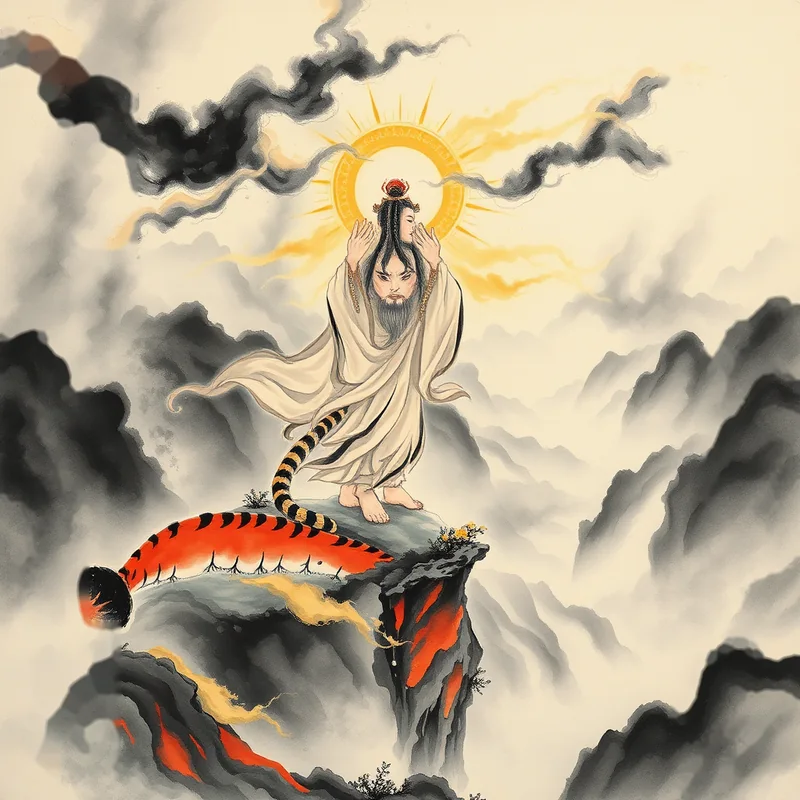
Mount He is the nine-fold confluence of the Yellow River. The auspicious god Taifeng governs it: human form with a tiger tail, coming and going in light. Taifeng stirs the breath of heaven and earth.
Original & Translations
中山经曰:又东二十里,曰和山。其上无草木而多瑶碧。实惟河之九都。是山也,五曲,九水出焉,合而北流注于河,其中多苍玉。吉神泰逢司之,其状如人而虎尾,是好居于萯山之阳,出入有光。泰逢神动天地气也。
先看地理。
和山,"实惟河之九都"。九都,是九条水汇合的地方。这座山五道弯,九条水从山里出来,合起来往北流进黄河。
这是一个河口。或者更准确地说,是一个水系枢纽。
在这种地方住一位神,是《山海经》的常规操作。但泰逢前面加了两个字:吉神。
整部《山海经》里,"吉神"这个词出现的次数,一只手数得完。绝大多数神是"其神状如……",中性的;或者"见则……",凶的。泰逢是少数几个被明确标为"吉"的。
再看形象:人形,虎尾。
虎尾这个细节很有意思。它不是虎头,不是虎爪,只是一条尾巴。一条尾巴在人的身后——这在视觉上几乎不构成威胁,反而像一件配饰,一条腰带。神明保留了一点兽性,但兽性被压缩到了最低限度。
然后是"出入有光"。
神身上有光,这在古代记载里通常和两件事挂钩:雷,或者火。
"泰逢神动天地气也"——这一句是注释式的总结,也是关键。"天地气"是什么?是风,是云,是雷,是雨,是一切大气里的运动。
所以泰逢是一位气象神。而且他的职能范围很清楚:他管"动",不管"降"。
对比一下计蒙。计蒙"恒游于漳渊,出入必有飘风暴雨"——计蒙管的是下雨,是具体的降水。泰逢管的是"气"的启动,是先于雨的那一步。
风起,云聚,天地之气开始动,然后才轮到雨落下来。
这就把两位神分开了:泰逢是开关,计蒙是水龙头。
和山在黄河边,九水汇流。这个位置在气象上意味着什么?意味着这里是水汽的通道。九条河谷把山里的湿气带出来,汇到黄河谷地,冷暖气流在这里交汇,最容易起风、起雾、起雷。
"五曲"——五道弯。弯曲的河谷是风道。风在山谷里拐弯会加速,会发出声音,会在转弯处形成涡旋。
古人站在和山上看:九条水出来,山有五道弯,风从弯里过,云在顶上转。然后他们说:这里有神,神一动,天地之气就动了。
这个解释,比"神"这个字本身要精确得多。
泰逢的祭祀规格也不低:一牡羊,配吉玉。和熏池、武罗同列。熏池"常出美玉",武罗是青要之山的神,"人面而豹文,小要而白齿"。三位神,一条山谷里的三个节点。
一条河、九条水、三个神。这套配置,是一个完整的水文—气象系统,被翻译成了神话的语言。
The Classic of Central Mountains: twenty li east is Mount He. No grass, no trees, but much precious stone. This is truly the nine-fold confluence of the River. The mountain bends five times; nine waters issue from it and join to flow north into the Yellow River, and in them is much grey jade. The auspicious god Taifeng governs it: human form with a tiger's tail. He likes to dwell on the sunny slope of Mount Fu, and he comes and goes in light. Taifeng stirs the breath of heaven and earth.
Geography first.
Mount He is "the nine-fold confluence of the River." Nine waters meeting. The mountain bends five times; nine streams come out of it, gather, and run north into the Yellow River.
This is a river mouth. More precisely, a hydrological junction.
Putting a god at such a place is standard Shanhaijing practice. But Taifeng carries two extra characters in front: auspicious god.
That phrase occurs a handful of times in the entire book. Most gods are introduced neutrally — "the god's form is thus" — or ominously, with "when it appears." Taifeng is one of the very few explicitly labelled auspicious.
Then the form: human, with a tiger's tail.
The tail is the interesting detail. Not a tiger's head, not tiger claws — a tail. A tail behind a human figure is visually almost harmless; it reads as an accessory, a belt. The divinity keeps a trace of the animal, and the animal is compressed to its minimum.
Then: he comes and goes in light.
A god who glows is, in ancient records, usually attached to one of two things: lightning, or fire.
"Taifeng stirs the breath of heaven and earth." That closing line is the key. What is the breath of heaven and earth? Wind, cloud, thunder, rain — everything that moves in the atmosphere.
So Taifeng is a weather god, and his portfolio is specific: he governs motion, not precipitation.
Compare Jimeng, who roams the Zhang deeps and brings wild wind and driving rain wherever he goes. Jimeng delivers rain — actual water. Taifeng starts the air. He is the step before the rain.
Wind rises, cloud gathers, the breath of the world begins to move; only then does water fall.
That separates the two cleanly. Taifeng is the switch. Jimeng is the tap.
Mount He sits beside the Yellow River where nine streams converge. What does that mean meteorologically? It means a corridor for moisture. Nine valleys carry damp air out of the hills into the river basin; warm and cold air meet there; and such places generate wind, fog, and thunder more readily than flat ground.
"Five bends" — five turns. A winding valley is a wind tunnel. Air accelerating around a bend makes noise and sheds vortices at the corners.
The ancients stood on Mount He and saw: nine waters emerging, a mountain folded five times, wind running through the folds, cloud turning on the summit. Then they said: there is a god here, and when the god moves, the breath of heaven and earth moves.
That account is more precise than the word "god" by itself.
His cult is not minor either: one ram, with auspicious jade, ranked alongside Xunchi and Wuluo. Xunchi "constantly produces fine jade"; Wuluo is the god of Mount Qingyao, "human-faced with leopard markings, narrow-waisted, white-toothed." Three gods, three nodes in one valley.
One river, nine streams, three gods. The configuration is a complete hydrological and meteorological system, translated into the language of myth.
เขาฮัว "คือจุดรวมเก้าสายของแม่น้ำ" ภูเขาหักห้าทาง เก้าสายน้ำไหลรวมกันลงเหนือสู่แม่น้ำเหลือง
เทพไท่เฟิงดูแลที่นี่ ร่างคน หางเสือ "ไปมามีแสง" และ "เขย่าลมฟ้าอากาศ"
ดังนั้นเขาจึงเป็นเทพอากาศ แต่คุม "การเคลื่อน" ไม่ใช่ "การตก" — ต่างจากจี้เหมิงที่ทำให้ฝนตกตรง ๆ ไท่เฟิงคือสวิตช์ จี้เหมิงคือก๊อกน้ำ
หุบเขาโค้งห้าทางคือรางลม เก้าสายน้ำคือทางความชื้น นี่คือระบบอุตุนิยมวิทยาแปลงเป็นภาษาเทพ
Gunung He "pertemuan sembilan cabang Sungai". Gunung berbelit lima kali, sembilan anak sungai berkumpul lalu mengalir ke utara ke Sungai Kuning.
Dewa Taifeng menjaganya. Tubuh manusia, ekor harimau. "Datang dan pergi dalam cahaya," dan "menggerakkan nafas langit dan bumi."
Jadi dia dewa cuaca — tetapi mengurus "gerakan", bukan "hujan". Berbeza dengan Jimeng yang terus membawa hujan. Taifeng suis, Jimeng paip.
Lembah berbelit lima kali jadi terowong angin; sembilan anak sungai jadi lorong lembap. Itu sistem meteorologi yang diterjemah jadi bahasa dewa.
Núi Hòa "là nơi hội tụ chín nhánh sông". Núi uốn năm khúc, chín dòng nước tụ lại rồi chảy bắc vào Hoàng Hà.
Thần Thái Phùng trấn giữ. Mình người, đuôi hổ. "Đi lại có ánh sáng," và "làm chuyển động khí trời đất."
Vậy ngài là thần khí tượng — nhưng coi "cái động", không coi "cái rơi". Khác Kế Mông, người trực tiếp mang mưa. Thái Phùng là công tắc, Kế Mông là vòi nước.
Thung lũng uốn năm khúc là đường hầm gió; chín dòng nước là hành lang ẩm. Đó là hệ khí tượng học dịch sang ngôn ngữ thần linh.
Gunung He "pertemuan sembilan cabang Sungai". Gunung berbelit lima kali, sembilan anak sungai berkumpul lalu mengalir ke utara ke Sungai Kuning.
Dewa Taifeng menjaganya. Tubuh manusia, ekor harimau. "Datang dan pergi dalam cahaya," dan "menggerakkan napas langit dan bumi."
Jadi dia dewa cuaca — tetapi mengurus "gerakan", bukan "hujan". Berbeda dengan Jimeng yang langsung membawa hujan. Taifeng sakelar, Jimeng keran.
Lembah berbelit lima kali jadi terowong angin; sembilan anak sungai jadi lorong lembap. Itu sistem meteorologi yang diterjemahkan ke bahasa dewa.
Nearby Creatures