 化蛇
中山经
《中山经》
化蛇
Huashe
4.433k中山经
BeastFloodOmenShapeshifter
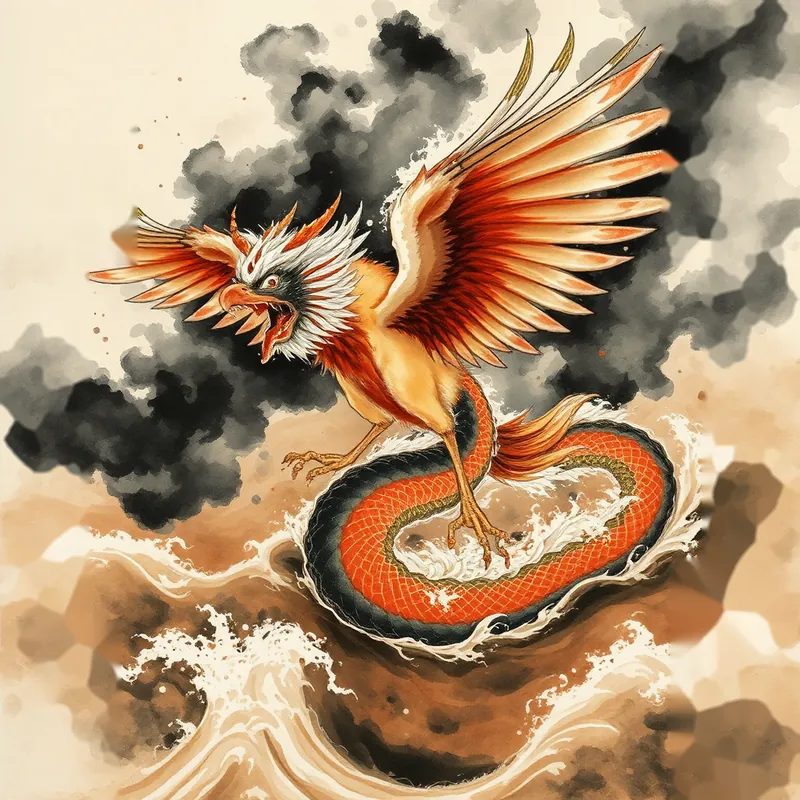
From Mount Yang flows the Yang River, and in it are many Huashe: human face, jackal body, bird wings, moving like a snake. Its cry is a shout of rebuke. When it appears, the town floods.
Original & Translations
中山经曰:又西三百里,曰阳山,多石,无草木。阳水出焉,而北流注于伊水。其中多化蛇,其状如人面而豺身,鸟翼而蛇行,其音如叱呼,见其邑大水。
先数一下这条记录里的动物:人、豺、鸟、蛇。四个。
人面,豺身,鸟翼,蛇行。这是《山海经》里拼得最狠的形象之一。别的异兽大多是"两合一"——人面虎身、牛形蛇尾。化蛇是"四合"。
而且这四样东西不是随便拼的。它们各自对应一个部位:脸(识别)、身(体型)、翼(运动方式)、行(运动方式)。前面两个是"看起来像什么",后面两个是"怎么动"。
一个东西看起来像人,身体像豺,有翅膀,但爬行的时候像蛇。
这种描述,如果把它当成"一个生物",永远画不出来。但如果把它当成"一次目击的记录",就通了。
洪水来的时候,水面上会同时出现什么?
——人的脸。不是真的人脸,是漂浮的尸体,肿胀变形的脸。
——豺的身体。被冲下来的狗、豺、猪、羊。
——鸟的翅膀。水鸟被洪水惊起,或者死鸟的翅膀张开浮在水面。
——蛇的动作。真正的蛇,洪水前会大量从洞里出来,往高处爬;水里也有蛇在游。
洪水退去以后,河滩上留下这些东西,交错叠在一起。从远处看,是"人面、豺身、鸟翼、蛇行"。
而"其音如叱呼"——像人呵斥的声音。
洪水的声音不是"哗"。洪水的声音里有一种低频的轰鸣,也有水流撞在障碍物上的爆响。但在山谷里,最像的是"叱"——短促、粗暴、带怒气的一声断喝。
人在洪水里听见这个声音,第一反应是:有人在骂我。
然后是最后一句:见其邑大水。
这一句把整条记录的性质说清楚了。它不是"化蛇出现了,所以发大水",而是"发大水的时候,能看见化蛇"。
《山海经》的"见则"句式,因果关系经常是反的。不是凶兽带来灾祸,是灾祸发生时凶兽才显形。凶兽是灾祸的可见部分。
所以化蛇是什么?化蛇是洪水本身,被写成了一个生物。
"化"这个字,正好。化是变化、转化。水化成兽,灾化成形。
阳山,多石,无草木。一座石头山,什么也不长。阳水从山里出来,往北流进伊水。伊水是黄河的支流,豫西的暴雨中心之一。石头山不吸水,雨一下,水全下来。
所以这条记录的地理是准的:石山、陡溪、汇入大河。这是山洪的标准配置。
古人把山洪写成了一个人面豺身、有翅膀、像蛇一样爬、还会骂人的东西。
他们不是在编。他们是在描述一件他们看见了、但没法命名的事。
The Classic of Central Mountains: three hundred li west is Mount Yang. Much stone, no grass or trees. The Yang River issues from it and flows north into the Yi. In it are many Huashe: human face, jackal body, bird wings, moving like a snake. Its cry is like a shout of rebuke. When it appears, the town floods.
Count the animals in this entry: human, jackal, bird, snake. Four.
Human face, jackal body, bird wings, snake movement. This is one of the most aggressively assembled images in the book. Most creatures are two-in-one — human-faced tiger, ox-shaped with a snake's tail. Huashe is four-in-one.
And the four are not random. Each maps to a part: face (identification), body (mass), wings (means of motion), movement (means of motion). The first two say what it looks like; the last two say how it moves.
Something that looks human, has a jackal's body, has wings, and crawls like a snake.
Treated as a single organism, this can never be drawn. Treated as a record of one sighting, it works immediately.
What appears on the water at once when a flood comes through?
A human face — not a living one, a floating corpse, the face swollen and deformed.
A jackal's body — dogs, jackals, pigs, sheep washed down.
A bird's wings — waterbirds startled up by the flood, or a dead bird with its wings spread, riding the surface.
The motion of a snake — real snakes, which come out of their burrows in numbers before a flood and climb for high ground; and snakes swimming in the water.
After the water drops, these things are left on the flats, overlapping. From a distance: human face, jackal body, bird wings, snake movement.
And "its cry is like a shout of rebuke."
A flood does not go "splash." It has a low-frequency roar, and it has the crack of water hitting an obstacle. But in a mountain valley the closest human analogue is a rebuke — short, harsh, angry, cut off.
Hearing that inside a flood, a person's first thought is: someone is shouting at me.
Then the last clause: when it appears, the town floods.
That clause settles the nature of the entry. It is not "Huashe appeared, therefore the flood came." It is: when the flood comes, Huashe can be seen.
The "when it appears" formula in the Shanhaijing frequently runs the causality backwards. The beast does not bring the disaster; the disaster is when the beast becomes visible. The beast is the visible portion of the disaster.
So what is Huashe? Huashe is the flood itself, written as an animal.
The name is exactly right. Hua means to transform. Water transforms into a beast; disaster takes on a shape.
Mount Yang: much stone, no grass. A rock mountain that grows nothing. The Yang River comes out of it and runs north into the Yi, a tributary of the Yellow River, through one of the storm centres of western Henan. Rock does not absorb rain. When it rains, all of it comes down at once.
The geography is accurate: stone mountain, steep stream, big river below. The standard configuration for a flash flood.
The ancients wrote that flash flood as a thing with a human face and a jackal's body, with wings, crawling like a snake, and swearing.
They were not inventing. They were describing something they had seen and could not name.
เขาหยาง เป็นภูเขาหิน ไม่มีต้นไม้ แม่น้ำหยางไหลเหนือลงสู่อี๋สุย
ในน้ำมีงูฮว่าฉอ: หน้ามนุษย์ ตัวหมาจิ้งจอก ปีกนก เลื้อยเหมือนงู เสียงเหมือนตวาด
ลองนับสัตว์: คน หมาจิ้งจอก นก งู — สี่อย่าง ถ้าเป็น "ตัวเดียว" วาดไม่ได้ แต่ถ้าเป็น "บันทึกการพบเห็นครั้งหนึ่ง" ก็เข้าใจทันที
เวลาน้ำท่วม จะมี: หน้าคน (ศพลอย swollen), ตัวหมาจิ้งจอก/หมา/หมูที่ถูกพัดมา, ปีกนกน้ำที่ตกใจบิน, งูที่หนีน้ำขึ้นที่สูง
ทั้งหมดลอยปนกัน บนผืนน้ำ ระยะไกลก็เห็นเป็น "หน้ามนุษย์ ตัวหมาจิ้งจอก ปีกนก เลื้อยเหมือนงู"
"เห็นเมื่อไรเมืองนั้นน้ำท่วม" — ไม่ได้แปลว่ามันทำให้ท่วม แต่ท่วมแล้วถึงเห็นมัน
Gunung Yang: gunung batu, tiada tumbuhan. Sungai Yang mengalir ke utara ke Sungai Yi.
Di dalamnya banyak Huashe: muka manusia, badan serigala, sayap burung, bergerak seperti ular. Bunyinya seperti hardikan.
Kira binatangnya: manusia, serigala, burung, ular — empat. Sebagai satu makhluk, tidak boleh dilukis. Sebagai catatan satu penampakan, terus masuk akal.
Bila banjir datang: muka manusia (mayat terapung, bengkak), badan serigala/anjing/babi hanyut, sayap burung air terkejut terbang, ular naik ke tempat tinggi.
Semua terapung bercampur. Dari jauh nampak seperti "muka manusia, badan serigala, sayap burung, gerak ular."
"Muncul, bandar banjir" — bukan ia menyebabkan banjir, tetapi bila banjir baru ia kelihatan.
Núi Dương: núi đá, không cây. Sông Dương chảy bắc vào sông Y.
Trong sông nhiều Hóa Xà: mặt người, mình chó rừng, cánh chim, bò như rắn. Tiếng như quát mắng.
Đếm loài: người, chó rừng, chim, rắn — bốn. Nếu là "một sinh vật" thì không thể vẽ. Nếu là "ghi chép một lần chứng kiến" thì hiểu ngay.
Khi lũ đến: mặt người (xác trôi, sưng), mình chó rừng/chó/lợn bị cuốn, cánh chim nước giật mình bay, rắn bò lên chỗ cao.
Tất cả trôi lẫn nhau. Từ xa thấy thành "mặt người, mình chó rừng, cánh chim, bò như rắn."
"Xuất hiện thì thành lụt" — không phải nó gây lụt, mà lụt đến mới thấy nó.
Gunung Yang: gunung batu, tanpa tumbuhan. Sungai Yang mengalir ke utara ke Sungai Yi.
Di dalamnya banyak Huashe: wajah manusia, tubuh serigala, sayap burung, bergerak seperti ular. Bunyinya seperti bentakan.
Hitung hewannya: manusia, serigala, burung, ular — empat. Sebagai satu makhluk, tidak bisa dilukis. Sebagai catatan satu penampakan, langsung masuk akal.
Saat banjir datang: wajah manusia (mayat terapung, bengkak), tubuh serigala/anjing/babi hanyut, sayap burung air terkejut terbang, ular naik ke tempat tinggi.
Semua terapung bercampur. Dari jauh tampak seperti "wajah manusia, tubuh serigala, sayap burung, gerak ular."
"Muncul, kota banjir" — bukan ia menyebabkan banjir, tetapi saat banjir baru ia terlihat.
Nearby Creatures