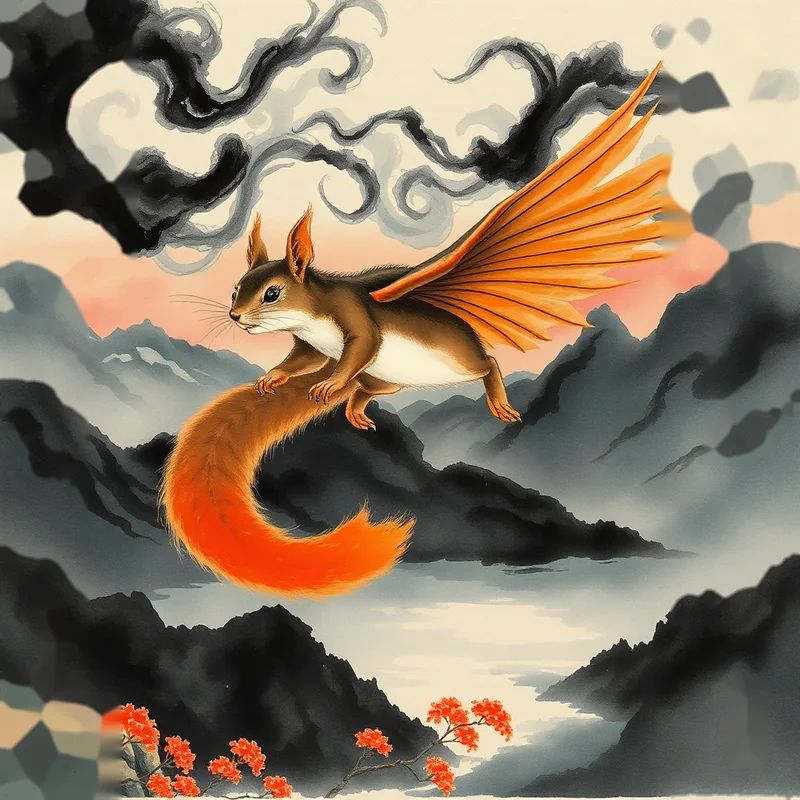
 飞鼠
北山经
《北山经》
飞鼠
Flying Squirrel
4.652k北山经
BeastFlightCuriosity
On Mount Tianchi lives a beast shaped like a hare with a rat's head. It flies with its back. Its name is Feishu.
Original & Translations
北山经曰:又东北二百里,曰天池之山,其上无草木,多文石。有兽焉,其状如兔而鼠首,以其背飞,其名曰飞鼠。
"以其背飞"——用背飞。
这四个字是整条记录里最古怪的部分,也是最真实的部分。
先说实物。中国有鼯鼠,也就是俗称的飞鼠,现存十三种左右,从东北的沟牙鼯鼠到华南的棕鼯鼠,分布很广。
鼯鼠不会飞,它滑翔。前后肢之间有一层皮膜,叫飞膜。飞膜展开的时候,整个身体变成一片薄薄的翼面,从高处的树冠上一跃,滑出几十米甚至上百米,落在另一棵树上。
关键是飞膜的附着点。它从颈部两侧开始,沿着体侧一直连到后肢和尾根。
现在想象一下:黄昏,光线很暗,一只鼯鼠从树上滑下来。它四肢摊开,皮膜绷紧,从下面或从侧面看——你看到的是什么?
你看到的是一片摊开的、连着背部的膜,把整个身体包成一个扁平的形状。前面一个小头,后面一条尾巴,中间是一整片。
"以其背飞"。它看起来就是靠背部那片东西在飞。
而"状如兔而鼠首"——像兔子,头像老鼠。鼯鼠蹲在树枝上的时候,缩成一团,圆背,短前肢,长后肢,耳朵小而圆,确实像一只小兔子。但脸是尖的,眼睛大而黑,是鼠的脸。
所以这条记录,从"兔形"到"鼠首"到"以背飞",每一个特征都是准确的,而且顺序就是一个人观察的顺序:先看见蹲着的整体(像兔),再看脸(像鼠),然后它跳下去(用背飞)。
古人没有解剖学,他们不知道那层膜连在前肢上。他们只看见"背上有东西展开了"。
现在说天池之山。
"天池"这个名字,在山西北部有一个非常有名的对应:宁武天池,在管涔山,海拔一千七百多米,是华北少见的高山湖泊群。而管涔山至今有复齿鼯鼠分布。
"其上无草木,多文石"——山顶没有草木,多带纹路的石头。管涔山的主峰芦芽山,山顶是花岗岩,确实是裸岩加碎石。
所以这条记录的地理位置,很可能就是晋北的管涔山。
于是画面完整了:黄昏,晋北的高山,裸岩,一片湖水,湖边几棵老树。一只鼯鼠从树冠上跳下来,展开皮膜,无声地滑过湖面,落在对岸。
一个猎人看见了。他没有"滑翔"这个词。他只有"飞"。而飞的东西要么有翅膀,要么——像这个——有一片从背上展开的东西。
他记下来:状如兔而鼠首,以其背飞。
两千多年后,我们叫它复齿鼯鼠,学名 Trogopterus xanthipes。它的干燥粪便是一味中药,叫五灵脂,活血止痛。
而《山海经》里,它只有十四个字。
The Classic of Northern Mountains: two hundred li northeast is Mount Tianchi. No grass or trees on the summit; much patterned stone. A beast lives there, shaped like a hare with a rat's head, which flies with its back. Its name is Feishu.
"Flies with its back."
Those four characters are the strangest part of the entry and also the truest.
Take the animal first. China has flying squirrels — the true gliding squirrels — with about thirteen species, from the groove-toothed flying squirrel of the northeast to the brown flying squirrel of the south. Wide distribution.
They do not fly. They glide. A membrane between the fore and hind limbs, the patagium, spreads into a thin aerofoil; the animal launches from a high canopy, covers tens or even a hundred metres, and lands on another tree.
The attachment points matter. The membrane begins at the sides of the neck and runs along the flanks to the hind limbs and the base of the tail.
Now picture it: dusk, poor light, a flying squirrel launching. Limbs spread, membrane taut. Seen from below, or from the side — what do you actually see?
A spread sheet of membrane, joined along the back, wrapping the whole body into a flattened shape. A small head in front, a tail behind, and one continuous surface between.
"Flies with its back." It looks exactly as though the thing on its back is doing the flying.
And "shaped like a hare with a rat's head" — a flying squirrel perched on a branch, hunched into a ball, round-backed, short forelimbs, long hindlimbs, small round ears, does read as a small rabbit. But the face is pointed, the eyes large and black. A rat's face.
So every feature in the record is accurate, and the order is the order of observation: first the perched whole (like a hare), then the face (like a rat), then the launch (flies with its back).
The ancients had no anatomy. They did not know the membrane attaches at the wrist. They saw something spread open on the back.
Now Mount Tianchi.
The name has a well-known counterpart in northern Shanxi: the Tianchi lakes of Ningwu, in the Guancen range, at over seventeen hundred metres — a rare group of alpine lakes in north China. And the Guancen mountains still have groove-toothed flying squirrels.
"No grass or trees on the summit, much patterned stone." The main peak, Luya Shan, is granite: bare rock and scree.
So the location is probably the Guancen range in northern Shanxi.
Now the picture completes. Dusk, a high northern mountain, bare rock, a lake, a few old trees at the shore. A flying squirrel drops from the canopy, spreads its membrane, and crosses the water without a sound, landing on the far bank.
A hunter saw it. He had no word for gliding. He had "fly." And things that fly either have wings, or — like this one — have something that opens out of the back.
He wrote it down: shaped like a hare, head like a rat, flies with its back.
Two thousand years later we call it Trogopterus xanthipes, the complex-toothed flying squirrel. Its dried droppings are a Chinese medicine, wulingzhi, used to move blood and stop pain.
In the Shanhaijing it has fourteen characters.
"บินด้วยหลัง" — สี่คำนี้คือส่วนที่แปลกที่สุดและจริงที่สุด
ที่จริงคือกระรอกบิน จีนมีราว 13 ชนิด มันไม่บิน แต่ร่อน มีแผ่นหนังระหว่างขาหน้าและขาหลัง
ตอนพลบค่ำ เห็นมันกางออก แผ่นหนังเชื่อมไปตามแนวหลัง ทั้งตัวแบนราบ หัวเล็กข้างหน้า หางข้างหลัง ตรงกลางเป็นแผ่นเดียว — ดูเหมือน "หลัง" ต่างหากที่บิน
"รูปเหมือนกระต่าย หัวหนู" ก็ตรง: ตอนเกาะกิ่งมันขดกลมเหมือนกระต่าย แต่หน้าแหลม ตาดำโต เหมือนหนู
เขาถียนฉือ = น่าจะเป็นเทือกเขากวานเฉิน มณฑลซานซี ซึ่งยังมีกระรอกบินชนิดนี้อยู่
"Terbang dengan punggungnya" — empat perkataan paling pelik dan paling tepat.
Sebenarnya ini tupai terbang. China ada kira-kira 13 spesies. Ia tidak terbang, ia meluncur. Ada selaput antara kaki depan dan belakang.
Waktu senja, selaput terbuka, menyambung sepanjang belakang, badan jadi rata. Kepala kecil di depan, ekor di belakang, tengahnya satu keping — nampak macam "belakang" itulah yang terbang.
"Bentuk arnab, kepala tikus" pun tepat: masa bertenggek ia bergulung bulat macam arnab, tetapi muka tajam, mata hitam besar macam tikus.
Gunung Tianchi mungkin banjaran Guancen di Shanxi utara, yang masih ada tupai terbang ini.
"Bay bằng lưng" — bốn chữ lạ nhất và cũng thật nhất.
Thực ra là sóc bay. Trung Quốc có khoảng 13 loài. Nó không bay, nó lượn. Có màng da giữa chi trước và chi sau.
Lúc hoàng hôn, màng xòe ra, nối dọc theo lưng, cả thân dẹt lại. Đầu nhỏ phía trước, đuôi phía sau, giữa là một tấm liền — trông như thể "cái lưng" mới là thứ đang bay.
"Hình thỏ, đầu chuột" cũng đúng: khi đậu nó cuộn tròn như thỏ, nhưng mặt nhọn, mắt đen to như chuột.
Núi Thiên Trì có lẽ là dãy Quản Sầm, bắc Sơn Tây, nơi vẫn còn loài sóc bay này.
"Terbang dengan punggungnya" — empat kata paling aneh dan paling tepat.
Sebenarnya ini tupai terbang. Tiongkok punya sekitar 13 spesies. Ia tidak terbang, ia meluncur. Ada selaput antara kaki depan dan belakang.
Saat senja, selaput terbuka, menyambung sepanjang punggung, tubuh jadi rata. Kepala kecil di depan, ekor di belakang, tengahnya satu lembar — tampak seperti "punggung" itulah yang terbang.
"Bentuk kelinci, kepala tikus" juga tepat: saat bertengger ia menggulung bulat seperti kelinci, tetapi wajah tajam, mata hitam besar seperti tikus.
Gunung Tianchi mungkin pegunungan Guancen di Shanxi utara, yang masih punya tupai terbang ini.
Nearby Creatures