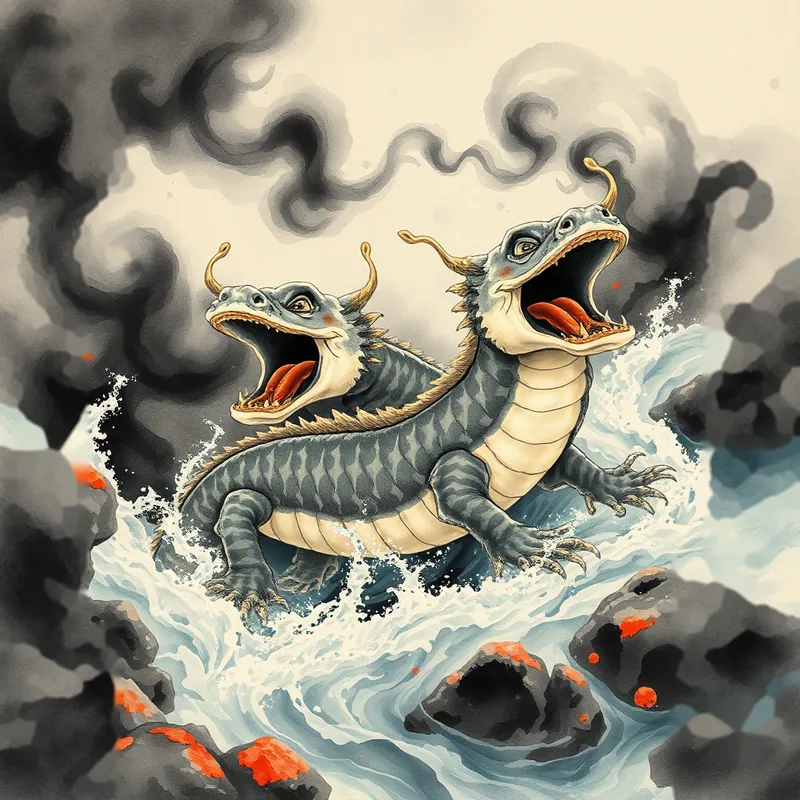
 人鱼
北山经
《北山经》
人鱼
Man-Fish
4.868k北山经
Divine FishHealingMedicine
In the Juejue River are many man-fish: shaped like a catfish, four-legged, crying like a baby. Eat them and you will not become feeble-minded.
Original & Translations
北山经曰:又东北二百里,曰龙侯之山,无草木,多金玉。决决之水出焉,而东流注于河。其中多人鱼,其状如䱱鱼,四足,其音如婴儿,食之无痴疾。
人鱼。这两个字在中国古代,指的不是安徒生那种半人半鱼。
它指的是一种真实的动物:大鲵。
大鲵,俗称娃娃鱼。体长可达一米八,是现存最大的两栖动物。头扁宽,眼小,体表灰褐带斑,皮肤黏滑有疣粒。四条短腿,前肢四趾,后肢五趾。尾巴侧扁,像鱼。
它生活在水质清澈、水流湍急的山溪里,白天藏在石缝中,夜里出来捕食鱼虾蟹蛙。
"其状如䱱鱼"——䱱鱼是鲇类,也就是鲶鱼。大鲵的形状确实像鲶鱼:扁头,宽嘴,长尾,无鳞,黏滑。
"四足"——这是大鲵和鱼的根本区别。古人注意到了。
"其音如婴儿"——这是"娃娃鱼"这个名字的由来。大鲵会叫。受惊或被捉住时,它会发出像婴儿啼哭的叫声,短促、尖锐、带哭腔。这不是传说,是很多人亲耳听过的。
所以"人鱼"这个名字,逻辑很清楚:像人一样会哭,像鱼一样生活在水里。
现在说最后一句:食之无痴疾。
"痴疾"是什么病?
不是"傻"。在古代医书里,"痴"常常指一种特定的病症:智力低下、反应迟钝、身材矮小、面容特殊。这些症状合在一起,现代医学有个名字:地方性克汀病,也就是碘缺乏导致的呆小症。
这个病有明确的地域性。它发生在土壤和饮水中缺碘的山区。中国是世界上碘缺乏最严重的国家之一,而缺碘最严重的区域之一,就是秦岭—太行—吕梁这一线,也就是《北山经》覆盖的范围。
患病的人,脖子肿(甲状腺肿),生的孩子智力受损。整个村子都可能这样。
而山溪里的鱼、蛙、蟹,含碘量远高于山里的粮食和蔬菜。
所以"食之无痴疾"这句话,是一个营养学结论:吃这条溪里的东西,孩子不会变傻。
这不是巫术。这是几百年、几代人的对照观察得出的经验:住在溪边、常吃水产的村子,呆小症少;住在山上、只吃旱地粮食的村子,呆小症多。
于是大鲵被记进了《山海经》,作为一味药。
后面的事,是另一段历史。
大鲵现在是国家二级保护动物,野外种群极度濒危。原因不是被吃——虽然确实被吃得很厉害——而是栖息地丧失:山溪被水坝截断,水质变差,洞穴被淤塞。
它在一九八〇年代还是山区常见的"害兽",被当作补品大量捕捉。三十年间,从常见到极危。
《山海经》记它的时候,它在决决之水里"多"。多到什么程度?多到可以当成一味药来推荐。
这句话现在读起来,像一句悼词。
The Classic of Northern Mountains: two hundred li northeast is Mount Longhou. No grass or trees; much gold and jade. The Juejue River issues from it and flows east into the Yellow River. In it are many man-fish: shaped like a catfish, four-legged, crying like a baby. Eat them and you will not become feeble-minded.
Man-fish. In ancient Chinese this does not mean the Andersen thing, half human and half fish.
It means a real animal: the Chinese giant salamander.
Andrias davidianus. Up to one metre eighty, the largest living amphibian. Broad flat head, tiny eyes, grey-brown blotched skin, slimy and warty. Four short legs — four toes in front, five behind. A laterally flattened tail like a fish's.
It lives in clear, fast hill streams, hides in rock crevices by day, and comes out at night for fish, shrimp, crabs, frogs.
"Shaped like a catfish" — the comparison is exact. Flat head, wide mouth, long tail, no scales, slimy.
"Four legs" — the fundamental difference from a fish, and the ancients noted it.
"It cries like a baby" — which is where the Chinese nickname comes from: wawa yu, baby fish. Giant salamanders vocalize. Disturbed or handled, they produce a cry that is short, sharp, and unmistakably infant-like. Not legend. Many people have heard it.
So the name is logical: it cries like a person, it lives in water like a fish.
Then the last clause: eat it and you will not become feeble-minded.
What illness is this?
Not "stupidity." In classical medical texts the term often names a specific syndrome: impaired intelligence, slow responses, short stature, distinctive facial features. Together those symptoms have a modern name — endemic cretinism, the mental impairment caused by iodine deficiency.
The disease is sharply regional. It occurs in mountain areas where soil and drinking water are iodine-poor. China has some of the worst iodine deficiency in the world, and among the worst belts runs through the Qinling, Taihang, and Lüliang ranges — precisely the ground the Classic of Northern Mountains covers.
Affected people develop goitre, and their children are born with damaged cognition. An entire village can be affected.
Fish, frogs, and crabs from hill streams carry far more iodine than upland grain and vegetables.
So "eat it and you will not become feeble-minded" is a nutritional finding: eat from this stream and your children will not be dulled.
Not sorcery. Centuries of comparison, generation after generation: villages by the water, eating from it, had little cretinism; villages up the slope, eating only dry-field grain, had much.
And so the giant salamander entered the Shanhaijing as a medicine.
What happened afterwards is a different history.
The giant salamander is now a Class II protected species in China, and wild populations are critically endangered. Not primarily because it was eaten — though it was, heavily — but because the habitat went: streams dammed, water quality degraded, crevices silted up.
In the 1980s it was still a common "pest" of mountain districts, harvested in quantity as a tonic. Within thirty years it went from common to critical.
When the Shanhaijing recorded it, the Juejue had many. How many? Enough to recommend as a course of treatment.
That sentence now reads like a eulogy.
"คนปลา" ในจีนโบราณไม่ใช่เงือกแบบเทพนิยาย แต่คือตัวจริง: จิ้งจกน้ำยักษ์จีน ("ปลาเด็ก")
ตัวยาวได้ถึง 1.8 เมตร เป็นสัตว์ครึ่งบกครึ่งน้ำที่ใหญ่ที่สุดที่ยังมีชีวิต หัวแบนกว้าง ตาเล็ก ผิวสีน้ำตาลเทาลายจุด มีสี่ขาสั้น หางแบนข้างเหมือนปลา
"รูปร่างเหมือนปลาดุก" — ตรง "มีสี่ขา" — ต่างจากปลาโดยสิ้นเชิง "เสียงเหมือนทารก" — นี่คือที่มาของชื่อ "ปลาเด็ก" มันร้องจริง เวลาตกใจหรือถูกจับ
"กินแล้วไม่เป็นโรคปัญญาอ่อน" — "ฉือจี" น่าจะหมายถึงโรคเอ๋อจากการขาดไอโอดีน (endemic cretinism) ซึ่งพบมากในเขตกึ่งภูเขาจีนเหนือที่ขาดไอโอดีน
ปลา กบ ปู ในลำธารมีไอโอดีนสูงกว่าธัญพืชบนภูเขามาก นี่คือข้อสรุปทางโภชนาการ ไม่ใช่เวทมนตร์
วันนี้มันเป็นสัตว์คุ้มครองระดับสอง ใกล้สูญพันธุ์อย่างยิ่ง — เพราะถิ่นที่อยู่ถูกทำลาย ไม่ใช่เพราะถูกกิน
"Ikan-manusia" dalam bahasa China lama bukan makhluk dongeng, tetapi haiwan sebenar: salamander gergasi China ("ikan bayi").
Boleh sampai 1.8 meter, amfibia terbesar yang masih hidup. Kepala lebar rata, mata kecil, kulit kelabu coklat berbercak, berlendir. Empat kaki pendek. Ekor pipih seperti ikan.
"Bentuk macam ikan duri" — tepat. "Berkaki empat" — bezanya dengan ikan. "Bunyi macam bayi" — inilah asal nama "ikan bayi". Ia memang berbunyi bila terkejut atau dipegang.
"Makan, tidak jadi lemah akal" — "chiji" mungkin penyakit bodoh akibat kekurangan iodin (endemic cretinism), lazim di tanah tinggi China utara yang miskin iodin.
Ikan, katak, ketam di anak sungai jauh lebih tinggi iodin daripada bijirin di lereng bukit. Itu kesimpulan pemakanan, bukan sihir.
Hari ini ia spesies terlindung kelas dua, sangat terancam — kerana habitat dimusnahkan, bukan kerana dimakan.
"Người cá" trong tiếng Hán cổ không phải sinh vật thần thoại, mà là loài có thật: cá cóc khổng lồ Trung Quốc ("cá em bé").
Dài tới 1,8 mét, lưỡng cư lớn nhất còn sống. Đầu rộng dẹt, mắt nhỏ, da xám nâu đốm, nhớt. Bốn chân ngắn. Đuôi dẹt bên như cá.
"Hình như cá trê" — đúng. "Bốn chân" — khác cá ở chỗ đó. "Kêu như trẻ con" — đây là nguồn gốc tên "cá em bé". Nó thật sự kêu khi bị động.
"Ăn vào không bị đần độn" — "si tật" có lẽ là bệnh đần do thiếu i-ốt (endemic cretinism), phổ biến ở vùng núi bắc Trung Quốc thiếu i-ốt.
Cá, ếch, cua ở suối nhiều i-ốt hơn lương thực trên núi rất nhiều. Đó là kết luận dinh dưỡng, không phải phép thuật.
Nay nó là loài được bảo vệ cấp hai, cực kỳ nguy cấp — vì mất sinh cảnh, không phải vì bị ăn.
"Ikan-manusia" dalam bahasa Tiongkok kuno bukan makhluk dongeng, melainkan hewan nyata: salamander raksasa Tiongkok ("ikan bayi").
Bisa sampai 1,8 meter, amfibi terbesar yang masih hidup. Kepala lebar rata, mata kecil, kulit kelabu coklat berbintik, berlendir. Empat kaki pendek. Ekor pipih seperti ikan.
"Bentuk seperti ikan lele" — tepat. "Berkaki empat" — bedanya dengan ikan. "Bunyi seperti bayi" — inilah asal nama "ikan bayi". Ia memang berbunyi saat terkejut atau dipegang.
"Makan, tidak jadi lemah akal" — "chiji" mungkin penyakit bodoh akibat kekurangan yodium (endemic cretinism), lazim di dataran tinggi Tiongkok utara yang miskin yodium.
Ikan, katak, kepiting di anak sungai jauh lebih tinggi yodium daripada biji-bijian di lereng bukit. Itu kesimpulan gizi, bukan sihir.
Kini ia spesies dilindungi kelas dua, sangat terancam — karena habitat hancur, bukan karena dimakan.
Nearby Creatures