 领胡
北山经
《北山经》
领胡
Linghu
4.219k北山经
BeastMedicineOx
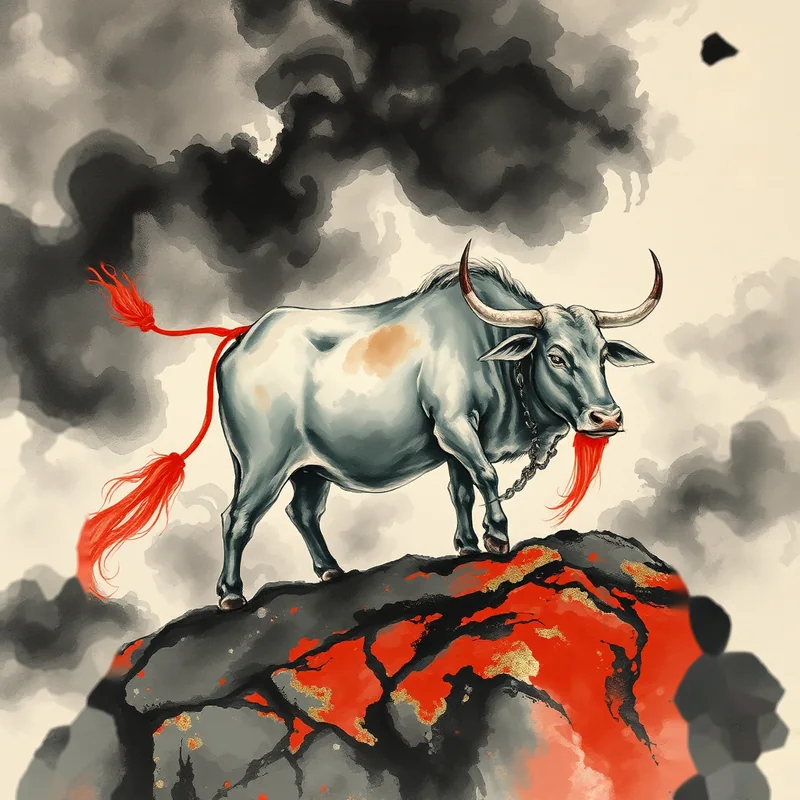
On Mount Yang lives a beast like an ox with a red tail and a ladle-shaped growth at its throat. Its name is Linghu; its call is its own name, and eating it cures madness.
Original & Translations
北山经曰:又东三百里,曰阳山,其上多玉,其下多金铜。有兽焉,其状如牛而赤尾,其颈𦜜,其状如句瞿,其名曰领胡,其鸣自詨,食之已狂。
"其颈𦜜,其状如句瞿"——这句话卡在一个字上:𦜜。
这个字,历代注家都说不清。有人说是"颈上有肉",有人说是"颈下垂肉",有人说是"颈项隆起"。
但后面那句解释得很清楚:其状如句瞿。句瞿是什么?一种盛食物的器皿,曲柄,口部外张,形状像一个弯钩加一个碗。
所以这句话的意思是:脖子上有一块肉,形状像一只句瞿——弯的,下垂的,末端有个膨大。
现在看图。牛。脖子下面有一块下垂的肉,从下颌一直垂到胸前,走起来晃。
这块东西,学名叫"垂皮",也叫"颈垂"。黄牛、瘤牛都有。瘤牛的垂皮特别发达,可以垂到膝盖。
它的作用是什么?散热。
牛是大型动物,代谢产热多,但汗腺不发达。它靠什么散热?靠皮肤表面积。垂皮把颈部皮肤的面积扩大了好几倍,血管密布,表面积大,是主要的散热器官。天热的时候,垂皮会明显松弛下垂,血流增加。
所以"其状如句瞿",是一句准确的形态描述。
然后是"食之已狂"。
"狂"在古医书里,指的不是"疯狂",是一类以精神症状为主的病:躁动、妄言、奔走、不避水火、甚至自伤。今天看,可能是精神分裂、躁狂、癫痫发作后的意识障碍、或者狂犬病。
"食之已狂"——吃它的肉,能治这个。
牛身上有什么东西能治精神症状?
牛黄。
牛黄是牛的胆结石,主产于胆囊、胆管。中医用它清热、解毒、定惊、开窍。安宫牛黄丸、牛黄清心丸,都是治高热神昏、惊厥抽搐的经典方。
现代药理学证实,牛黄中的胆红素、胆汁酸、牛磺酸确实有中枢镇静、抗惊厥、解热作用。
所以"食之已狂"的背后,是一条真实的药物链:牛身上有牛黄,牛黄能定惊,所以"这种牛"能治狂。
问题在于:不是每头牛都有牛黄。发生率大概在千分之一到百分之一之间。所以这条记录不能理解成"随便杀头牛吃",而应该理解成"这种牛里出过牛黄,救过人"。
古人不知道牛黄是胆结石。他们只知道:某头牛的某个部位,或者整头牛,治好了某个疯掉的人。
然后他们把这件事,记在了这座山的这只牛身上。
阳山,出玉,出金铜。同一座山上还有象蛇——那只半雄半雌的鸟。一座山,一只治疯病的牛,一只性别错乱的鸟。
这两个条目放在一起,很像一个地方病区的档案:精神疾病多,性别发育异常多。
也可能只是巧合。但《山海经》把这两条并排写在同一座山下,至少说明:记录的人觉得它们属于同一个地方。
The Classic of Northern Mountains: three hundred li east is Mount Yang. Jade above; gold and copper below. A beast lives there like an ox with a red tail; its neck bears a mass shaped like a ladle-vessel. Its name is Linghu; its call is its own name; eating it cures madness.
The description hangs on one character, an obscure graph meaning something at the neck. Commentators have never agreed: flesh on the neck, a dewlap, a swelling.
But the next clause explains it: shaped like a juqu. A juqu is a serving vessel — curved handle, flared mouth, a hook with a bowl on the end.
So: a mass of flesh at the neck, curved, hanging, widening at the tip.
Now look at the animal. An ox. A flap of skin hanging under the neck, from the jaw down to the chest, swinging as it walks.
This has a name: the dewlap. Cattle have it. Zebu cattle have an extreme version, hanging to the knee.
What is it for? Heat.
Cattle are large animals generating a lot of metabolic heat, with poorly developed sweat glands. They dump heat through skin surface. The dewlap multiplies the neck's skin area several times over, densely vascularized — it is a primary radiator. In hot weather it slackens and drops visibly, and blood flow through it increases.
So "shaped like a juqu" is accurate morphological description.
Then: eating it cures madness.
In classical medical texts, madness is not "insanity" as a category. It is a cluster of psychiatric symptoms: agitation, raving, running, indifference to water and fire, self-injury. Today one would read it as schizophrenia, mania, post-seizure confusion, or rabies.
Eat this animal and the madness stops.
What in an ox treats psychiatric symptoms?
Bezoar. Niu huang — ox bezoar, a gallstone from the gallbladder or bile ducts. Chinese medicine uses it to clear heat, resolve toxicity, calm the spirit, and open the orifices. Angong Niuhuang Wan and Niuhuang Qingxin Wan, both classics for high fever with delirium and convulsion, contain it.
Pharmacology supports this: bilirubin, bile acids, and taurine in bezoar do have central sedative, anticonvulsant, and antipyretic effects.
So behind "eating it cures madness" is a real drug chain: this animal produces bezoar; bezoar stops convulsions; therefore this animal cures madness.
The complication: not every ox has a bezoar. The incidence is somewhere between one in a thousand and one in a hundred. So the entry cannot mean "kill any ox and eat it." It means: among these oxen, bezoar has occurred, and it saved someone.
The ancients did not know bezoar was a gallstone. They knew that some part of a particular ox, or the ox entire, had restored a mad person.
And they wrote it down against this ox, on this mountain.
Mount Yang yields jade, gold, copper. The same mountain also has Xiangshe, the half-male bird. One mountain: an ox that cures psychosis, and a bird with disordered sex development.
Read together, the two entries look like the file of an endemic zone: elevated psychiatric illness, elevated anomalies of sexual development.
It may be coincidence. But the Shanhaijing placed them side by side under one mountain, which at least means the recorder thought they belonged to the same place.
"ที่คอมีเนื้อเป็นก้อนเหมือนทัพพี (รูปทัพพี)" — นี่คือ "เหนียงคอ" (dewlap) ของวัว
วัวมีต่อมเหงื่อน้อย ระบายความร้อนทางผิวหนัง เหนียงคอขยายพื้นที่ผิวหลายเท่า มีเส้นเลือดหนาแน่น เป็นอวัยวะระบายความร้อนหลัก อากาศร้อนมันจะหย่อนลงชัดเจน
"กินแล้วหายบ้า" — "บ้า" ในตำราแพทย์โบราณหมายถึงกลุ่มอาการทางจิต: กระสับกระส่าย พูดเพ้อ วิ่ง ไม่กลัวน้ำไม่กลัวไฟ
วัวมี "นิ่วน้ำดี" (นิ่วหวง) ใช้ลดไข้ หยุดชัก สงบจิต มีงานวิจัยรองรับ
แต่ไม่ใช่วัวทุกตัวมีนิ่ว (ประมาณ 1/1000–1/100) ดังนั้นบันทึกนี้หมายถึง "ในฝูงนี้เคยมี" ไม่ใช่ "ฆ่าตัวไหนก็ได้"
"Di leher ada daging berbentuk senduk (bentuk senduk)" — ini "dewlap", gelambir leher lembu.
Lembu kurang kelenjar peluh; ia buang haba melalui permukaan kulit. Gelambir menggandakan luas kulit leher, penuh saluran darah — radiator utama. Bila panas, ia kendur dan turun dengan jelas.
"Makan, hilang gila" — "gila" dalam teks perubatan lama bermaksud sekumpulan gejala jiwa: gelisah, meracau, berlari, tidak takut air atau api.
Lembu menghasilkan batu hempedu (niuhuang) yang menurunkan demam, menghentikan sawan, menenangkan. Ada sokongan farmakologi.
Tetapi bukan setiap lembu ada batu hempedu (kira-kira 1/1000–1/100). Jadi catatan ini bermaksud "dalam kumpulan ini pernah ada", bukan "sembelih mana-mana pun boleh".
"Cổ có thịt như cái muôi" — đây là "yếm cổ" (dewlap) của bò.
Bò ít tuyến mồ hôi, thải nhiệt qua bề mặt da. Yếm cổ nhân diện tích da vùng cổ lên nhiều lần, mạch máu dày — là cơ quan tản nhiệt chính. Khi nóng nó chùng xuống rõ rệt.
"Ăn vào hết điên" — "điên" trong y thư cổ chỉ nhóm triệu chứng tâm thần: kích động, nói nhảm, chạy, không sợ nước lửa.
Bò có "ngưu hoàng" (sỏi mật) dùng hạ sốt, chống co giật, an thần. Có bằng chứng dược lý.
Nhưng không phải con bò nào cũng có (khoảng 1/1000–1/100). Nên ghi chép này nghĩa là "trong đàn này từng có", không phải "giết con nào cũng được".
"Di leher ada daging berbentuk sendok (bentuk sendok)" — ini "dewlap", gelambir leher sapi.
Sapi kurang kelenjar keringat; ia membuang panas lewat permukaan kulit. Gelambir melipatgandakan luas kulit leher, penuh pembuluh darah — radiator utama. Saat panas, ia mengendur dan turun dengan jelas.
"Makan, hilang gila" — "gila" dalam teks medis lama berarti sekumpulan gejala jiwa: gelisah, mengigau, berlari, tidak takut air atau api.
Sapi menghasilkan batu empedu (niuhuang) yang menurunkan demam, menghentikan kejang, menenangkan. Ada dukungan farmakologi.
Tetapi tidak setiap sapi punya batu empedu (sekitar 1/1000–1/100). Jadi catatan ini berarti "di kawanan ini pernah ada", bukan "sembelih mana pun boleh".
Nearby Creatures