 颙
南山经
《南山经》
颙
Yong
4.641k南山经
Divine BirdDroughtOmenFire
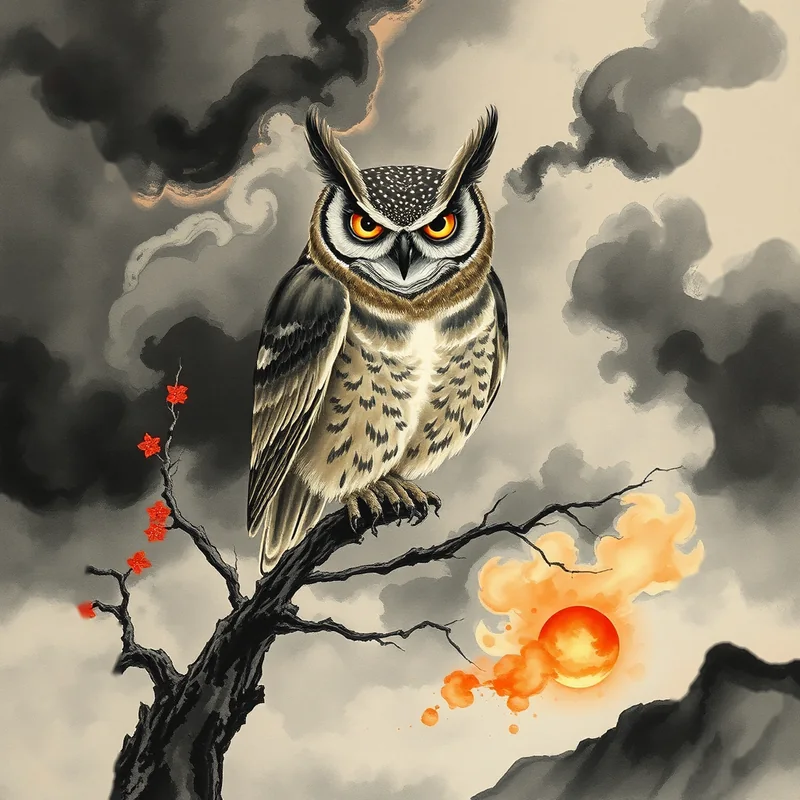
Mount Lingqiu has no plants and much fire. A bird lives there like an owl, with a human face, four eyes, and ears. Its name is Yong, and its cry is its own name. When it appears, the world suffers drought.
Original & Translations
南山经曰:又东四百里,曰令丘之山,无草木,多火。其南有谷焉,曰中谷,条风自是出。有鸟焉,其状如枭,人面四目而有耳,其名曰颙,其鸣自号也,见则天下大旱。
令丘之山,没有草木,多火。
"多火"是什么火?
第一种,火山。岭南有火山:雷州半岛的湖光岩,是几十万年前火山喷发留下的玛珥湖;海南岛北部有大片玄武岩台地。火山地区地表温度高,有硫气,草木难生。
第二种,天然气。地下天然气沿裂隙渗出,遇到雷击或者自燃,会形成常年不灭的火苗。四川自贡的火井,从汉代烧到清代。
第三种,磷火。沼泽地的磷化氢自燃,夜里一片蓝绿色的火,不烧草木。
"无草木,多火",最像前两种的叠加:一处地热区。
然后是"其南有谷焉,曰中谷,条风自是出"。
条风,是东北风。《淮南子·天文训》说:距日冬至四十五日,条风至。条风是立春前后的风,也叫融风,是春天的第一阵风。
一个山谷,常年往外吹风。
这在气象上叫山谷风,或者洞穴风。山体内部有大型溶洞或者裂隙,洞内温度稳定,洞外温度变化,空气就在洞口进出。夏天洞外热,冷空气从洞里流出;冬天反过来。如果洞口朝向合适,一年四季都在出风。
古人站在谷口,感到风从地底吹上来,就记下了:条风自是出。
然后是鸟。
"其状如枭",像猫头鹰。
"人面",脸像人。鸮的面盘是平的,两只眼睛朝前,这个结构在所有鸟类里是唯一的。它看起来像一张脸。
"四目",四只眼睛。
鸮只有两只眼睛。四只从哪里来?
看一只长耳鸮的正面。面盘上有两个深色的眼窝,每个眼窝外有一圈浅色的羽缘,浅色外面又是一圈深色。在昏暗的光线下,这一圈一圈的明暗交替,会读成眼睛旁边还有眼睛。
另一个解释更直接:鸮有瞬膜。眨眼的时候,眼球表面被一层半透明的膜盖住,眼睛变成两个白色的圆。睁眼是黑的,闭眼是白的——一只鸟,两副眼睛。
"有耳",鸮的耳是耳羽簇,两撮竖起来的羽毛,不是耳朵。真正的耳孔在面盘两侧,被羽毛盖住,而且左右不对称:左耳孔常常比右耳孔高,形状也不同。这种不对称是为了定位声音——声音到达两耳的时间差和强度差,让它在全黑的夜里能定位一只老鼠,误差不超过一度。
最后一句:"见则天下大旱。"
鸮和大旱,有什么关系?
鸮吃老鼠。旱年,鼠类向有水的谷地集中,鸮也跟着集中。一个村子里,平时听不见的鸮叫,旱年突然夜夜都有。
还有一层:旱年晴空无云,夜里地面辐射降温快,空气层结稳定,声音传得特别远。同样的叫声,旱年能传三公里,湿年只能传一公里。
所以"见则大旱"不是预报,是共现。鸮不是旱的原因,是旱的见证者——它跟着老鼠来,老鼠跟着水来。
《山海经》里"见则大旱"的动物不止颙一个。旱魃、肥遗、蠃鱼,都是。这些条目共享同一个结构:一个在旱年变得显眼的动物,被记成了旱的征兆。
古人没有错。他们只是把"同时发生"读成了"因此发生"。
而我们今天做的,是反过来:看见旱,想起那只鸟。
The Classic of Southern Mountains: four hundred li east is Mount Lingqiu. No grass, no trees, much fire. South of it is a valley called Zhonggu, and from it the Tiao wind blows. A bird lives there shaped like an owl, with a human face, four eyes, and ears. Its name is Yong, and its cry is its own name. When it appears, the world suffers drought.
Mount Lingqiu: nothing grows, and there is much fire.
What fire?
First, volcanic. There are volcanoes in Lingnan: Huguangyan on the Leizhou peninsula is a maar lake left by an eruption hundreds of thousands of years ago, and northern Hainan is a basalt plateau. In volcanic country the ground is warm, sulfurous, and hostile to plants.
Second, natural gas. Gas seeps up through fissures and, struck by lightning or spontaneously ignited, burns for centuries. The fire wells of Zigong in Sichuan burned from the Han to the Qing.
Third, marsh gas. Phosphine ignites over wetlands at night as sheets of blue-green flame that burn nothing.
"No plants, much fire" most resembles the first two together: a geothermal field.
Then: "south of it is a valley called Zhonggu, and from it the Tiao wind blows."
The Tiao wind is the northeast wind. The Huainanzi says: forty-five days from the winter solstice, the Tiao wind arrives. It is the wind around the beginning of spring, also called the thaw wind — the first wind of the year.
A valley that blows outward, all year.
Meteorology calls it mountain-valley wind, or cave wind. A large karst chamber or fissure inside the mountain holds a stable temperature; outside, the temperature swings; air moves in and out of the mouth. In summer the outside is hot and cool air flows out of the cave; in winter it reverses. With the right orientation, the cave breathes all year.
Standing at the mouth and feeling wind rise out of the ground, the ancients wrote: from here the Tiao wind blows.
Then the bird.
"Shaped like an owl."
"Human face." An owl's facial disc is flat and its eyes face forward — a structure unique among birds. It reads as a face.
"Four eyes."
An owl has two. Where do four come from?
Look at a long-eared owl head-on. The facial disc has two dark eye sockets; around each socket a ring of pale feathers, and outside that another dark ring. In poor light, that alternation of light and dark reads as an eye beside an eye.
A more direct explanation: the nictitating membrane. When an owl blinks, a translucent membrane slides over the eye and the eye becomes a white disc. Open, black; closed, white — one bird, two sets of eyes.
"And ears." An owl's "ears" are ear tufts, two erect feather clusters, not ears. The real ear openings sit at the sides of the facial disc under the feathers, and they are asymmetrical: the left opening is usually higher than the right and differently shaped. The asymmetry is for sound localization — the difference in arrival time and intensity between the two ears lets an owl place a mouse in total darkness to within a degree.
Then the last clause: "when it appears, the world suffers drought."
What do owls have to do with drought?
Owls eat rodents. In a drought year, rodents concentrate around the valleys that still hold water, and the owls concentrate with them. A village that never heard an owl suddenly hears one every night.
And another layer: in a drought the sky is clear, the ground radiates heat away after dark, the air column is stable, and sound carries unusually far. The same call that travels one kilometre in a wet year travels three in a dry one.
So "when it appears, drought" is not prediction. It is co-occurrence. The owl is not the cause of drought; it is a witness to it — it follows the rats, and the rats follow the water.
Yong is not the only drought animal in the book. The drought demon, the Feiyi snake, the Yingyu fish — all carry the same clause. They share one structure: an animal that becomes conspicuous in a dry year gets recorded as a sign of drought.
The ancients were not wrong. They read "happens together" as "happens because."
What we do now is the reverse: we see the drought, and remember the bird.
เขาหลิงชิว "ไม่มีต้นไม้ มีไฟมาก" ทางใต้มีหุบเขาชื่อจงกู่ ลมเถียวพัดออกมาจากที่นั่น
"ไฟมาก" อาจเป็นภูเขาไฟ แก๊สธรรมชาติที่ผุดขึ้นมาและติดไฟ หรือฟอสฟอรัสในบึงที่ลุกเป็นเปลวสีเขียว
ลมเถียวคือลมตะวันออกเฉียงเหนือ ลมแรกของฤดูใบไม้ผลิ หุบเขาที่พัดลมออกมาตลอดปีคือ "ลมถ้ำ" — อากาศในโพรงถ้ำอุณหภูมิคงที่ ต่างจากภายนอก จึงไหลเข้าออกที่ปากถ้ำ
นก: "คล้ายนกเค้า หน้าเป็นคน สี่ตา มีหู"
"หน้าเป็นคน" = จานหน้านกเค้าแบน ตาสองข้างหันไปข้างหน้า เหมือนใบหน้า
"สี่ตา" = วงขนสว่างสลับมืดรอบเบ้าตา อ่านเป็นตาเพิ่มอีกคู่ หรือเยื่อตาที่พอกระพริบแล้วตากลายเป็นวงขาว
"มีหู" = ขนหูสองกระจุก ไม่ใช่หูจริง รูหูจริงซ่อนใต้ขนและสองข้างไม่สมมาตร เพื่อระบุตำแหน่งเสียงในความมืด
"เห็นเมื่อไรโลกแล้ง": ปีแล้ง หนูรวมตัวใกล้แหล่งน้ำ นกเค้าก็ตามมา และท้องฟ้าโปร่งทำให้เสียงดังไปไกล
นกเค้าไม่ได้ทำให้แล้ง มันเป็นพยานของความแล้ง
Gunung Lingqiu "tiada tumbuhan, banyak api". Di selatannya ada lembah Zhonggu, dan dari situ angin Tiao bertiup.
"Banyak api" mungkin gunung berapi, gas asli yang meresap dan terbakar, atau fosfin paya yang menyala hijau biru.
Angin Tiao ialah angin timur laut, angin pertama musim bunga. Lembah yang menghembus keluar sepanjang tahun ialah "angin gua": suhu dalam gua stabil, luar berubah, jadi udara masuk keluar di mulut gua.
Burung: "seperti burung hantu, muka manusia, empat mata, bertelinga."
"Muka manusia": cakera muka burung hantu rata, dua mata menghadap ke depan — seperti wajah.
"Empat mata": cincin bulu cerah-gelap di sekeliling mata terbaca sebagai sepasang mata tambahan; atau selaput mata yang menjadikan mata bulatan putih.
"Bertelinga": jumbai bulu tegak, bukan telinga. Lubang telinga sebenar di bawah bulu dan tidak simetri, untuk mengesan bunyi dalam gelap.
"Muncul, dunia kemarau": pada tahun kering tikus berkumpul berhampiran air, burung hantu mengikut, dan langit cerah membuat bunyi kedengaran jauh.
Burung hantu bukan penyebab kemarau; ia saksi kemarau.
Núi Linh Khâu "không cây, nhiều lửa". Phía nam có thung lũng Trung Cốc, gió Điều thổi ra từ đó.
"Nhiều lửa" có thể là núi lửa, khí tự nhiên rò rỉ rồi bốc cháy, hoặc phosphine ở đầm lầy cháy xanh.
Gió Điều là gió đông bắc, ngọn gió đầu xuân. Thung lũng thổi gió quanh năm là "gió hang": nhiệt độ trong hang ổn định, ngoài hang thay đổi, không khí ra vào ở cửa hang.
Chim: "như cú, mặt người, bốn mắt, có tai."
"Mặt người": đĩa mặt cú phẳng, hai mắt hướng ra trước — giống một khuôn mặt.
"Bốn mắt": vòng lông sáng tối quanh hốc mắt đọc thành thêm một cặp mắt; hoặc màng mí khi chớp làm mắt thành vòng trắng.
"Có tai": hai túm lông dựng, không phải tai thật. Lỗ tai thật nằm dưới lông và hai bên không đối xứng, để định vị âm thanh trong bóng tối.
"Xuất hiện thì đại hạn": năm hạn, chuột tập trung quanh nước, cú theo chuột, và trời quang khiến tiếng kêu vang xa.
Cú không gây hạn; nó là nhân chứng của hạn.
Gunung Lingqiu "tanpa tumbuhan, banyak api". Di selatannya ada lembah Zhonggu, dan dari situ angin Tiao bertiup.
"Banyak api" mungkin gunung berapi, gas alam yang merembes lalu terbakar, atau fosfin rawa yang menyala hijau biru.
Angin Tiao adalah angin timur laut, angin pertama musim semi. Lembah yang bertiup keluar sepanjang tahun adalah "angin gua": suhu di dalam gua stabil, luar berubah, jadi udara masuk keluar di mulut gua.
Burung: "seperti burung hantu, wajah manusia, empat mata, bertelinga."
"Wajah manusia": cakram wajah burung hantu rata, dua mata menghadap ke depan — seperti wajah.
"Empat mata": cincin bulu terang-gelap di sekitar mata terbaca sebagai sepasang mata tambahan; atau selaput mata yang membuat mata menjadi bulatan putih.
"Bertelinga": jumbai bulu tegak, bukan telinga. Lubang telinga sebenarnya di bawah bulu dan tidak simetris, untuk mendeteksi bunyi dalam gelap.
"Muncul, dunia kemarau": pada tahun kering tikus berkumpul dekat air, burung hantu mengikuti, dan langit cerah membuat bunyi terdengar jauh.
Burung hantu bukan penyebab kemarau; ia saksi kemarau.
Nearby Creatures