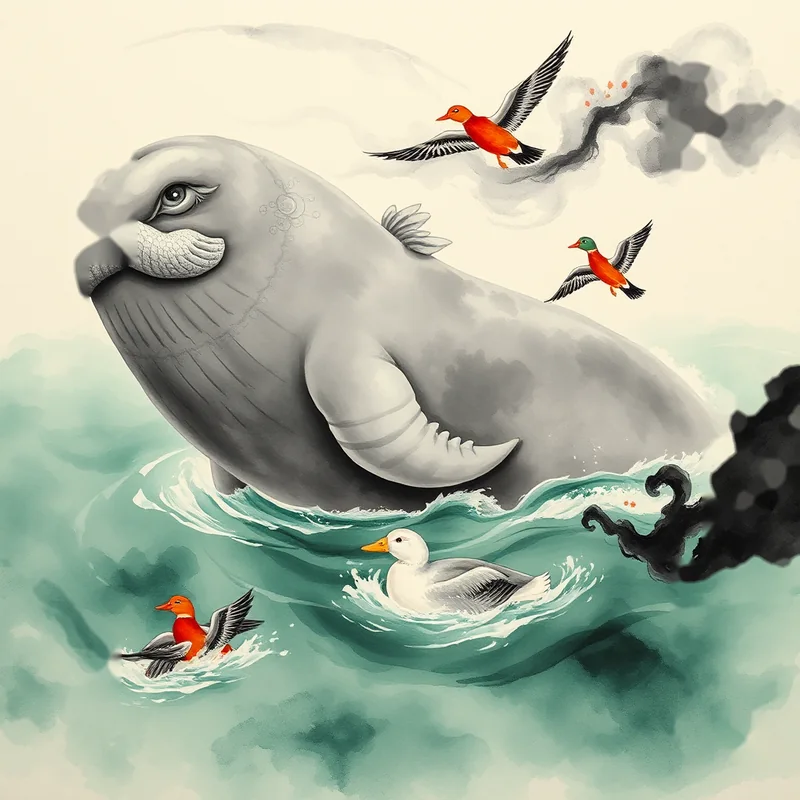
 赤鱬
南山经
《南山经》
赤鱬
Chiru
4.647k南山经
Divine FishHealingMedicine
From Mount Qingqiu flows the Ying River into the Ji-yi marsh. In it are many Chiru: shaped like a fish with a human face, crying like a mandarin duck. Eat them and you will not break out in scabies.
Original & Translations
南山经曰:又东三百里,曰青丘之山,其阳多玉,其阴多青雘。有兽焉,其状如狐而九尾……英水出焉,南流注于即翼之泽。其中多赤鱬,其状如鱼而人面,其音如鸳鸯,食之不疥。
青丘之山,就是九尾狐住的那座山。一条英水从山里出来,往南流进即翼之泽。
赤鱬住在那片水里。
先看"人面"。一条鱼,怎么会长人脸?
如果按字面理解,永远画不出来。但中国东南沿海真的有一种动物,被历代水手叫作"人鱼",而且它的脸,从水里看确实是"人面"。
儒艮。海牛目,体长三米,体重四百公斤。它浮到水面呼吸的时候,头是抬起来的,吻部朝下,眼睛小,脸圆而平——那个角度,从船上往下看,是一张朝上仰着的、没有表情的人脸。
更关键的是它抱孩子的方式。儒艮是哺乳动物,幼崽出生后,母兽会用一侧胸鳍把幼崽拢在胸前,浮到水面喂奶。它浮水的姿态是直立的,上半身露出水面,一只前鳍搂着一个小的。
古代的水手看见这个,会怎么记?
——鱼的身体,人的脸,怀里抱着孩子。
这就是"人鱼"的全部来源。不是想象,是目击。而且这个目击,从红海到南海,从古希腊到中国,独立发生过很多次。欧洲的水手叫它 siren,中国的水手叫它人鱼。
再看"其音如鸳鸯"。鸳鸯的叫声是什么样的?短促、清亮、带一点鼻音的"咕咕"。
儒艮会叫。它发出的声音是短促的哨音和颤音,在水面上听起来,确实像水鸟。而且它呼吸的时候,喷出的气会发出一声短促的"噗"。
然后是"赤"。儒艮的皮肤是灰褐色的,但老年个体背部常附着一层红褐色的寄生藻,在阳光下泛红。另外,它被切开以后,肉是暗红的——像牛肉,不像鱼。
最后是"食之不疥"。
疥,是疥疮,一种由疥螨引起的皮肤病,传染性极强,在渔民和船工中非常普遍——因为潮湿、拥挤、共用衣物。
儒艮的脂肪和肝脏富含维生素 A 和 D。维生素 A 缺乏会引起皮肤角化,加重皮肤病;鱼肝油治皮肤病,是全世界沿海民族的共同经验。
所以"食之不疥"不是巫术,是营养学:吃这种海兽的脂肪,皮肤会好。
一条鱼、一张人脸、一个抱孩子的姿势、一身能治皮肤病的脂肪。四个特征,全部对应得上。
而儒艮今天的处境是这样的:2022 年,科学家宣布儒艮在中国沿海已功能性灭绝——意思是,还有零星个体,但已经不足以维持种群。最后一次确切的目击,是 2008 年在海南。
《山海经》写"其中多赤鱬"。
"多"。多到可以当成一味常备药。
两千三百年,从"多"到"功能性灭绝"。
The Classic of Southern Mountains: three hundred li east is Mount Qingqiu, jade on its sunny side, blue pigment on its shady side. A beast lives there, a fox with nine tails... The Ying River issues from it and flows south into the marsh of Jiyi. In that water are many Chiru: shaped like a fish with a human face, crying like a mandarin duck. Eat them and you will not break out in scabies.
Mount Qingqiu is the mountain of the nine-tailed fox. The Ying River comes out of it and runs south into the Jiyi marsh.
Chiru lives in that water.
Start with "human face." How does a fish get a human face?
Read literally, it can never be drawn. But there is an animal on the coasts of southeast Asia that sailors have called a mermaid for millennia, and whose face, seen from the water, genuinely reads as human.
The dugong. Order Sirenia, three metres long, four hundred kilograms. When it surfaces to breathe, it lifts its head; the muzzle points down; the eyes are small; the face is round and flat. From a boat, looking down, that is an upturned human face with no expression.
More importantly, the way it holds its young. The dugong is a mammal. After the calf is born, the mother gathers it against her chest with one flipper and rises to the surface to nurse. She floats upright, upper body out of the water, one flipper around something small.
What would an ancient sailor write down?
A fish's body, a human face, a child in its arms.
That is the entire origin of the mermaid. Not invention — sighting. And the sighting has happened independently from the Red Sea to the South China Sea, from Greek sailors to Chinese ones. The Greeks called it a siren. The Chinese called it a man-fish.
Then "cries like a mandarin duck." What does a mandarin duck sound like? Short, clear, faintly nasal.
Dugongs vocalize. They produce short whistles and trills that carry over water and do sound like waterfowl, and when they blow, the breath makes a brief flatulent report.
Then "red." Dugong skin is grey-brown, but older animals carry a film of red-brown algae on the back that glows reddish in sun. And cut open, the flesh is dark red — like beef, not like fish.
Finally, "eat it and you will not break out in scabies."
Scabies is a skin infestation by a mite, highly contagious, and extremely common among fishermen and boat crews — damp, crowded, shared clothing.
Dugong fat and liver are rich in vitamins A and D. Vitamin A deficiency causes skin keratinization and worsens dermatitis; fish-liver oil as a treatment for skin disease is a shared experience of every coastal people on earth.
So "eat it and you will not break out" is not magic. It is nutrition: eat this sea mammal's fat and your skin improves.
A fish, a human face, a nursing posture, a fat that cures skin disease. Four features, all of them check out.
And here is where the dugong stands now: in 2022 scientists declared it functionally extinct in Chinese waters — meaning a few individuals may remain, but not enough to sustain a population. The last confirmed sighting was in 2008, off Hainan.
The Shanhaijing says: in that water are many Chiru.
Many. Enough to prescribe as a standing medicine.
Twenty-three hundred years, from "many" to "functionally extinct."
เขาชิงชิว (ภูเขาของจิ้งจอกเก้าหาง) มีแม่น้ำอิงไหลลงหนองจี้ยี้ ในน้ำมี "ชื่อหรู" มาก
"ตัวเป็นปลา หน้าเป็นคน ร้องเหมือนเป็ดแมนดาริน กินแล้วไม่เป็นหิด"
สัตว์นี้คือ "พะยูน" (dugong) เวลาขึ้นมาหายใจ หัวเชิดขึ้น หน้าสั้นกลม มองจากเรือเห็นเป็น "หน้ามนุษย์" และเวลาอุ้มลูก มันใช้ครีบอกโอบลูกไว้ที่อก ลอยตัวตั้งขึ้นครึ่งตัว — ภาพเดียวกับ "เงือก"
"ร้องเหมือนเป็ด" ก็จริง พะยูนส่งเสียงผิวปากสั้น ๆ คล้ายนกน้ำ
"กินแล้วไม่เป็นหิด" — ไขมันและตับพะยูนมีวิตามิน A กับ D สูง โรคผิวหนังจากขาดวิตามิน A พบบ่อยในชาวประมง
แต่วันนี้ พ.ศ. 2565 นักวิทยาศาสตร์ประกาศว่าพะยูน "สูญพันธุ์เชิงหน้าที่" ในน่านน้ำจีนแล้ว
Gunung Qingqiu (gunung rubah sembilan ekor) melahirkan Sungai Ying yang mengalir ke paya Jiyi. Di dalamnya banyak "Chiru".
"Bentuk ikan, muka manusia, bunyi seperti itik mandarin. Makan, tidak kena kudis."
Haiwan ini ialah duyung (dugong). Bila naik bernafas, kepalanya tegak, muka bulat pendek — dari perahu nampak seperti "muka manusia". Bila menyusukan anak, ia memeluk anak dengan sirip dada dan terapung tegak — sama seperti gambaran "orang ikan".
"Bunyi seperti itik" pun betul: dugong mengeluarkan siulan pendek seperti burung air.
"Makan, tidak kena kudis" — lemak dan hati dugong kaya vitamin A dan D; penyakit kulit akibat kurang vitamin A lazim di kalangan nelayan.
Tetapi pada 2022 saintis mengisytiharkan dugong "pupus secara fungsi" di perairan China.
Núi Thanh Khâu (núi của cáo chín đuôi) có sông Anh chảy vào đầm Tức Dực. Trong đó nhiều "Xích Nhu".
"Mình cá, mặt người, kêu như uyên ương. Ăn vào không bị ghẻ."
Loài này là bò biển (dugong). Khi nổi lên thở, đầu ngẩng, mặt tròn ngắn — nhìn từ thuyền giống "mặt người". Khi cho con bú, nó ôm con bằng vây ngực, nổi thẳng đứng — đúng như hình ảnh "người cá".
"Kêu như vịt" cũng đúng: bò biển phát ra tiếng huýt ngắn như chim nước.
"Ăn vào không bị ghẻ" — mỡ và gan bò biển giàu vitamin A, D; bệnh da do thiếu vitamin A phổ biến ở ngư dân.
Nhưng năm 2022, các nhà khoa học tuyên bố bò biển đã "tuyệt chủng về chức năng" ở vùng biển Trung Quốc.
Gunung Qingqiu (gunung rubah sembilan ekor) melahirkan Sungai Ying yang mengalir ke rawa Jiyi. Di dalamnya banyak "Chiru".
"Bentuk ikan, wajah manusia, bunyi seperti bebek mandarin. Makan, tidak kena kudis."
Hewan ini adalah duyung (dugong). Saat naik bernapas, kepalanya tegak, wajah bulat pendek — dari perahu tampak seperti "wajah manusia". Saat menyusui anak, ia memeluk anak dengan sirip dada dan terapung tegak — persis gambaran "orang ikan".
"Bunyi seperti bebek" juga benar: dugong mengeluarkan siulan pendek seperti burung air.
"Makan, tidak kena kudis" — lemak dan hati dugong kaya vitamin A dan D; penyakit kulit akibat kurang vitamin A lazim di kalangan nelayan.
Tetapi pada 2022 ilmuwan menyatakan dugong "punah secara fungsi" di perairan Tiongkok.
Nearby Creatures