 窫窳
西山经
《海内西经》
窫窳
Yayu
4.867k西山经
BeastMan-eaterImmortalityRebirth
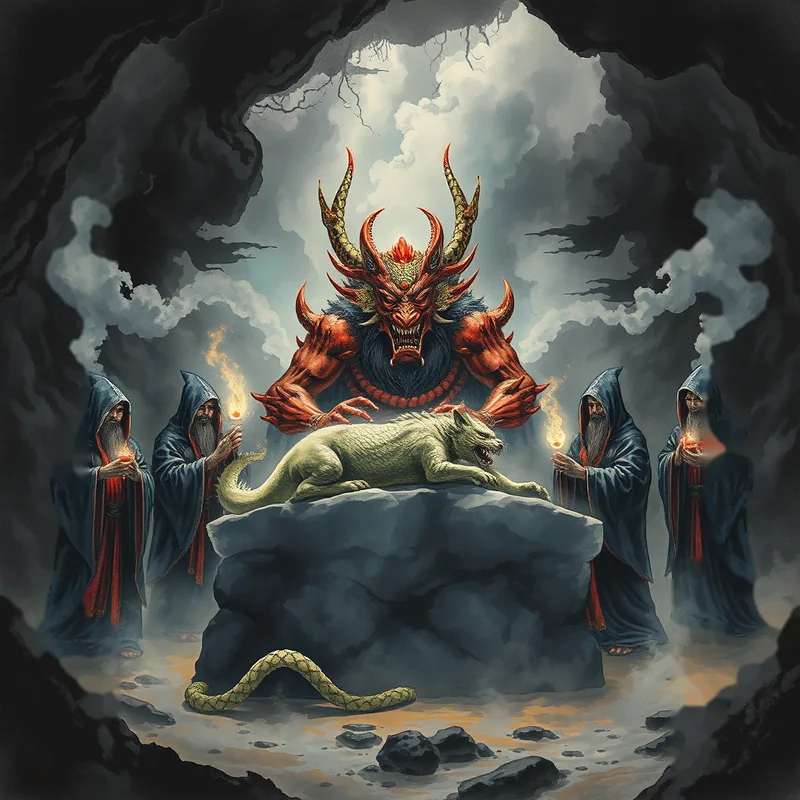
Wei, servant of Erfu, killed Yayu together with his master. The Emperor shackled them on Mount Shushu. East of Kaiming, six shamans stand around the corpse of Yayu, each holding the drug of no death, holding it back.
Original & Translations
海内西经曰:贰负之臣曰危,危与贰负杀窫窳。帝乃梏之疏属之山,桎其右足,反缚两手与发,系之山上木。
又说:开明东有巫彭、巫抵、巫阳、巫履、巫凡、巫相,夹窫窳之尸,皆操不死之药以距之。窫窳者,蛇身人面,贰负臣所杀也。
海内南经曰:窫窳龙首,居弱水中,其状如龙首,食人。
把三条拼起来,是一个完整的故事。这个故事,是中国文学里最早的一次复活。
第一步:谋杀。
贰负,是一个神。危,是他的臣。
他们杀了窫窳。
为什么杀?原文没说。这是《山海经》的常态:它记录事件,不记录动机。
第二步:审判。
帝——应该是天帝——把贰负和危抓起来,关在疏属之山。
刑罚的细节非常具体:梏,是手铐;桎,是脚镣;"桎其右足",只锁右脚;"反缚两手与发",把两只手反绑在背后,再把头发也绑上去,系在山上的树上。
这是一个羞辱性的姿势。手反绑,头发被吊起来,头只能往后仰。人被固定在一棵树上,动不了,也低不下头。
汉代画像石里,有一类图像叫"贰负杀窫窳图":两个人,一个被反绑,一个在旁。学者认为画的就是这个场景。
第三步:复活。
这是最奇怪的一步。
开明兽的东边,有六个巫:巫彭、巫抵、巫阳、巫履、巫凡、巫相。
他们围在窫窳的尸体旁边,每个人手里都拿着"不死之药"。
"以距之"。
距,是一个多义字。它可以读作"拒",是阻挡;也可以读作"距",是到达、接近。
如果是"拒",那么六巫是在用不死药阻止尸体腐坏。
如果是"距",那么六巫是在用不死药接近尸体,准备让它复活。
两种读法,指向两个完全不同的故事。
我倾向于后者。因为后面还有一句:窫窳复活了,变成了一个"龙首"或者"蛇身人面"的东西,住在弱水里,吃人。
第四步:变形。
复活之后的窫窳,不是原来的窫窳。
它变成了一个怪物。
这是中国神话里第一次出现"复活是有代价的"这个母题。
后来的所有复活故事,都在重复这个结构:人回来了,但不是原来那个人。
《搜神记》里的韩凭夫妇,死后墓上长树,树根交缠,树枝交错,是复活,但复活的是一棵树。
《牡丹亭》里的杜丽娘,死而复生,但她已经不是那个闺阁小姐,她是一个已经走过一遍阴间的人。
《聊斋》里的许多故事,复活的尸体带着尸气。
而窫窳是最早的一个:它被杀死,被药救回来,回来的时候,头变成了龙的头,或者身子变成了蛇的身子,脸还是人的脸。
一张人脸,配一个不是人的身体。
这就是"不死"的代价:你可以回来,但你回来的地方,不是原来那个位置。
第五步:处决。
窫窳后来的命运,记录在《淮南子》里。
尧的时候,天下有六大害:大风、凿齿、九婴、修蛇、封豨、窫窳。
尧派后羿去处理。后羿"上射十日,而下杀猰貐"。
猰貐,就是窫窳。
所以窫窳死了第二次。
第一次,它是受害者。第二次,它是该被杀的东西。
一个被谋杀的人,被药救活,变成怪物,然后被英雄杀死。
这个故事,比玛丽·雪莱的《弗兰肯斯坦》早了两千多年。
而且它更狠:弗兰肯斯坦的怪物至少还记得自己是谁;窫窳连自己是谁都不记得了,它只剩下一个"食人"的动作。
再说"弱水"。
窫窳住在弱水里。
弱水,是"鸿毛不浮"的水——连羽毛都浮不起来。所有的东西都会沉下去。
所以窫窳住在一个没有人能到达的地方。
一个复活的怪物,被放在一个不可渡的水里。这既是隔离,也是保护。
天帝没有杀它第二次。天帝只是把它放在那里。
这可能是这个故事里最接近"仁慈"的一笔。
最后说那六个巫。
巫彭、巫抵、巫阳、巫履、巫凡、巫相。
六个名字,都是"巫"加一个字。这六个人,在《大荒西经》里也出现过,是"十巫"中的六个,从灵山上下,采百药。
所以六巫不是六个普通人,是一个职业集团:医巫。
中国最早的医生,是巫。
而他们手里拿的"不死之药",是中国文献里第一次出现的"不死药"。
比秦始皇派徐福求药,早了一千多年。
比后羿从西王母那里求药,也早。
而它第一次被使用,是在一具尸体上。
用在一具被谋杀的神的尸体上。
药没有把人救回原样。药只是让尸体站了起来。
这可能是中国医学史上最早的一条"失败病例"记录。
The Classic of the Regions Within the Seas, West: Wei, servant of Erfu, killed Yayu together with Erfu. The Emperor then shackled them on Mount Shushu, fettered the right foot, bound the two hands behind the back together with the hair, and tied them to a tree on the mountain.
And: east of Kaiming are the shamans Wu Peng, Wu Di, Wu Yang, Wu Lü, Wu Fan, and Wu Xiang. They stand around the corpse of Yayu, each holding the drug of no death, holding it back. Yayu was serpent-bodied with a human face, killed by the servant of Erfu.
The southern chapter: Yayu has a dragon's head, lives in the Weak Water, is shaped like a dragon's head, and eats people.
Put the three together and you have a complete story. It is the earliest resurrection in Chinese literature.
Step one: murder.
Erfu is a god. Wei is his servant.
They killed Yayu.
Why? The text does not say. This is normal for the Shanhaijing: it records events, not motives.
Step two: judgment.
The Emperor — presumably the high god — has them seized and shut on Mount Shushu.
The details of the punishment are very specific. A gu is a handcuff; a zhi is a shackle. "Fettered the right foot" — only the right. "Bound the two hands behind the back together with the hair" — hands tied behind, hair tied to the hands, the whole fixed to a tree on the mountain.
It is a humiliating posture. Hands behind, hair hauled up, head forced back. A person fixed to a tree, unable to move and unable to look down.
Among Han reliefs there is a type called "Erfu kills Yayu": two figures, one bound behind, one standing by. Scholars read it as this scene.
Step three: resurrection.
This is the strangest step.
East of the Kaiming beast are six shamans: Wu Peng, Wu Di, Wu Yang, Wu Lü, Wu Fan, Wu Xiang.
They stand around Yayu's corpse. Each holds the drug of no death.
"To hold it back."
Ju is a multivalent character. It can be read as "resist," to block; or as "arrive," to approach.
If "resist," the six are using the drug to stop the corpse from rotting.
If "approach," they are bringing the drug to the corpse, preparing to bring it back.
Two readings, two entirely different stories.
I lean to the second, because of what follows: Yayu revived, and became a thing with a dragon's head, or a serpent's body and a human face, living in the Weak Water, eating people.
Step four: transformation.
The Yayu that came back was not the Yayu that went in.
It came back a monster.
This is the first appearance in Chinese myth of the idea that resurrection has a price.
Every later resurrection story repeats the structure: the person returns, but not as the person.
In the Records of Search for Spirits, Han Ping and his wife die and trees grow from their graves, roots tangled, branches interwoven. That is resurrection, but what resurrects is a tree.
In The Peony Pavilion, Du Liniang dies and returns, but she is no longer the girl of the inner chamber; she is someone who has been through the underworld once.
In Liaozhai, the risen dead carry the smell of the grave.
Yayu is the first: killed, restored by medicine, and restored with a dragon's head, or a serpent's body, and a human face.
A human face on a body that is not human.
That is the price of not dying: you may come back, but you do not come back to the place you left.
Step five: execution.
Yayu's later fate is in the Huainanzi.
In the time of Yao there were six great scourges: the Great Wind, the Toothed, the Nine Infants, the Long Serpent, the Great Boar, and Yayu.
Yao sent Hou Yi. Hou Yi "shot the ten suns above and killed Yayu below."
Yayu died a second time.
The first time, it was a victim. The second time, it was something that had to be killed.
A murdered being, restored by medicine, turned into a monster, and then killed by a hero.
This story predates Mary Shelley's Frankenstein by more than two thousand years.
And it is harsher. Frankenstein's creature at least remembers who it is. Yayu does not. All that is left of it is one action: eating people.
Now the Weak Water.
Yayu lives in the Weak Water.
The Weak Water is water on which even a feather will not float. Everything sinks.
So Yayu lives where no one can reach.
A resurrected monster placed in an uncrossable river. It is quarantine, and it is also protection.
The Emperor did not kill it a second time. The Emperor simply put it there.
That may be the closest thing to mercy in the whole story.
Finally, the six shamans.
Wu Peng, Wu Di, Wu Yang, Wu Lü, Wu Fan, Wu Xiang.
Six names, each "wu" plus one character. These six also appear in the western chapter among the Ten Shamans, who go up and down Mount Ling and gather the hundred herbs.
So they are not six individuals. They are a profession: the shaman-physicians.
The first doctors in China were shamans.
And the "drug of no death" in their hands is the first appearance of such a drug in Chinese literature.
A thousand years before Qin Shi Huang sent Xu Fu to look for it.
Earlier than Hou Yi's elixir from the Queen Mother of the West.
And its first use was on a corpse.
On the corpse of a murdered god.
The drug did not restore him. The drug only made the corpse stand up.
It may be the earliest recorded failed case in Chinese medicine.
เวย ข้าราชบริพารของเอ้อฝู่ ร่วมกับนายสังหารเยี่ยอวี่
จักรพรรดิจองจำทั้งสองบนเขาซูซู่ ใส่กุญแจมือ ใส่ตรวนที่เท้าขวาข้างเดียว มัดมือทั้งสองไพล่หลังพร้อมผม แล้วผูกติดกับต้นไม้บนภูเขา
ทางตะวันออกของไคหมิง หมอผีหกคน — เผิง ตี้ หยาง ลวี่ ฟาน เซียง — ยืนล้อมศพเยี่ยอวี่ แต่ละคนถือ "ยาอมตะ"
"เพื่อกั้นไว้" หรือ "เพื่อเข้าไปหา" — สองความหมาย สองเรื่อง
ถ้าเป็นการกั้น คือป้องกันศพเน่า
ถ้าเป็นการเข้าไปหา คือเตรียมชุบชีวิต
เรื่องต่อไปบอกว่าเยี่ยอวี่ฟื้นขึ้นมา แต่ไม่เหมือนเดิม กลายเป็นตัวมีหัวมังกรหรือตัวเป็นงูหน้าเป็นคน อาศัยอยู่ในน้ำอ่อนที่ขนนกก็ลอยไม่ได้ และกินคน
นี่คือเรื่อง "การฟื้นคืนชีพครั้งแรก" ในวรรณกรรมจีน และเป็นครั้งแรกที่บอกว่า การกลับมามีราคา
ต่อมาในคัมภีร์หวนหนานจื่อ เยี่ยอวี่กลายเป็นหนึ่งในหกภัยพิบัติยุคเหยา และถูกโฮ่วอี้สังหารเป็นครั้งที่สอง
ครั้งแรกเป็นเหยื่อ ครั้งที่สองเป็นสิ่งที่ต้องถูกกำจัด
เรื่องนี้เก่ากว่าแฟรงเกนสไตน์กว่าสองพันปี และโหดกว่า เพราะสิ่งมีชีวิตของแฟรงเกนสไตน์ยังจำตัวเองได้ ส่วนเยี่ยอวี่เหลือเพียงอาการเดียว: กินคน
ยาที่ใช้ครั้งแรกในประวัติศาสตร์จีน ถูกใช้กับศพ
ยาไม่ได้คืนคนกลับมาเป็นคนเดิม ยาเพียงทำให้ศพลุกขึ้นยืน
อาจเป็นบันทึก "ผู้ป่วยที่รักษาไม่สำเร็จ" ครั้งแรกของจีน
Wei, hamba Erfu, membunuh Yayu bersama tuannya.
Maharaja merantai mereka di Gunung Shushu: gari di tangan, belenggu pada kaki kanan sahaja, kedua tangan diikat ke belakang bersama rambut, lalu diikat pada pokok di gunung.
Di timur Kaiming, enam dukun — Peng, Di, Yang, Lü, Fan, Xiang — berdiri mengelilingi mayat Yayu, masing-masing memegang "ubat tiada mati".
"Untuk menahan" atau "untuk menghampiri" — dua makna, dua kisah.
Jika menahan: menghalang mayat daripada reput.
Jika menghampiri: bersiap menghidupkan kembali.
Kisah seterusnya: Yayu bangkit, tetapi tidak seperti dahulu. Ia menjadi makhluk berkepala naga atau bertubuh ular bermuka manusia, tinggal di Air Lemah yang tidak dapat menampung bulu pun, dan makan orang.
Inilah "kebangkitan pertama" dalam kesusasteraan Cina, dan kali pertama dikatakan kebangkitan ada harganya.
Kemudian dalam kitab Huainanzi, Yayu menjadi salah satu daripada enam bencana zaman Yao dan dibunuh Hou Yi untuk kali kedua.
Pertama sebagai mangsa. Kedua sebagai sesuatu yang mesti dibunuh.
Kisah ini dua ribu tahun lebih tua daripada Frankenstein, dan lebih kejam: makhluk Frankenstein masih ingat siapa dirinya; Yayu hanya tinggal satu perbuatan — makan orang.
Ubat itu, kali pertama digunakan dalam sejarah Cina, digunakan pada mayat.
Ubat tidak mengembalikan orang itu. Ubat hanya membuat mayat berdiri.
Mungkin ini rekod "kes gagal" terawal dalam perubatan Cina.
Ngụy, bề tôi của Nhị Phụ, cùng chủ giết Dát Vũ.
Thiên Đế gông họ trên núi Sơ Thuộc: còng tay, xiềng chân phải, hai tay trói ra sau cùng tóc, rồi buộc vào cây trên núi.
Phía đông Khai Minh, sáu thầy đồng — Bành, Để, Dương, Lữ, Phàm, Tương — đứng quanh xác Dát Vũ, mỗi người cầm "thuốc bất tử".
"Để ngăn" hay "để đến gần" — hai nghĩa, hai câu chuyện.
Nếu ngăn: giữ xác khỏi phân hủy.
Nếu đến gần: chuẩn bị làm sống lại.
Đoạn sau: Dát Vũ sống lại, nhưng không như cũ. Nó thành sinh vật đầu rồng hoặc mình rắn mặt người, sống trong Nước Yếu mà lông chim cũng không nổi, và ăn thịt người.
Đây là "lần sống lại đầu tiên" trong văn học Trung Hoa, và lần đầu nói rằng sống lại phải trả giá.
Về sau trong Hoài Nam Tử, Dát Vũ thành một trong sáu tai họa thời Nghiêu và bị Hậu Nghệ giết lần thứ hai.
Lần đầu là nạn nhân. Lần hai là thứ phải diệt.
Câu chuyện sớm hơn Frankenstein hơn hai nghìn năm, và tàn nhẫn hơn: sinh vật của Frankenstein còn nhớ mình là ai; Dát Vũ chỉ còn một hành vi — ăn thịt người.
Thuốc ấy, lần đầu được dùng trong lịch sử Trung Hoa, được dùng trên một cái xác.
Thuốc không đưa người ấy trở lại. Thuốc chỉ làm xác đứng dậy.
Có lẽ đây là "ca thất bại" sớm nhất trong y học Trung Hoa.
Wei, hamba Erfu, membunuh Yayu bersama tuannya.
Kaisar merantai mereka di Gunung Shushu: borgol di tangan, belenggu pada kaki kanan saja, kedua tangan diikat ke belakang bersama rambut, lalu diikat pada pohon di gunung.
Di timur Kaiming, enam dukun — Peng, Di, Yang, Lü, Fan, Xiang — berdiri mengelilingi mayat Yayu, masing-masing memegang "obat tiada mati".
"Untuk menahan" atau "untuk mendekat" — dua makna, dua kisah.
Jika menahan: mencegah mayat membusuk.
Jika mendekat: bersiap menghidupkan kembali.
Kisah berikutnya: Yayu bangkit, tetapi tidak seperti dahulu. Ia menjadi makhluk berkepala naga atau bertubuh ular berwajah manusia, tinggal di Air Lemah yang tidak dapat menampung bulu pun, dan makan orang.
Inilah "kebangkitan pertama" dalam sastra Tiongkok, dan kali pertama dikatakan kebangkitan punya harga.
Kemudian dalam kitab Huainanzi, Yayu menjadi salah satu dari enam bencana zaman Yao dan dibunuh Hou Yi untuk kedua kalinya.
Pertama sebagai korban. Kedua sebagai sesuatu yang harus dibunuh.
Kisah ini dua ribu tahun lebih tua dari Frankenstein, dan lebih kejam: makhluk Frankenstein masih ingat siapa dirinya; Yayu hanya tersisa satu perbuatan — makan orang.
Obat itu, pertama kali dipakai dalam sejarah Tiongkok, dipakai pada mayat.
Obat tidak mengembalikan orang itu. Obat hanya membuat mayat berdiri.
Mungkin ini catatan "kasus gagal" paling awal dalam pengobatan Tiongkok.
Nearby Creatures