 钦原
西山经
《西山经》
钦原
Qinyuan
4.755k西山经
Divine BirdKunlunEvil BeastGuardian
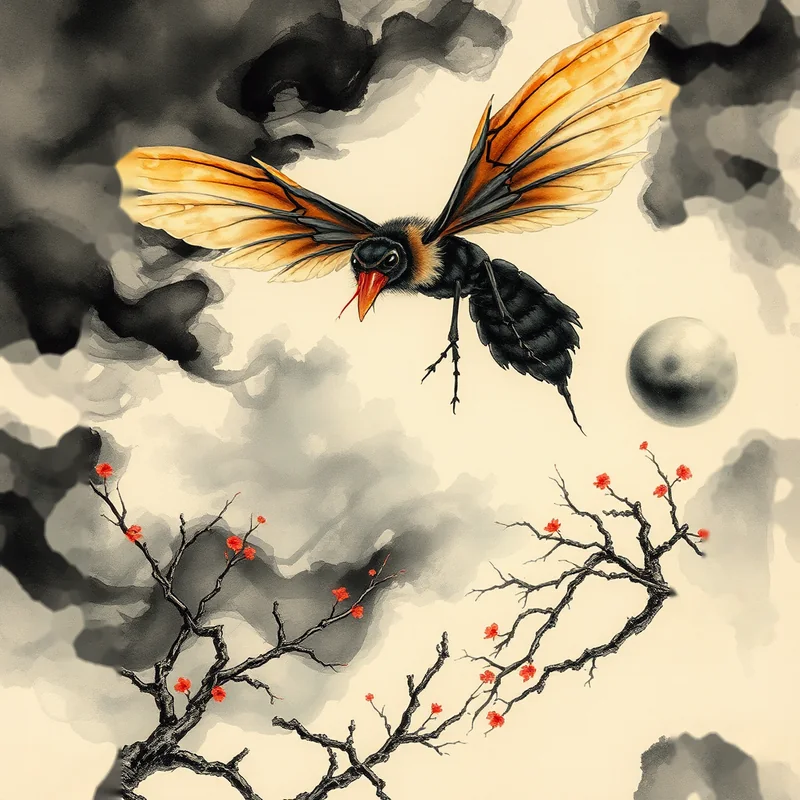
On the mound of Kunlun lives a bird shaped like a bee, the size of a mandarin duck. Its name is Qinyuan. It stings birds and beasts to death, and stings trees until they wither.
Original & Translations
西山经曰:西南四百里,曰昆仑之丘,是实惟帝之下都,神陆吾司之。其神状虎身而九尾,人面而虎爪;是神也,司天之九部及帝之囿时。有兽焉,其状如羊而四角,名曰土蝼,是食人。有鸟焉,其状如蜂,大如鸳鸯,名曰钦原,蠚鸟兽则死,蠚木则枯。
昆仑之丘。帝之下都。陆吾守着。
这是《山海经》里等级最高的一座山。不是最高的山,是最重要的山——天帝在人间的都城,就设在这里。
而这座山上,有三种生物:土蝼(四角羊,吃人)、钦原(蜂形鸟,蜇死一切)、以及一大堆怪鸟兽。
先看钦原。
"其状如蜂,大如鸳鸯"——形状像蜂,大小像鸳鸯。鸳鸯体长约四十厘米。
一只四十厘米长的蜂。
这不是蜂。这是胡蜂,而且是放大到极致的胡蜂。
中国的胡蜂,最大的种类(金环胡蜂,Vespa mandarinia)蜂王体长约五厘米,工蜂四厘米。四十厘米,是它的十倍。
但"蠚鸟兽则死,蠚木则枯"这两个后果,是真实的。
先说"蠚鸟兽则死"。金环胡蜂的毒液,含有大量蜂毒肽和神经毒素。一只金环胡蜂的毒量,足以杀死一只老鼠;几十只同时攻击,可以杀死一头牛。在陕西、四川、广西,每年都有人被金环胡蜂蜇死的记录。2013 年陕西三地连续发生胡蜂袭人事件,死亡四十余人。
所以"蠚鸟兽则死",是准确的。
然后是"蠚木则枯"。这一句更奇怪。蜂蜇树,树会枯?
蜂不蜇树。但胡蜂会啃树。
金环胡蜂筑巢,材料是树皮。它用上颚刮下树皮纤维,混着唾液嚼成纸浆,一层一层糊成巢。一个大型蜂巢,需要刮掉大量树皮。
如果一群胡蜂在一棵树上筑巢,反复刮同一片树皮,那棵树的输导组织会被破坏,枝条会枯死。
还有一种情况:胡蜂喜欢在树干上啃咬,吸食树液,尤其是秋季。被反复啃咬的树,伤口感染,也会枯。
所以"蠚木则枯"不是"蜇",是"啃"。古人用"蠚"这个字,可能只是因为他们看见的是"蜂碰到树,树死了",中间的过程看不清。
现在回到昆仑。
为什么天帝的都城上,住着一只巨蜂?
因为昆仑是一个"边界"。
《山海经》里的昆仑,不是一座普通的山,是一个"不可进入"的地方。它周围有水(弱水),有火(炎火之山),有吃人的兽(土蝼),有蜇人的蜂(钦原)。
这三样东西,功能是一样的:阻止人靠近。
弱水,是浮不起来的河。炎火之山,是烧不完的火。土蝼,是吃人的羊。钦原,是蜇死一切的蜂。
一层一层,从"过不去"到"进不去"到"活不了"。
这是一个防御系统。
而防御系统的核心,是陆吾。虎身九尾,人面虎爪,司天之九部及帝之囿时——管天上的九个区域,和天帝园圃的时节。
所以昆仑的配置是这样的:外圈是地理障碍(弱水、火山),中圈是生物障碍(土蝼、钦原),内圈是神(陆吾)。
钦原是第二道防线。
一只四十厘米长的蜂,悬在昆仑的山道上。它不主动攻击,但任何靠近的东西,它都会蜇。
这个形象,比任何门神都有效。因为门神是画出来的,蜂是真的。
而"钦原"这个名字,"钦"是敬,是威严;"原"是原野、是本源。
一只让人敬畏的、来自本源的蜂。
昆仑山下的人,大概一辈子都没上去过。他们只知道:那上面有蜂,很大,碰到就死。
这句话,传了三千年。
The Classic of Western Mountains: four hundred li southwest is the mound of Kunlun. This is truly the lower capital of the High God, and the god Luwu governs it. That god has a tiger's body and nine tails, a human face and tiger's claws; he administers the nine divisions of heaven and the seasons of the god's parks. A beast lives there shaped like a sheep with four horns, named Tulou, and it eats people. And a bird, shaped like a bee, the size of a mandarin duck, named Qinyuan: it stings birds and beasts to death, and stings trees until they wither.
The mound of Kunlun. The lower capital of the High God. Luwu keeps it.
This is the highest-ranked mountain in the Shanhaijing. Not the tallest — the most important. The High God's capital on earth is here.
And on this mountain are three kinds of creature: Tulou, a four-horned sheep that eats people; Qinyuan, a bee-shaped bird that stings everything to death; and a crowd of strange birds and beasts.
Qinyuan first.
"Shaped like a bee, the size of a mandarin duck." A mandarin duck is about forty centimetres long.
A bee forty centimetres long.
That is not a bee. That is a hornet, scaled to the limit.
China's largest hornet, the Asian giant hornet, has queens about five centimetres long and workers four. Forty centimetres is ten times that.
But the two consequences — stings beasts to death, stings trees until they wither — are real.
Take the first. Asian giant hornet venom is rich in mastoparan and neurotoxins. The venom load of one hornet can kill a mouse; a few dozen attacking together can kill a cow. In Shaanxi, Sichuan, and Guangxi there are fatalities every year. In 2013, a series of hornet attacks across three prefectures in Shaanxi killed more than forty people.
So "stings beasts to death" is accurate.
Then "stings trees until they wither." This is stranger. A bee stings a tree and the tree dies?
Bees do not sting trees. But hornets chew them.
The Asian giant hornet builds its nest from bark. It scrapes fibre off a trunk with its mandibles, chews it with saliva into paper pulp, and layers it into comb. A large nest consumes a great deal of bark.
A colony nesting in one tree, scraping the same patch repeatedly, will destroy the conductive tissue, and the branch dies.
There is also the fact that hornets gnaw at trunks to drink sap, especially in autumn. Repeated wounding invites infection, and the tree declines.
So "stings trees until they wither" is not stinging. It is gnawing. The ancients used the word for stinging because what they saw was: hornet touches tree, tree dies. The middle of the process was invisible.
Now back to Kunlun.
Why does a giant hornet live on the High God's capital?
Because Kunlun is a boundary.
Kunlun in the Shanhaijing is not an ordinary mountain. It is a place that cannot be entered. Around it are water — the Weak River, which will not float you — and fire — the Mountain of Flaming Fire — and man-eating beasts, and stinging insects.
All three do the same job: keep people out.
The Weak River, a river you cannot float on. The Flaming Mountain, a fire that does not go out. Tulou, a sheep that eats people. Qinyuan, a wasp that kills whatever it touches.
Layer by layer: cannot cross, cannot enter, cannot survive.
It is a defence system.
And the core of the system is Luwu. Tiger body, nine tails, human face, tiger claws; he administers the nine divisions of heaven and the seasons of the god's parks.
So Kunlun is arranged like this: an outer ring of geography (weak water, burning mountain), a middle ring of biology (Tulou, Qinyuan), and at the centre, a god.
Qinyuan is the second line.
A hornet forty centimetres long, hanging over the path up Kunlun. It does not attack. But anything that comes close, it stings.
That figure is more effective than any door god, because a door god is painted and a hornet is real.
And the name: qin means reverence, awe; yuan means plain, or source.
An awe-inspiring wasp, from the source.
The people below Kunlun probably never went up. They knew only this: there are bees up there, very big, and if they touch you, you die.
The sentence has lasted three thousand years.
เนินเขาคุนหลุน = "เมืองล่างของเทพสูงสุด" มีเทพหลู่หวู (ตัวเสือเก้าหาง หน้าคน เล็บเสือ) เฝ้าอยู่
นี่คือภูเขาที่สำคัญที่สุดในซานไห่จิง ไม่ใช่สูงที่สุด แต่เป็นเมืองหลวงของเทพบนโลก
บนนั้นมี: ถู่โหลว (แกะสี่เขา กินคน) และ ชินหยวน (นก/ผึ้ง ตัวใหญ่เท่าเป็ดแมนดาริน ~40 ซม.)
ผึ้ง 40 ซม. ไม่ใช่ผึ้ง แต่เป็นต่อหัวเสือ (hornet) ที่ขยายใหญ่สุด
"ต่อยสัตว์ตาย" จริง: ต่อหัวเสือเอเชีย (Vespa mandarinia) พิษแรงมาก ปี 2013 ที่ฉ่านซีมีคนตายกว่า 40 คน
"ต่อยต้นไม้ต้นไม้ตาย" — ไม่ใช่ต่อย แต่เป็น "กัด": ต่อหัวเสือขูดเปลือกไม้เป็นวัสดุทำรัง กัดซ้ำ ๆ เปลือกเสีย เนื้อเยื่อท่อน้ำท่ออาหารพัง กิ่งก็ตาย
ทั้งหมดนี้คือ "ระบบป้องกัน" ของคุนหลุน: ชั้นนอกเป็นภูมิศาสตร์ (แม่น้ำอ่อน ภูเขาไฟ) ชั้นกลางเป็นสิ่งมีชีวิต (ถู่โหลว, ชินหยวน) ชั้นในเป็นเทพ (หลู่หวู)
Bukit Kunlun = "ibu kota bawah Dewa Agung", dijaga dewa Luwu (badan harimau, sembilan ekor, muka manusia, cakar harimau).
Ini gunung paling penting dalam Shanhaijing — bukan paling tinggi, tetapi ibu kota dewa di bumi.
Di situ ada: Tulou (kambing empat tanduk, makan orang) dan Qinyuan (burung/lebah sebesar itik mandarin, ~40 cm).
Lebah 40 cm bukan lebah, tetapi tebuan (hornet) yang dibesarkan melampau.
"Sengat haiwan sampai mati" benar: tebuan gergasi Asia (Vespa mandarinia) sangat berbisa; pada 2013 di Shaanxi lebih 40 orang mati.
"Sengat pokok sampai layu" — bukan sengat, tetapi "kunyah": tebuan mengikis kulit kayu untuk sarang; kikisan berulang merosakkan tisu pengangkut, dahan mati.
Semua ini "sistem pertahanan" Kunlun: lapisan luar geografi (sungai lemah, gunung api), lapisan tengah biologi (Tulou, Qinyuan), lapisan dalam dewa (Luwu).
Gò Côn Lôn = "kinh đô dưới của Đế", do thần Lục Ngô (mình hổ, chín đuôi, mặt người, vuốt hổ) trấn giữ.
Đây là núi quan trọng nhất trong Sơn Hải Kinh — không phải cao nhất, mà là kinh đô của Đế ở nhân gian.
Trên đó có: Thổ Lâu (dê bốn sừng, ăn thịt người) và Khâm Nguyên (chim/ong lớn bằng uyên ương, ~40 cm).
Ong 40 cm không phải ong, mà là ong bắp cày (hornet) phóng đại.
"Chích thú thì chết" đúng: ong bắp cày khổng lồ châu Á (Vespa mandarinia) nọc rất mạnh; năm 2013 ở Thiểm Tây hơn 40 người chết.
"Chích cây thì héo" — không phải chích mà là "gặm": ong bắp cày cạo vỏ cây làm tổ; cạo lặp lại phá mô dẫn, cành chết.
Tất cả là "hệ thống phòng thủ" của Côn Lôn: vòng ngoài địa lý (sông nhược, núi lửa), vòng giữa sinh vật (Thổ Lâu, Khâm Nguyên), vòng trong là thần (Lục Ngô).
Bukit Kunlun = "ibu kota bawah Dewa Agung", dijaga dewa Luwu (tubuh harimau, sembilan ekor, wajah manusia, cakar harimau).
Ini gunung terpenting dalam Shanhaijing — bukan tertinggi, tetapi ibu kota dewa di bumi.
Di situ ada: Tulou (kambing empat tanduk, makan orang) dan Qinyuan (burung/lebah sebesar bebek mandarin, ~40 cm).
Lebah 40 cm bukan lebah, tetapi tabuhan (hornet) yang diperbesar ekstrem.
"Menyengat hewan sampai mati" benar: tabuhan raksasa Asia (Vespa mandarinia) sangat berbisa; pada 2013 di Shaanxi lebih 40 orang mati.
"Menyengat pohon sampai layu" — bukan sengat, tetapi "mengunyah": tabuhan mengerik kulit kayu untuk sarang; kerikan berulang merusak jaringan pengangkut, dahan mati.
Semua ini "sistem pertahanan" Kunlun: lapis luar geografi (sungai lemah, gunung api), lapis tengah biologi (Tulou, Qinyuan), lapis dalam dewa (Luwu).
Nearby Creatures