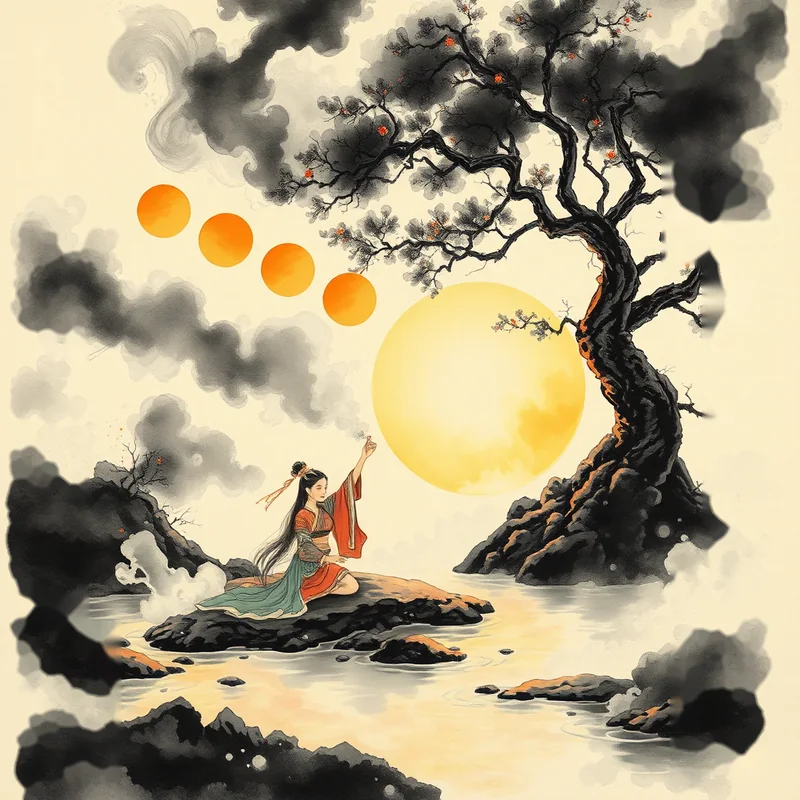
 羲和
东山经
《大荒南经》
羲和
Xihe
4.869k东山经
DeitySunCreationMother
Beyond the southeast sea, among the sweet waters, lies the land of Xihe. A woman there is named Xihe, and she bathes the sun in the Sweet Pool. Xihe is the wife of Di Jun, and she gave birth to ten suns.
Original & Translations
大荒南经曰:东南海之外,甘水之间,有羲和之国。有女子名曰羲和,方日浴于甘渊。羲和者,帝俊之妻,生十日。
十八个字,三个信息。
一,地点:东南海之外,甘水之间。
二,动作:一个叫羲和的女人,正在甘渊里给太阳洗澡。
三,身份:她是帝俊的妻子,她生了十个太阳。
先说"生十日"。
十个太阳。这个数字在古代中国不是随意的。
十天为一旬。一个月分三旬。天干有十:甲乙丙丁戊己庚辛壬癸。十个天干,对应十个太阳,每天一个,轮流值班。
所以"生十日"不是生了十个孩子,是生出了一套历法。
十进位的时间单位,需要一个神话来解释:为什么是十?因为天上有十个太阳,一天出来一个。
再看常羲。《大荒西经》说:"有女子方浴月。帝俊妻常羲,生月十有二,此始浴之。"
常羲生十二个月亮。十二,是地支的数,是一年十二个月,是木星十二年一周天。
一个生十,一个生十二。一个管日,一个管月。一个在东南,一个在西南。
这是中国神话里最整齐的一组对称。
羲和和常羲,是帝俊的两个妻子。她们不做别的事,只做一件事:给天体洗澡。
为什么是洗澡?
因为日出之前,太阳在海里。它从水里出来,身上是湿的。它需要被擦干、被洗净,然后才能升上去。
"甘渊",也叫汤谷、温源谷。《大荒东经》说:"汤谷上有扶木,一日方至,一日方出,皆载于乌。"
汤谷,是热水。太阳从热水里出来。扶木,是扶桑,一棵巨大的树,太阳落在枝上,像鸟一样。
所以在古人的宇宙图景里,日出是这样发生的:
太阳在海面以下的热水里泡了一夜,早上被母亲捞起来,洗干净,放在扶桑树的枝头,然后由一只三足乌背着,从东往西飞。
这是一套完整的、有画面感的、可以讲给小孩听的宇宙论。
而羲和的工作,是这套宇宙论里最温柔的一环。
她不是创世神。她不造天,不造地,不造人。她只负责每天早上的那一次清洗。
一个母亲,天不亮就起来,把孩子从水里捞出来,擦干净,送出门。
十个孩子,轮着来。
然后是"日浴"这两个字。
洗澡这件事,在物理上当然不成立。但如果把它当成一种观察记录呢?
日出的时候,太阳从海平面升起。海面有雾,有水汽,太阳的光穿过水汽,被散射,变成橙红色。太阳的边缘在抖动,像被水波揉过。
一个人站在海边看日出,看到的是:一个发红的东西,从水里出来,湿的,软的,边缘在晃。
"浴"。
这个字,是对日出视觉经验最准确的翻译。
还有一层。太阳表面有黑子。黑子大的时候,肉眼可见——不是直视,是透过雾、透过云、透过水面反光。中国古代有大量黑子记录,《汉书·五行志》"日出黄,有黑气大如钱,居日中央",是世界上最早的黑子记录之一。
如果一个人在日出时看见太阳上有一块黑斑,他会怎么想?
——孩子身上有块没洗掉的污渍。
母亲在洗,但没洗干净。
这个联想,把"日浴"从一个比喻变成了一个日常。
最后说羲和后来的命运。
《尚书·尧典》里,羲和变成了官名:"乃命羲和,钦若昊天,历象日月星辰,敬授人时。"
尧任命羲和,观测天象,制定历法,告诉百姓什么时候播种。
从一个人,变成一个职位。从一个母亲,变成一个部门。
再往后,羲和又变成了神话里的日御——驾太阳车的人。《离骚》"吾令羲和弭节兮,望崦嵫而勿迫",屈原让羲和停下车,别让太阳落得那么快。
从母亲,到官员,到车夫。
这是中国神话人物最常见的三种结局:被官僚化,被工具化,被文学化。
而"生十日"这件事,后来变成了灾难。十个太阳一起出来,庄稼焦了,河流干了,于是有了后羿射日。
十个太阳为什么会一起出来?
因为母亲管不住了。
一个生了十个孩子的女人,终于有一天,孩子们一起跑了出来。
这可能是整个故事里最像人间的一部分。
The Classic of the Great Wilderness, South: beyond the southeast sea, among the sweet waters, lies the land of Xihe. A woman is named Xihe, and she is bathing the sun in the Sweet Pool. Xihe is the wife of Di Jun; she gave birth to ten suns.
Eighteen characters, three pieces of information.
One, the place: beyond the southeast sea, among the sweet waters.
Two, the action: a woman named Xihe is washing the sun in the Sweet Pool.
Three, the identity: she is Di Jun's wife, and she bore ten suns.
Start with "ten suns."
Ten is not an arbitrary number in ancient China.
Ten days make a xun. A month is three xun. There are ten heavenly stems: jia, yi, bing, ding, wu, ji, geng, xin, ren, gui. Ten stems, ten suns, one per day, taking turns on duty.
So "bore ten suns" is not ten children. It is a calendar.
A decimal unit of time needs a myth to explain it: why ten? Because there are ten suns in the sky, and one comes out each day.
Now Changxi. The Classic of the Great Wilderness, West: "A woman is bathing the moon. Di Jun's wife Changxi bore twelve moons, and this is where she first bathed them."
Changxi bore twelve moons. Twelve is the number of earthly branches, of months in a year, of years in Jupiter's circuit.
One bears ten, one bears twelve. One governs days, one governs months. One in the southeast, one in the southwest.
It is the neatest symmetry in Chinese myth.
Xihe and Changxi are the two wives of Di Jun. They do nothing else. They do one thing: bathe celestial bodies.
Why bathing?
Because before sunrise the sun is in the sea. It comes out of the water wet. It must be wiped and washed before it can climb.
The "sweet pool" is also called Tanggu, the Hot Valley, or the Warm Source Valley. The Classic of the Great Wilderness, East: "Above Tanggu stands the Fu Tree; one sun arrives, one sun departs, and all are carried by crows."
Tanggu is hot water. The sun comes out of hot water. The Fu Tree is the fusang, a vast tree where the sun perches like a bird.
So in the ancient cosmos, sunrise happens like this:
The sun soaks all night in hot water below the sea. In the morning its mother lifts it out, washes it, sets it on a branch of the fusang, and a three-legged crow carries it from east to west.
That is a complete, visual, tellable cosmology.
And Xihe's job is its gentlest part.
She is not a creator. She does not make sky, earth, or people. She is responsible for one wash, every morning.
A mother, up before dawn, lifting a child out of the water, drying it, sending it out the door.
Ten children, taking turns.
Then the word "bath."
Bathing the sun is physically impossible. But what if it is an observation record?
At sunrise the sun comes up out of the sea. There is mist, spray, water vapour. Sunlight passes through the vapour and scatters into orange-red. The edge of the disc shimmers, as if kneaded by ripples.
A person standing on the shore sees: a red thing, coming out of the water, wet, soft, its edge wavering.
Bath.
That character is the most exact translation of the visual experience of sunrise.
And another layer. The sun has spots. Large spots are visible to the naked eye — not by staring, but through mist, through cloud, through reflection on water. China has a long record of sunspots: the Han dynastic history notes "the sun rose yellow, with black qi the size of a coin at its centre," one of the earliest sunspot records in the world.
If a person saw a dark patch on the rising sun, what would they think?
The child has a smudge that did not come off.
The mother is washing, but not getting it clean.
That association turns "bathing the sun" from a metaphor into a household chore.
Finally, what became of Xihe.
In the Book of Documents, Xihe becomes an office: "He commanded Xihe, reverently to follow the great heaven, to survey and model the sun, moon, and stars, and respectfully to give the seasons to the people."
Yao appoints Xihe to observe the sky, fix the calendar, and tell the people when to sow.
From a person to a post. From a mother to a department.
Later still, Xihe becomes the charioteer of the sun. In the Li Sao, Qu Yuan says: "I bid Xihe rein in and slow, and gaze on Yanzi and not press on" — stop the chariot, do not let the sun go down so fast.
Mother, official, driver.
Those are the three usual fates of a Chinese mythological figure: bureaucratised, instrumentalised, literary.
And the ten suns became a disaster. All ten came out at once, the crops scorched, the rivers dried, and Hou Yi shot them.
Why did ten suns come out together?
Because the mother lost control.
A woman with ten children, and one day they all ran out at once.
That may be the most human part of the whole story.
นอกทะเลตะวันออกเฉียงใต้ ระหว่างสายน้ำหวาน มีแคว้นซีเหอ
"มีหญิงชื่อซีเหอ กำลังอาบดวงอาทิตย์ในสระหวาน นางคือมเหสีของตี้จวิ้น ให้กำเนิดดวงอาทิตย์สิบดวง"
"สิบดวง" ไม่ใช่ลูกสิบคน แต่คือปฏิทิน สิบวันเป็นหนึ่งรอบ (ซุน) หนึ่งเดือนมีสามรอบ และมี "สิบฟ้า" (เทียนกาน) สิบตัว ตรงกับดวงอาทิตย์สิบดวง ผลัดกันขึ้นวันละดวง
คู่กันคือฉางซี (คัมภีร์ต้าฮวงตะวันตก) ผู้ให้กำเนิดดวงจันทร์สิบสองดวง สิบสองคือจำนวนเดือนในหนึ่งปี และจำนวนกิ่งดินสิบสองตัว
หนึ่งดูแลวัน หนึ่งดูแลเดือน หนึ่งอยู่ตะวันออกเฉียงใต้ หนึ่งอยู่ตะวันตกเฉียงใต้ — สมมาตรที่เรียบร้อยที่สุดในเทพปกรณัมจีน
ทำไมต้อง "อาบน้ำ"? เพราะก่อนดวงอาทิตย์ขึ้น มันอยู่ในทะเล เปียก ต้องเช็ดให้แห้งก่อนขึ้นฟ้า
"สระหวาน" คือ "ถังกู่" น้ำร้อน มีต้นฝูซัง ต้นไม้ยักษ์ที่ดวงอาทิตย์เกาะ และมีอีกาสามขาคอยแบก
การ "อาบ" ยังเป็นการบันทึกสิ่งที่ตาเห็น: ตอนขึ้นจากทะเล มีไอน้ำ แสงแตกกระจายเป็นสีส้มแดง ขอบดวงสั่นไหวเหมือนถูกน้ำยี
และจุดดับบนดวงอาทิตย์ ที่มองเห็นได้ด้วยตาเปล่าผ่านหมอก — เหมือนคราบที่แม่ยังล้างไม่ออก
ต่อมาซีเหอกลายเป็นชื่อตำแหน่งข้าราชการด้านดาราศาสตร์ในคัมภีร์โบราณ และกลายเป็นสารถีรถม้าดวงอาทิตย์ในกวีนิพนธ์
จากแม่ สู่ข้าราชการ สู่คนขับรถ — ชะตากรรมสามแบบของเทพจีน
และวันที่ดวงอาทิตย์ทั้งสิบขึ้นพร้อมกัน ก็คือวันที่แม่คุมลูกไม่อยู่
Di luar laut tenggara, antara air manis, terletak negeri Xihe.
"Seorang wanita bernama Xihe memandikan matahari di Kolam Manis. Xihe isteri Di Jun, dan melahirkan sepuluh matahari."
"Sepuluh" bukan sepuluh anak, tetapi kalendar. Sepuluh hari satu pusingan; sebulan tiga pusingan; ada sepuluh batang langit, sepadan dengan sepuluh matahari yang bergilir satu sehari.
Pasangannya ialah Changxi, yang melahirkan dua belas bulan. Dua belas ialah bilangan bulan dalam setahun dan bilangan cabang bumi.
Satu menjaga hari, satu menjaga bulan; satu di tenggara, satu di barat daya — simetri paling kemas dalam mitos Cina.
Mengapa "memandikan"? Kerana sebelum terbit matahari berada di dalam laut, basah, dan perlu dikeringkan sebelum naik.
"Kolam manis" ialah Tanggu, air panas, dengan pokok Fusang tempat matahari hinggap dan gagak tiga kaki yang membawanya.
"Mandian" juga catatan penglihatan: ketika terbit dari laut ada kabus, cahaya tersebar menjadi jingga merah, tepi bulatan bergetar seperti diuli air.
Dan tompok hitam matahari yang kadang kelihatan melalui kabus — seperti kotoran yang ibu belum basuh habis.
Kemudian Xihe menjadi nama jawatan astronomi dalam kitab klasik, dan kemudian menjadi pemandu kereta matahari dalam puisi.
Ibu, pegawai, pemandu — tiga takdir biasa dewa Cina.
Dan hari sepuluh matahari terbit serentak ialah hari ibu tidak lagi dapat mengawal anak-anaknya.
Ngoài biển đông nam, giữa những dòng nước ngọt, có nước Hy Hòa.
"Một người nữ tên Hy Hòa đang tắm mặt trời trong ao ngọt. Hy Hòa là vợ Đế Tuấn, sinh ra mười mặt trời."
"Mười" không phải mười đứa con, mà là lịch. Mười ngày một tuần; một tháng ba tuần; có mười thiên can, ứng với mười mặt trời thay phiên mỗi ngày một mặt.
Cặp đối xứng là Thường Hy, sinh mười hai mặt trăng. Mười hai là số tháng trong năm và số địa chi.
Một người coi ngày, một người coi tháng; một ở đông nam, một ở tây nam — đối xứng gọn nhất trong thần thoại Trung Hoa.
Vì sao "tắm"? Vì trước khi mọc, mặt trời ở trong biển, ướt, phải lau khô mới lên được.
"Ao ngọt" là Thang Cốc, nước nóng, có cây Phù Tang cho mặt trời đậu và quạ ba chân cõng đi.
"Tắm" cũng là ghi chép thị giác: lúc mọc lên khỏi biển có sương, ánh sáng tán xạ thành đỏ cam, mép đĩa rung như bị nước nhào.
Và vết đen mặt trời đôi khi thấy được qua sương — như vết bẩn mẹ chưa rửa sạch.
Về sau Hy Hòa thành tên chức quan thiên văn trong kinh điển, rồi thành người đánh xe mặt trời trong thơ.
Mẹ, quan, người đánh xe — ba số phận quen thuộc của thần linh Trung Hoa.
Và ngày mười mặt trời cùng mọc là ngày người mẹ không giữ nổi các con.
Di luar laut tenggara, antara air manis, terletak negeri Xihe.
"Seorang wanita bernama Xihe memandikan matahari di Kolam Manis. Xihe istri Di Jun, dan melahirkan sepuluh matahari."
"Sepuluh" bukan sepuluh anak, melainkan kalender. Sepuluh hari satu putaran; sebulan tiga putaran; ada sepuluh batang langit, sepadan dengan sepuluh matahari yang bergiliran satu sehari.
Pasangannya adalah Changxi, yang melahirkan dua belas bulan. Dua belas adalah jumlah bulan dalam setahun dan jumlah cabang bumi.
Satu menjaga hari, satu menjaga bulan; satu di tenggara, satu di barat daya — simetri paling rapi dalam mitos Tiongkok.
Mengapa "memandikan"? Karena sebelum terbit matahari berada di dalam laut, basah, dan perlu dikeringkan sebelum naik.
"Kolam manis" adalah Tanggu, air panas, dengan pohon Fusang tempat matahari hinggap dan gagak tiga kaki yang membawanya.
"Mandian" juga catatan penglihatan: saat terbit dari laut ada kabut, cahaya tersebar menjadi jingga merah, tepi bulatan bergetar seperti diuleni air.
Dan bintik hitam matahari yang kadang terlihat melalui kabut — seperti kotoran yang belum ibu basuh bersih.
Kemudian Xihe menjadi nama jabatan astronomi dalam kitab klasik, lalu menjadi pengendara kereta matahari dalam puisi.
Ibu, pejabat, pengendara — tiga takdir biasa dewa Tiongkok.
Dan hari sepuluh matahari terbit serentak adalah hari ibu tidak lagi dapat mengawal anak-anaknya.
Nearby Creatures