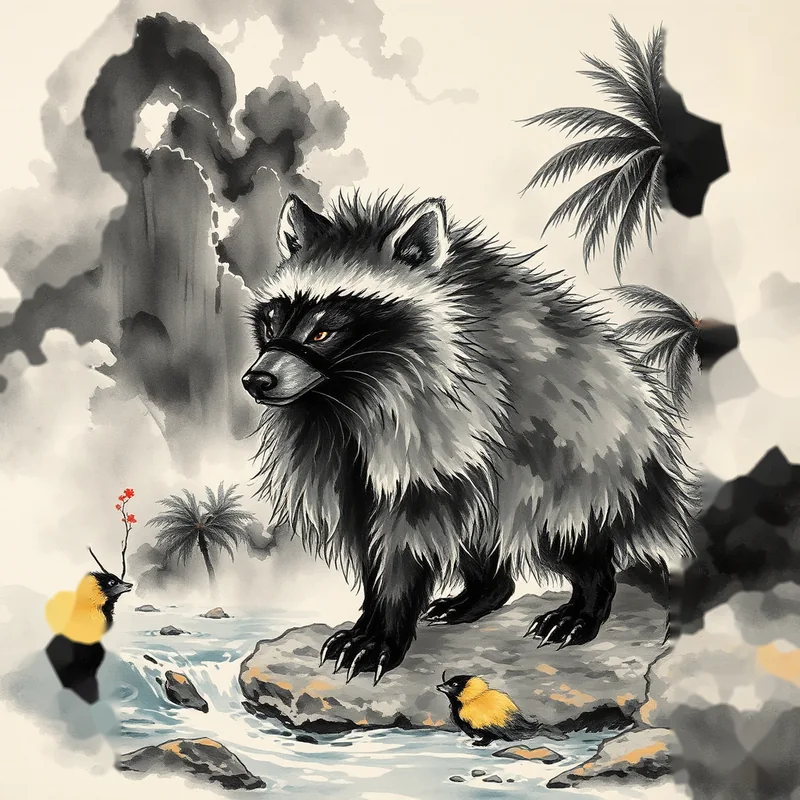
 溪边
西山经
《西山经》
溪边
Xibian
4.123k西山经
BeastProtectionMedicine
On Mount Tiandi lives a beast shaped like a dog, named Xibian. Whoever sleeps on its hide is safe from gu — the poison of crafted curses.
Original & Translations
西山经曰:又西三百五十里,曰天帝之山,多棕枬;下多菅蕙。有兽焉,其状如狗,名曰溪边,席其皮者不蛊。
这条记录极短,但里面有一个字,值得说很久:蛊。
先说溪边。
形状像狗,住在天帝之山。天帝之山在西次一经,从华山往西数,是第十四座山。山上多棕榈和枬木,山下多菅草和蕙兰。
一座有棕榈的山。棕榈在北方不长,这说明天帝之山的位置偏南偏暖,大概在秦岭一带。
溪边。这个名字很朴素:溪水边上的东西。
什么狗住在溪边?
貉。貉是犬科,体型介于狗和浣熊之间,脸有黑色"面罩",毛厚。它喜欢水边,会下水捕鱼、捕蟹、捕蛙。中国的貉分布极广,从东北到华南都有。
还有一种可能:水獭。水獭也是犬形,也住水边,也捕鱼。但水獭的体型更细长,尾巴更粗,古人一般叫"獭"而不叫"狗"。
所以溪边更可能是貉,或者某种野犬。
然后是"席其皮者不蛊"。
席,是名词作动词:把它的皮当席子用。不蛊,是不会中蛊。
"蛊"这个字,是中国古代最阴的一个概念。
它的字形,是"皿"里放着三条虫。本义是器皿里养着的毒虫。
传统的说法是这样的:把五种毒虫(蛇、蜈蚣、蝎子、蟾蜍、蜘蛛)放进一个罐子里,封起来,让它们互相吃。最后活下来的那一个,就是"蛊"。它积累了所有死者的毒,成了最毒的东西。
然后把蛊的粉末下在食物里,人吃了就会得一种怪病:腹痛、消瘦、精神恍惚,最后死。而且传说蛊会认主,主人死了,蛊会反噬。
这套东西,在南方(尤其云南、贵州、湘西)流传极广。直到今天,"放蛊"仍然是民间真实的恐惧。
现在问题是:一张狗皮,为什么能防蛊?
有三个层次的解释。
第一层,最实在的:狗能辨毒。
狗鼻子灵,这是常识。而且狗对变质食物、有毒物质的反应,比人敏感得多。民间一直有"狗试毒"的做法:给狗先吃一口,狗没事人才吃。
一条住在溪边的狗,天天在水边翻找食物,它必须能分辨什么能吃、什么不能吃。这种能力,在古人眼里,就是"能识蛊"。
把这种狗的皮做成褥子,睡在上面,等于把这种能力带在身上。
第二层:气味。
貉和野犬的皮,有极重的气味。这种气味对人来说是臭,对虫蛇来说是驱避。而在古人的观念里,蛊是虫,虫怕这种气味。
第三层,也是最有趣的:温度。
"席其皮"——睡在兽皮上。这不是象征,这是物理。
中国南方的冬天,湿冷。睡在潮湿的地面上,会得什么病?风湿、关节炎、皮肤病。而这些病的症状——关节痛、消瘦、精神萎靡——和"中蛊"的症状,在古人看来是一样的。
一张厚毛的兽皮褥子,隔潮,保暖。睡了不关节痛,不咳嗽,不消瘦。
于是"不蛊"。
所以这句话的真相可能是:一张狗皮褥子,治好了风湿。
古人把"风湿"叫"蛊",把"褥子"叫"御蛊",然后写进《山海经》,记了两千三百年。
而天帝之山,山顶棕榈,山脚兰草。一只水边的狗,一张隔潮的皮。
这就是全部。它不神,但它有用。
The Classic of Western Mountains: three hundred and fifty li west is Mount Tiandi. Much palm and hardwood; below, much reed-grass and orchid. A beast lives there shaped like a dog, named Xibian. Whoever sleeps on its hide is not bewitched by gu.
A very short entry, containing one word worth a long discussion: gu.
Xibian first.
Shaped like a dog, living on Mount Tiandi. That mountain is the fourteenth going west from Hua Shan in the first western section. Palms above, and hardwood; reed-grass and orchid below.
A mountain with palms. Palms do not grow in the north, so Mount Tiandi sits somewhere warm and southerly — probably the Qinling.
Xibian. A plain name: the thing by the stream.
What kind of dog lives by a stream?
The raccoon dog. A canid, between a dog and a raccoon in build, with a black mask across the face and a thick coat. It favours watersides and will enter water for fish, crabs, frogs. Its range across China is enormous, from the northeast to the south.
Another possibility: the otter. Also dog-shaped, also waterside, also a fisher. But otters are longer and thinner with a thick tail, and the ancients generally called them ta, not dog.
So Xibian is more likely a raccoon dog, or some kind of wild canid.
Then: whoever sleeps on its hide is not bewitched by gu.
Xi here is a noun used as a verb: to use its hide as a mat. Not to be gu-bewitched.
Gu is the darkest concept in ancient Chinese thought.
The graph shows three insects inside a vessel. Its original sense: poison insects kept in a container.
The traditional account: take five venomous creatures — snake, centipede, scorpion, toad, spider — put them in a jar, seal it, and let them eat each other. Whatever survives is the gu. It has accumulated the venom of everything that died, and become the most toxic thing there is.
Then the gu is powdered and put in food. Whoever eats it develops a strange illness: abdominal pain, wasting, confusion, death. And gu is said to know its master; when the master dies, it turns on him.
This complex is widespread in the south — Yunnan, Guizhou, western Hunan especially. Even today, fear of gu-placement is a real folk anxiety.
So why would a dog's hide prevent it?
Three layers.
First, the practical one: dogs detect poison.
A dog's nose is famously sensitive, and dogs react to spoiled or toxic material far sooner than people do. The folk practice of testing food on a dog — let the dog eat first, and if it is fine, you eat — is widespread.
A dog that lives by a stream, foraging at the water's edge every day, must be able to tell what can be eaten and what cannot. To the ancients, that ability is the ability to recognise gu.
Make a mat of that dog's hide, sleep on it, and you carry the ability with you.
Second: smell.
The hide of a raccoon dog or wild canid carries a powerful odour. To humans it is rank; to insects and snakes it is a repellent. And in the ancient scheme, gu is an insect, and insects fear that smell.
Third, and most interesting: temperature.
"Sleep on its hide" is not symbolic. It is physics.
Winters in southern China are damp and cold. What do you get from sleeping on damp ground? Rheumatism, arthritis, skin disease. And those symptoms — joint pain, wasting, listlessness — look exactly like gu-poisoning to an ancient observer.
A thick-furred hide mat blocks damp and holds warmth. Sleep on it, and your joints do not ache, you do not cough, you do not waste away.
Hence: not bewitched.
So the truth behind the sentence may be: a dog-hide mat cured rheumatism.
The ancients called rheumatism gu, called the mat a defence against gu, and wrote it into the Shanhaijing, where it has sat for twenty-three hundred years.
And Mount Tiandi: palms on the summit, orchids at the foot. A waterside dog. A damp-proof hide.
That is all. Not divine. But useful.
เขาถียนตี้ (มีต้นปาล์ม → น่าจะอยู่แถวฉินหลิง) มีสัตว์คล้ายหมา ชื่อซีเปียน "ใครนอนบนหนังของมันจะไม่ถูกกู่ (คุณไสย)"
"กู่" คือแนวคิดที่มืดที่สุดของจีนโบราณ: เอาสัตว์มีพิษห้าชนิดใส่ไห ปิดฝา ให้มันกินกันเอง ตัวที่รอดคือ "กู่" บดใส่อาหาร ทำให้ป่วยผอมตาย
ทำไมหนังหมากันกู่ได้?
1. หมาได้กลิ่นพิษได้ไว → "รู้จักกู่"
2. หนังสัตว์มีกลิ่นแรง → ไล่แมลงและงู
3. ที่จริงที่สุด: ความอบแห้ง เมืองจีนตอนใต้อากาศหนาวชื้น นอนบนพื้นชื้นเป็นโรคข้ออักเสบ ผอม อ่อนเพลีย — อาการเหมือน "ถูกกู่"
หนังหนา ๆ กันความชื้น = "ไม่ถูกกู่" ความจริงอาจคือ: เสื่อหนังหมารักษาโรคข้อ
Gunung Tiandi (ada pokok palma → mungkin sekitar Qinling) ada binatang seperti anjing, namanya Xibian. "Sesiapa tidur atas kulitnya tidak terkena gu (sihir racun)."
"Gu" ialah konsep paling gelap dalam pemikiran China lama: lima haiwan berbisa dimasukkan ke dalam tempayan, ditutup, dibiarkan makan sesama sendiri. Yang hidup itulah "gu". Dikisar ke dalam makanan, orang jadi sakit, kurus, mati.
Mengapa kulit anjing menghalang gu?
1. Anjing kenal racun melalui hidung → "tahu gu"
2. Kulit haiwan berbau kuat → halau serangga dan ular
3. Paling nyata: kering dan hangat. Musim sejuk selatan China lembap dan dingin; tidur atas tanah lembap menyebabkan sakit sendi, kurus, lemah — gejala seperti "kena gu"
Kulit tebal menghalang lembap = "tidak kena gu". Kebenarannya mungkin: tikar kulit anjing menyembuhkan sakit sendi.
Núi Thiên Đế (có cây cọ → có lẽ vùng Tần Lĩnh) có thú như chó, tên Khê Biên. "Ai nằm trên da nó thì không bị cổ (bùa ngải)."
"Cổ" là khái niệm tối tăm nhất của tư tưởng Trung Hoa cổ: nhốt năm loài có nọc vào hũ, đậy kín, cho chúng ăn nhau. Con sống sót là "cổ". Nghiền bỏ vào thức ăn, người bệnh đau bụng, gầy mòn, chết.
Vì sao da chó chống được cổ?
1. Chó ngửi ra chất độc → "biết cổ"
2. Da thú mùi nồng → xua côn trùng và rắn
3. Thực tế nhất: khô và ấm. Mùa đông nam Trung Quốc ẩm lạnh; ngủ trên nền ẩm sinh đau khớp, gầy, mệt — giống triệu chứng "trúng cổ"
Da dày chắn ẩm = "không trúng cổ". Sự thật có lẽ là: chiếu da chó chữa đau khớp.
Gunung Tiandi (ada pohon palem → mungkin sekitar Qinling) ada binatang seperti anjing, namanya Xibian. "Siapa tidur di atas kulitnya tidak kena gu (sihir racun)."
"Gu" adalah konsep paling gelap dalam pemikiran Tiongkok lama: lima hewan berbisa dimasukkan ke tempayan, ditutup, dibiarkan saling makan. Yang hidup itulah "gu". Digiling ke dalam makanan, orang jadi sakit, kurus, mati.
Mengapa kulit anjing menghalau gu?
1. Anjing mengenali racun lewat hidung → "tahu gu"
2. Kulit hewan berbau kuat → mengusir serangga dan ular
3. Paling nyata: kering dan hangat. Musim dingin Tiongkok selatan lembap dan dingin; tidur di tanah lembap menyebabkan nyeri sendi, kurus, lemas — gejala seperti "kena gu"
Kulit tebal menahan lembap = "tidak kena gu". Kebenarannya mungkin: tikar kulit anjing menyembuhkan nyeri sendi.
Nearby Creatures