 举父
西山经
《西山经》
举父
Jufu
4.541k西山经
BeastPrimateStone
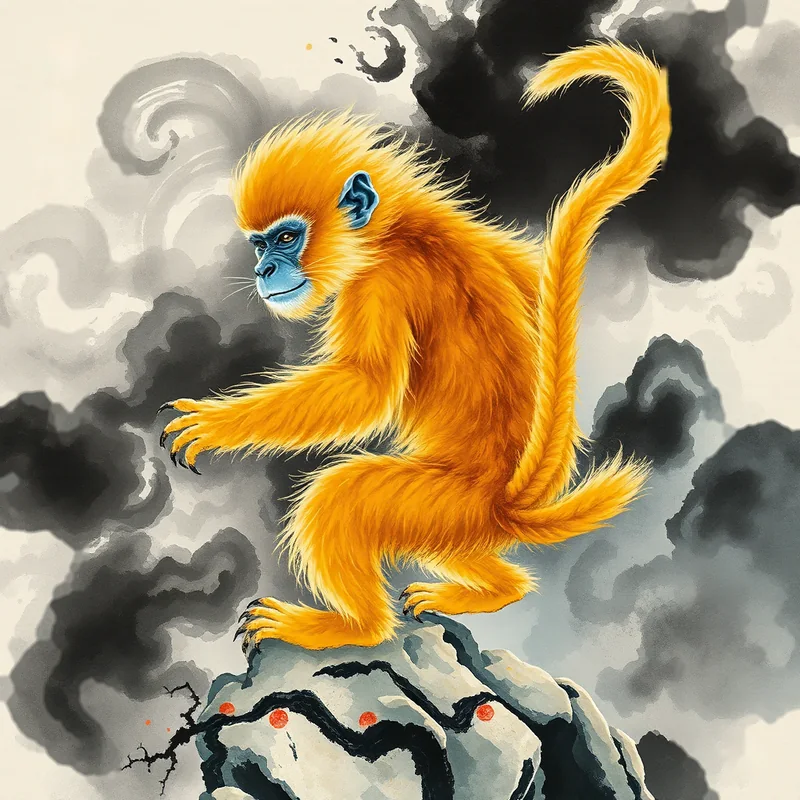
On Mount Chongwu lives a beast shaped like a monkey with patterned arms and a leopard's tail. It throws things well. Its name is Jufu.
Original & Translations
西山经曰:西次三经之首,曰崇吾之山,在河之南,北望冢遂,南望䍃之泽,西望帝之捕兽之丘,东望䗡渊。有木焉,员叶而白柎,赤华而黑理,其实如枳,食之宜子孙。有兽焉,其状如禺而文臂,豹尾而善投,名曰举父。
崇吾之山,是西次三经的第一座山。这一经是《西山经》里最重要的一段——昆仑、玉山、天山、翼望,全在这一段。
而它的开头,是举父。
"状如禺"——禺,是猿猴。古文字里的"禺",画的是一个头大、尾长的灵长类。
"文臂"——手臂上有花纹。
"豹尾"——尾巴像豹子的尾巴。
"善投"——擅长投掷。
三个特征,都很具体。但要理解它们,得先知道一件事:在中国境内,什么样的灵长类有花纹的手臂和豹子一样的尾巴?
答案是:金丝猴。
川金丝猴,中国特有。它的前肢外侧有一片金黄色的长毛,形成明显的色块——这就是"文臂"。它的尾巴很长,毛蓬松,颜色浅,垂下来的时候确实像豹尾。它的体型比猕猴大,脸是蓝的,鼻孔朝天。
而"善投",是灵长类里非常特殊的一项能力。
猕猴会扔东西,但扔不远。黑猩猩会扔,能扔十几米,而且准头很好。人类是唯一能把投掷发展成"武器"的物种。
"善投"这两个字,在《山海经》里是独一份。整部书里,只有举父被描述为"善投"。
为什么这件事重要?
因为投掷是人类独有的技术。它需要三样东西:肩关节的结构(能让手臂向后大幅度旋转)、手的抓握能力(能握住石头)、以及大脑的运动预判(能算出抛物线)。
这三样,人类有,其他灵长类只有一半。
所以当古人看见一只猴子"善投"的时候,他们看见的是:一个接近人的东西。
然后是名字:举父。
"举",是举起。"父",是成年男性,是尊称。
举父,就是"举石头的老人",或者"举石头的父亲"。
这个名字里有一种奇怪的敬意。它不叫"投石兽",不叫"石猴",它叫"父"。
在《山海经》里,被称为"父"的东西不多。夸父是一个。"夸父"——夸张的父亲,夸大的父亲。
夸父逐日,举父投石。两个"父",一个追太阳,一个扔石头。
我怀疑这两个名字来自同一个语源层:一个关于"巨大的、力量型的、接近人的东西"的记忆。
而这个记忆,可能有实物依据。
中国南方更新世地层里,出土过巨猿的牙齿和下颌骨。巨猿(Gigantopithecus)站立时高约三米,体重两百到三百公斤,是已知最大的灵长类。它和人类的分支在八百万年前分开,一直活到三十万年前。
如果古人类见过巨猿——或者见过巨猿的骨头——他们会怎么记?
"像猿,手臂有花纹(毛色分块),尾巴像豹,会扔东西。"
"举父"可能就是这样一只被记下来的、已经消失的巨猿。
而崇吾之山,在"河之南"——黄河以南。这个位置,大致在今天的陕西、甘肃一带。那里的更新世地层里,确实有巨猿化石。
一只三米高的、会扔石头的猿,站在黄河边上的山上。
这个画面,比任何神话都更接近真实。
The Classic of Western Mountains, third western section: its head is Mount Chongwu, south of the River. North you see Zhong Sui; south, the marsh of Yan; west, the Mound Where the High God Traps Beasts; east, the Yan abyss. There is a tree with round leaves and white stalks, red flowers and black grain, fruiting like a trifoliate orange; eat it and your descendants will prosper. A beast lives there shaped like a monkey with patterned arms and a leopard's tail, and it throws well. Its name is Jufu.
Mount Chongwu opens the third western section — the most important stretch of the whole Western Classic. Kunlun, Jade Mountain, Heaven Mountain, Yiwang all lie in it.
And it opens with Jufu.
"Shaped like a yu" — yu is the old word for a monkey or ape. The ancient graph draws a large-headed, long-tailed primate.
"Patterned arms." "A leopard's tail." "Throws well."
Three specific features. To read them, you need one fact: within China, what primate has patterned arms and a leopard-like tail?
The golden snub-nosed monkey. Endemic to China. Its forelimbs carry a long golden fringe on the outer side, forming a distinct block of colour — that is the patterned arm. Its tail is long, thickly furred, pale, and when it hangs down it does read as a leopard's tail. It is larger than a macaque, blue-faced, with upturned nostrils.
And throwing is a very particular ability among primates.
Macaques throw, but not far. Chimpanzees throw, up to ten or fifteen metres, and accurately. Humans are the only species that turned throwing into a weapon.
"Throws well" appears exactly once in the Shanhaijing. Jufu is the only creature in the book described this way.
Why does that matter?
Because throwing is a uniquely human technology. It requires three things: a shoulder that can rotate the arm far back, a hand that can grip a stone, and a brain that can predict a parabola.
Humans have all three. Other primates have about half.
So when the ancients saw a monkey that threw well, what they saw was: something close to a person.
Then the name: Jufu.
Ju means to lift. Fu means an adult male, or an honorific: father.
Jufu: the old man who lifts stones. The father who lifts.
There is an odd respect in the name. Not "stone-throwing beast," not "stone monkey" — fu.
Very few things in the Shanhaijing are called fu. Kuafu is one. Kuafu: the exaggerated father, the overgrown father.
Kuafu chased the sun. Jufu threw stones. Two fathers: one running at the sun, one throwing rocks.
I suspect both names come from the same stratum: a memory of something enormous, powerful, and nearly human.
And that memory may have a physical basis.
Pleistocene deposits in southern China have yielded teeth and mandibles of Gigantopithecus. Standing, it was about three metres tall and two to three hundred kilograms — the largest primate known. Its lineage split from ours eight million years ago and survived until roughly three hundred thousand years ago.
If early humans saw a Gigantopithecus — or its bones — how would they record it?
"Like an ape, arms patterned (blocks of colour in the fur), tail like a leopard, throws things."
Jufu may be exactly that: a vanished giant ape, written down.
And Mount Chongwu stands "south of the River" — south of the Yellow River, roughly modern Shaanxi and Gansu. Pleistocene beds there do contain Gigantopithecus fossils.
A three-metre ape that throws stones, standing on a mountain above the Yellow River.
That image is closer to fact than to myth.
เขาฉงอู๋ เป็นยอดแรกของ "ซีชื่อซานจิง" — ส่วนที่สำคัญที่สุดของตำราภูเขาตะวันตก (คุนหลุน ยู่ซาน เทียนซาน อยู่ทั้งหมดในส่วนนี้)
"รูปร่างเหมือนลิง แขนมีลาย หางเสือดาว ขว้างเก่ง"
ลิงชนิดไหนในจีนมีแขนเป็นลายและหางเหมือนเสือดาว? — ลิงจมูกเชิดสีทอง ขนสีทองเป็นแผงที่แขนนอก = "แขนลาย" หางยาวฟูสีอ่อน = "หางเสือดาว"
"ขว้างเก่ง" — ในซานไห่จิงมีแค่ตัวเดียวที่ได้คำนี้ การขว้างเป็นเทคโนโลยีเฉพาะมนุษย์ ต้องมีไหล่ที่หมุนได้มาก มือที่กำหินได้ และสมองที่คำนวณวิถีโค้ง
ชื่อ "จวี่ฟู่" = "ผู้ยก" + "พ่อ/ชายใหญ่" — ให้เกียรติเหมือน "ขวาฟู่"
อาจเป็นความจำถึง Gigantopithecus (ลิงยักษ์สูง 3 เมตร สูญพันธุ์เมื่อราว 3 แสนปีก่อน) ซึ่งมีฟอสซิลในฉ่านซี-กานซู่
Gunung Chongwu membuka "seksyen barat ketiga" — bahagian terpenting seluruh kitab barat (Kunlun, Gunung Jed, Gunung Syurga semuanya di sini).
"Bentuk macam monyet, lengan bercorak, ekor harimau bintang, pandai melontar."
Monyet apa di China berlengan bercorak dan berekor seperti harimau bintang? — monyet hidung pesek emas. Bulu keemasan berjambul di lengan luar = "lengan bercorak". Ekor panjang berbulu tebal pucat = "ekor harimau bintang".
"Pandai melontar" — hanya makhluk ini dalam Shanhaijing diberi gelaran itu. Melontar ialah teknologi khas manusia: bahu yang boleh berputar jauh, tangan yang menggenggam batu, otak yang mengira parabola.
Nama "Jufu" = "pengangkat" + "bapa/lelaki dewasa" — penghormatan seperti "Kuafu".
Mungkin memori tentang Gigantopithecus (mawas gergasi 3 meter, pupus ~300,000 tahun lalu) yang fosilnya ada di Shaanxi-Gansu.
Núi Sùng Ngô mở đầu "Tây Kinh phần ba" — đoạn quan trọng nhất của thiên Tây Sơn (Côn Lôn, Ngọc Sơn, Thiên Sơn đều ở đây).
"Hình như vượn, tay có vằn, đuôi báo, ném giỏi."
Loài linh trưởng nào ở Trung Quốc có tay vằn và đuôi như báo? — voọc mũi hếch vàng. Lông vàng thành dải ở mặt ngoài chi trước = "tay vằn". Đuôi dài, lông dày, màu nhạt = "đuôi báo".
"Ném giỏi" — trong Sơn Hải Kinh chỉ loài này được gọi vậy. Ném là công nghệ riêng của người: vai xoay rộng, tay nắm đá, não tính parabol.
Tên "Cử Phụ" = "kẻ nâng" + "cha/đàn ông lớn" — kính trọng như "Khoa Phụ".
Có lẽ là ký ức về Gigantopithecus (vượn khổng lồ cao 3 m, tuyệt chủng ~300.000 năm trước) có hóa thạch ở Thiểm Tây-Cam Túc.
Gunung Chongwu membuka "bagian barat ketiga" — bagian terpenting seluruh kitab barat (Kunlun, Gunung Jade, Gunung Surga semuanya di sini).
"Bentuk seperti monyet, lengan bercorak, ekor macan tutul, pandai melempar."
Monyet apa di Tiongkok berlengan bercorak dan berekor seperti macan tutul? — monyet hidung pesek emas. Bulu keemasan berjambul di lengan luar = "lengan bercorak". Ekor panjang berbulu tebal pucat = "ekor macan tutul".
"Pandai melempar" — hanya makhluk ini dalam Shanhaijing diberi sebutan itu. Melempar adalah teknologi khas manusia: bahu yang bisa berputar jauh, tangan yang menggenggam batu, otak yang menghitung parabola.
Nama "Jufu" = "pengangkat" + "bapak/lelaki dewasa" — penghormatan seperti "Kuafu".
Mungkin memori tentang Gigantopithecus (kera raksasa 3 meter, punah ~300.000 tahun lalu) yang fosilnya ada di Shaanxi-Gansu.
Nearby Creatures