 象蛇
北山经
《北山经》
象蛇
Xiangshe
4.744k北山经
Divine BirdFertilityCuriosity
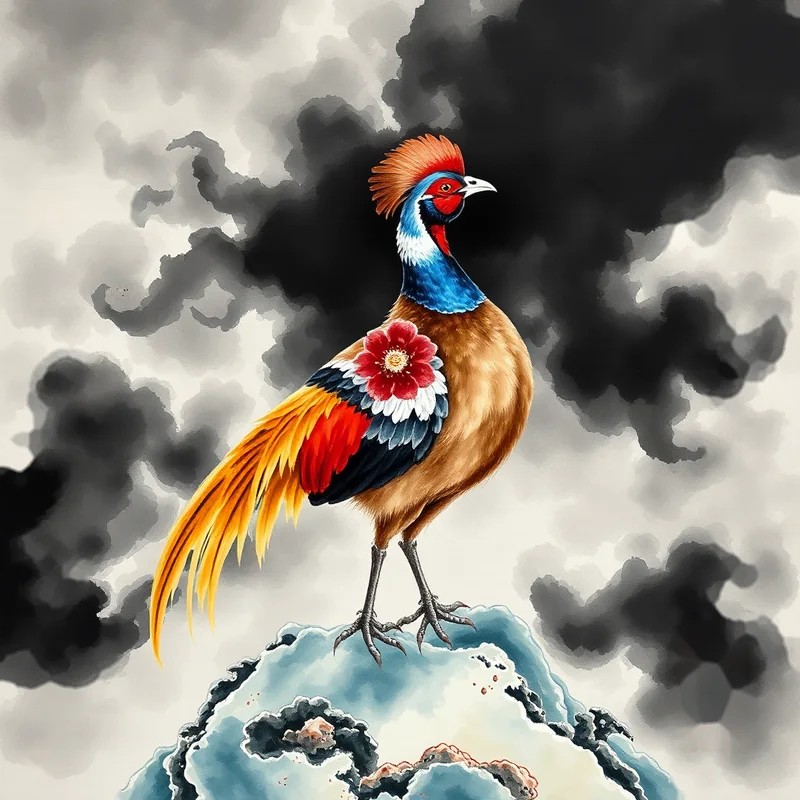
On Mount Yang lives a bird like a red pheasant, patterned in five colours. It is both male and female to itself. Its name is Xiangshe, and its call is its own name.
Original & Translations
北山经曰:又东三百里,曰阳山,其上多玉,其下多金铜。有兽焉,其状如牛而赤尾,其颈𦜜,其状如句瞿,其名曰领胡,其鸣自詨,食之已狂。有鸟焉,其状如赤雉,而五采以文,是自为牝牡,名曰象蛇,其名自詨。
先说清楚一件事:雌雄同体在自然界是真的。
不是比喻,不是神话。是可以在博物馆里看到的标本。
鸟类有一种现象叫"雌雄嵌合"(bilateral gynandromorphism)。一只鸟的身体,从正中线分成两半:左半边是雄性的羽毛,右半边是雌性的羽毛。界限清清楚楚,像拿尺子量过。
北美洲的红衣主教鸟有过多次记录。2021 年,宾夕法尼亚的一只玫胸白翅斑雀,左胸是玫瑰红(雄),右胸是金黄(雌),照片传遍全网。
原因在胚胎。鸟的性别由细胞决定(ZZ 为雄,ZW 为雌),当一个早期胚胎发生细胞分裂异常,一部分细胞是 ZZ,一部分是 ZW,长出来的就是一只"半雄半雌"的鸟。
而雉类,是雌雄异色最极端的鸟之一。雄雉羽色浓艳,金属绿、铜红、紫、金;雌雉朴素,褐灰带斑点。如果一只雉发生雌雄嵌合,它的左右两半会差得非常远——一半是"五采以文",一半是土褐色。
这正好对应"五采以文"和"自为牝牡"两个描述。
"五采"不是"五种颜色",是"多色"的意思——青、赤、黄、白、黑,古代的正色系统。一只雉的雄羽,确实同时具备这几种色相。
"自为牝牡"——自己给自己当公母。这个说法,比"雌雄同体"更精确地描述了一只嵌合鸟的行为困境:它既有雄性的羽毛,也有雌性的羽毛;它会被雄鸟追求,也会对雌鸟求偶。它自己完成了配对的一半。
然后是"其名自詨"——叫声就是它的名字。象蛇,象蛇。
"象"是"像"。"蛇"……为什么是蛇?
一种可能是:这类鸟的颈部在求偶时会伸缩、扭动,像蛇。雉类的颈部皮肤裸露,求偶时头部上下点动,颈部的动作确实有蛇的感觉。
另一种可能:这是音译。"象蛇"两个字可能记录的是一种已经消失的鸟鸣拟声。
我更倾向于第三种:这是一个错字。"象蛇"可能是"象它"——"它"在古文字里就是蛇的形状(它,本义为蛇)。"象它"意思是"像那个东西"。抄写的人把"它"写成了"蛇"。
如果这个推测成立,那么这条记录的原意是:有一种鸟,像"那个"——指前文的领胡?还是指某种说不清的东西?
无论哪种,"自为牝牡"这四个字是硬邦邦的观察。写这四个字的人,见过一只左右两半不一样的鸟。
他没有"基因"这个词。他只有"自为牝牡"。
而这四个字,把一只标本级罕见的嵌合鸟,准确地记了下来。
阳山,多玉,多金铜。同一座山上,还有领胡——一种吃了能治癫狂的牛形兽。一座山,一只治病的兽,一只半雄半雌的鸟。
这座山在山西。今天的太行山南段,雉类仍然很多。
The Classic of Northern Mountains: three hundred li east is Mount Yang. Jade above; gold and copper below. A beast lives there shaped like an ox with a red tail, whose neck bears a swelling like a ladle — its name is Linghu, its call is its own name, and eating it cures madness. And a bird, shaped like a red pheasant, patterned in five colours, which is male and female to itself. Its name is Xiangshe, and its call is its own name.
One thing first: hermaphroditism in nature is real.
Not metaphor, not myth. You can see it in a museum drawer.
Birds exhibit a phenomenon called bilateral gynandromorphism. A bird's body divides down the midline: the left half carries male plumage, the right half female plumage, the boundary as clean as if ruled.
Northern cardinals have been recorded with it repeatedly. In 2021 a rose-breasted grosbeak in Pennsylvania showed rose-red on the left breast and golden on the right, and the photographs went everywhere.
The cause is embryonic. A bird's sex is determined cell by cell — ZZ male, ZW female — and if a very early embryo divides abnormally, some cells end up ZZ and some ZW. What grows is a half-male, half-female bird.
And pheasants are among the most extremely dimorphic of all birds. The male is saturated: metallic green, copper red, purple, gold. The female is plain brown-grey, speckled. A pheasant with gynandromorphism would differ wildly across its two halves — one side "patterned in five colours," one side earth-brown.
That matches both phrases exactly: five-coloured patterning, and male-and-female to itself.
"Five colours" does not mean a count of five. It means polychrome — the classical system of blue, red, yellow, white, black. A male pheasant's plumage genuinely holds all of them at once.
"Male and female to itself" describes a gynandromorph's behavioural predicament more precisely than "hermaphrodite" does. It has male plumage and female plumage. It will be courted by males and will court females. It completes half a pair by itself.
Then: its call is its own name. Xiang-she. Xiang-she.
Xiang means "resembles." She means snake. Why snake?
One possibility: the neck. These birds stretch and twist the neck in display. Pheasants have bare skin at the throat, and the head-bobbing of courtship does read as serpentine.
Another: it is a transcription of the call, now lost.
I lean to a third. It may be a scribal error. The old graph for ta, "it," is a picture of a snake — the character originally meant snake. Xiang-ta, "resembles that thing." A copyist wrote she for ta.
If so, the original sense was: there is a bird that resembles "that" — the Linghu mentioned just before? Or something the writer could not name.
Either way, "male and female to itself" is hard observation. Whoever wrote it had seen a bird whose two halves did not match.
He had no word for genes. He had four characters.
And with those four characters he recorded, accurately, one of the rarest specimens in ornithology.
Mount Yang: much jade, much gold and copper. On the same mountain lives Linghu, an ox-shaped beast whose flesh cures madness. One mountain, one medicinal animal, one half-male bird.
The mountain is in Shanxi. The southern Taihang still has plenty of pheasants.
"เป็นทั้งตัวผู้และตัวเมียในตัวเอง" — เรื่องนี้จริงในธรรมชาติ
นกมีปรากฏการณ์ "gynandromorphism แบบสองข้าง": ตัวหนึ่งซีกซ้ายขนตัวผู้ ซีกขวาขนตัวเมีย แบ่งตรงกลางเป๊ะ ๆ
เกิดจากตัวอ่อน: เพศนกกำหนดที่ระดับเซลล์ (ZZ ผู้, ZW เมีย) ถ้าการแบ่งตัวผิดปกติช่วงแรก จะมีทั้ง ZZ และ ZW ในตัวเดียว
ไก่ฟ้าเป็นนกที่ตัวผู้-ตัวเมียสีต่างกันมากที่สุดชนิดหนึ่ง ถ้าเกิดภาวะนี้ ครึ่งหนึ่งจะ "ลายห้าสี" อีกครึ่งเป็นสีน้ำตาล
"เซี่ยงเสอ" อาจเป็นคำผิดของ "เซี่ยงทา" — อักษร "ทา" ในยุคโบราณคือรูปร่างงู แปลว่า "เหมือนสิ่งนั้น"
"Jantan dan betina pada dirinya sendiri" — ini benar dalam alam.
Burung ada fenomena "gynandromorphism dua belah": separuh kiri bulu jantan, separuh kanan bulu betina, sempadan lurus tepat.
Punca pada embrio: jantina burung ditentukan per sel (ZZ jantan, ZW betina). Jika pembelahan awal abnormal, ada kedua-duanya dalam satu badan.
Kuang ialah antara burung paling dimorfik. Jika ini berlaku, satu sisi "bercorak lima warna", satu sisi coklat tanah.
"Xiangshe" mungkin salah tulis bagi "Xiangta" — aksara "ta" dalam tulisan lama ialah bentuk ular, maksudnya "seperti benda itu".
"Tự nó vừa đực vừa cái" — điều này có thật trong tự nhiên.
Chim có hiện tượng "gynandromorphism hai bên": nửa trái lông trống, nửa phải lông mái, ranh giới thẳng như kẻ.
Nguyên nhân ở phôi: giới tính chim do từng tế bào quyết định (ZZ trống, ZW mái). Nếu phân chia sớm bất thường, một cơ thể có cả hai.
Trĩ là loài dị hình giới tính cực đoan. Nếu xảy ra, một bên "vằn năm màu", một bên nâu đất.
"Tượng Xà" có thể là chép nhầm của "Tượng Tha" — chữ "tha" thời cổ là hình con rắn, nghĩa "giống cái đó".
"Jantan dan betina pada dirinya sendiri" — ini nyata di alam.
Burung punya fenomena "gynandromorphism dua sisi": separuh kiri bulu jantan, separuh kanan bulu betina, batas lurus tepat.
Penyebabnya pada embrio: jenis kelamin burung ditentukan per sel (ZZ jantan, ZW betina). Jika pembelahan awal abnormal, ada keduanya dalam satu tubuh.
Kuang adalah antara burung paling dimorfik. Jika ini terjadi, satu sisi "bercorak lima warna", satu sisi coklat tanah.
"Xiangshe" mungkin salah tulis untuk "Xiangta" — aksara "ta" dalam aksara lama adalah bentuk ular, artinya "seperti benda itu".
Nearby Creatures