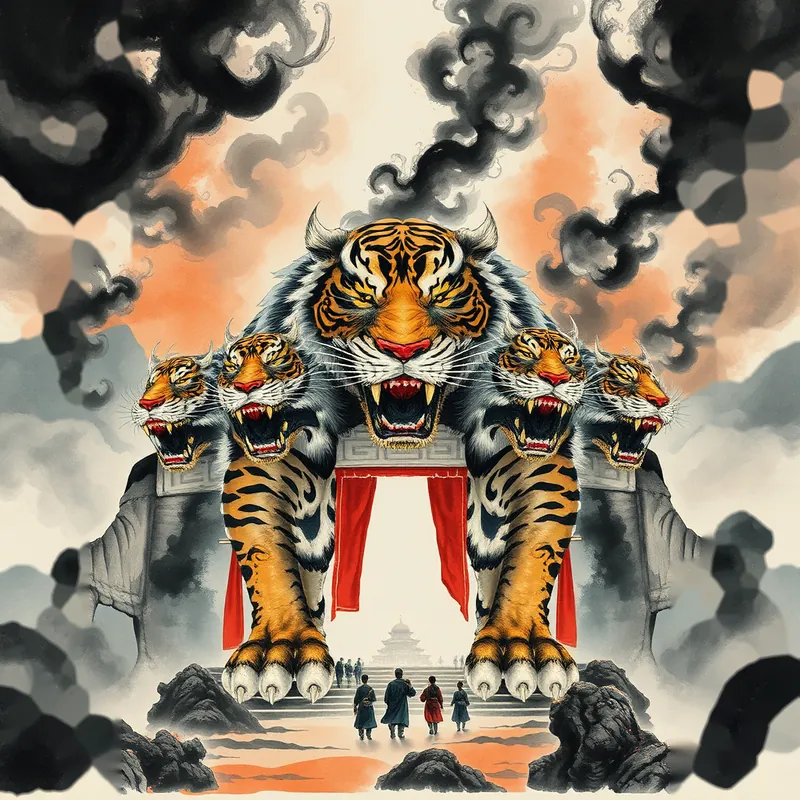
 开明兽
西山经
《海内西经》
开明兽
Kaiming Beast
4.876k西山经
GuardianKunlunDeityMultiplicity
On the face of the Kunlun mound are nine gates, and at each gate stands a Kaiming beast. Its body is that of a great tiger, with nine heads, all with human faces, standing eastward on Kunlun.
Original & Translations
海内西经曰:海内昆仑之虚,在西北,帝之下都。昆仑之虚,方圆八百里,高万仞。上有木禾,长五寻,大五围。面有九井,以玉为槛。面有九门,门有开明兽守之,百神之所在。
又说:开明兽身大类虎而九首,皆人面,东向立昆仑上。
先看这座城。
方圆八百里,高万仞。一仞是七尺或八尺,万仞是夸张,但意思是:高到看不见顶。
上面有木禾,长五寻,大五围。一寻八尺,五寻四十尺,约九米高;五围是五个人合抱。这是一棵九米高的谷物。
城的一面有九口井,井栏是玉做的。
城的一面有九道门,每道门有一只开明兽守着。
这是中国最早的"都城"描写之一。
九门,是一个真实的建筑规制。《周礼·考工记》讲王城:"匠人营国,方九里,旁三门。" 一面三门,四面十二门。但昆仑是九门,不是十二门。
九,是极数。天有九重,地有九泉,九州,九鼎。九门不是"九道门",是"所有的门"。
然后说守门的兽。
身大类虎,九个头,每个头都是人的脸,朝着东边站着。
一只兽,九个头。这句话在生物学上不可能,在建筑学上非常合理。
想象一座有九道门的城。每道门上方,装一个兽面。
兽面是什么?是铺首。
铺首是门上的装饰:一个兽头,通常是虎、狮、饕餮,嘴里衔着一个环,用来敲门。汉代墓葬的门上、棺上、器物上,到处都是铺首。它的功能有两个:一是实用,拉门;二是辟邪,兽面吓鬼。
九道门,九个铺首。九个兽面,九张脸。
如果一个人站在城门外的中轴线上,往城里看,会看见什么?
九道门一字排开,每道门上一个兽面。九个兽面,九张脸,都朝着他。
而铺首的脸,在汉代常常是人脸,或者半人半兽的脸。
于是"九首皆人面",不是九个长在人身上的头,是九个装在不同门上的头。
而"东向立",是因为城门朝东。
这不是猜测。昆仑的方位是西北,帝之下都。中国古代的都城,主门朝南,但昆仑的门朝东——因为它是"下都",是神住的地方,方向不必和人一样。也可能是因为太阳从东边来,门要迎着光。
无论哪种,这句话都带着一个具体的方向感:你从东边来,你看见九张脸。
再看"九井"。
九口井,玉做的井栏。
井是城的命脉。一个城有多少口井,能住多少人,是可以算出来的。九口井,是一个大城。
而玉做的井栏,说明这个城不缺玉。
昆仑确实产玉。和田玉从昆仑山的河里捞出来,这条河叫玉龙喀什河,白昆仑玉。从新石器时代到今天,一直在采。
所以"以玉为槛"不是想象。昆仑山下的河里,真的能捡到玉。
然后是最重要的一句:"百神之所在。"
昆仑不是一座空城。它是神的首都。所有的神,都在这里。
而开明兽的工作,是守门。
一个守门人,站在九个门口,长着九个头,朝着东边。
这个形象,后来变成了什么?
变成了门神。变成了石狮。变成了铺首。变成了故宫门上的九排门钉——九,还是九。
也变成了一个词:"开明"。
开明,是打开光明。一个守门的兽,叫"开明",意思是:它守的不是门,是门后面的光。
昆仑城里有光。城门外是黑暗。开明兽站在中间。
最后说一件事。
《海内西经》还说:"在八隅之岩,赤水之际,非仁羿莫能上冈之岩。"
只有仁德的羿,才能爬上那道山岩。
也就是说,这座城,除了羿,没有人进去过。
九道门,九个守门的头,都朝着东边,等一个不会来的人。
而玉做的井栏,还在那儿。井里有水,水里有玉。
The Classic of the Regions Within the Seas, West: the Kunlun mound within the seas lies in the northwest, the lower capital of the Emperor. The mound is eight hundred li around and ten thousand ren high. On it grows the wood-grain, five xun tall and five arm-spans thick. On each face are nine wells with jade railings. On each face are nine gates, and at each gate a Kaiming beast stands guard. This is where the hundred gods are.
And: the Kaiming beast is large like a tiger, with nine heads, all with human faces, standing eastward on Kunlun.
Look at the city first.
Eight hundred li around, ten thousand ren high. A ren is seven or eight feet; ten thousand ren is hyperbole, but the meaning is: too high to see the top.
On it grows the wood-grain, five xun tall, five arm-spans thick. A xun is eight feet; five xun is forty feet, about nine metres. Five arm-spans around. A nine-metre stalk of grain.
On one face are nine wells, with jade for railings.
On one face are nine gates, each with a Kaiming beast.
This is one of the earliest descriptions of a capital city in China.
Nine gates is a real architectural rule. The Rites of Zhou describes the royal city: the master builder lays out the state, nine li square, three gates on each side. Three per side, twelve in all. But Kunlun has nine, not twelve.
Nine is the number of completion. Nine heavens, nine springs, nine provinces, nine tripods. Nine gates does not mean "nine doorways." It means "all the doorways."
Now the guardian.
Body large like a tiger, nine heads, every head a human face, standing facing east.
One beast, nine heads. Biologically impossible. Architecturally entirely reasonable.
Picture a city with nine gates. Above each gate, a beast mask.
What is a beast mask? A door knocker.
The pushou is a door ornament: a beast head — usually tiger, lion, or taotie — holding a ring in its mouth, for knocking. Han tombs are covered in them, on doors, coffins, vessels. Two functions: practical, to pull the door; and apotropaic, a beast face to frighten ghosts.
Nine gates, nine knockers. Nine beast faces, nine faces.
Stand on the axis outside the gate and look in. What do you see?
Nine gates in a row, each with a mask above it. Nine masks, nine faces, all turned toward you.
And Han knockers very often have human faces, or half-human ones.
So "nine heads, all human-faced" is not nine heads on one neck. It is nine heads mounted on nine different gates.
And "standing eastward" is because the gates face east.
This is not guesswork. Kunlun is in the northwest, the lower capital. Chinese capitals normally face south, but Kunlun's gates face east — because it is a lower capital, a place for gods, and need not follow human orientation. Or because the sun comes from the east, and the gates should meet the light.
Either way the sentence carries a precise sense of direction: you come from the east, and you see nine faces.
Now the nine wells.
Nine wells with jade railings.
Wells are a city's lifeline. How many wells a city has tells you how many people it holds. Nine wells is a large city.
Jade railings mean the city is not short of jade.
Kunlun does produce jade. Hetian jade is gathered from the riverbeds of the Kunlun range, from the Yurungkash, the White Jade River. It has been worked from the Neolithic to the present.
So "jade for railings" is not invention. In the rivers below Kunlun you can genuinely pick up jade.
Then the most important line: "this is where the hundred gods are."
Kunlun is not an empty city. It is the capital of the gods. All of them are here.
And the Kaiming beast's job is the door.
A doorkeeper, standing at nine gates, with nine heads, facing east.
What did this image become?
It became the door god. The stone lion. The door knocker. The nine rows of door nails on the Forbidden City's gates — nine again.
It also became a word: kaiming.
Kaiming means "opening brightness." A gate-beast named Opening Brightness means: what it guards is not the gate but the light behind the gate.
Inside Kunlun there is light. Outside is dark. The beast stands between.
One last thing.
The same chapter says: "on the crags of the eight corners, at the edge of the Red Water, none but the virtuous Yi can climb the ridge."
That is: nobody has ever entered this city except Yi.
Nine gates, nine guardian heads, all facing east, waiting for someone who will not come.
And the jade railings are still there. There is water in the wells. There is jade in the water.
เนินคุนหลุน อยู่ทางตะวันตกเฉียงเหนือ เป็นเมืองล่างของเทพ
รอบ восемьร้อยลี้ สูงเหลือคณานับ บนยอดมีต้นข้าวยักษ์สูงเก้าสิบเมตร ด้านหนึ่งมีเก้าบ่อ ขอบบ่อทำจากหยก ด้านหนึ่งมีเก้าประตู แต่ละประตูมีอสูรไคหมิงเฝ้า
"ตัวใหญ่เหมือนเสือ เก้าหัว ทุกหัวเป็นหน้าคน หันหน้าไปทางตะวันออก"
เก้าหัวบนตัวเดียวเป็นไปไม่ได้ทางชีววิทยา แต่สมเหตุสมผลทางสถาปัตยกรรม
ประตูเก้าบาน แต่ละบานมี "โส่วโส่ว" — หน้ากากสัตว์หล่อหรือแกะสลักเหนือประตู มีห่วงอยู่ในปาก ใช้เคาะประตู พบมากบนประตูสุสานราชวงศ์ฮั่น หน้าของมันบางทีเป็นหน้าคน
ยืนอยู่หน้าประตูมองเข้าไป เห็นหน้ากากเก้าหน้าเรียงกัน หันมาทางคุณ
"เก้าหัว" จึงไม่ใช่เก้าหัวบนคอเดียว แต่เป็นเก้าหัวติดอยู่บนประตูเก้าบาน
"หันหน้าไปทางตะวันออก" เพราะประตูหันไปทางตะวันออก
เก้าเป็นเลขสูงสุด: ฟ้าเก้าชั้น แผ่นดินเก้าชั้น เก้ามณฑล เก้าหม้อทองคำ
ชื่อ "ไคหมิง" แปลว่า "เปิดความสว่าง" — ผู้เฝ้าประตูไม่ได้เฝ้าประตู แต่เฝ้าแสงที่อยู่หลังประตู
และคัมภีร์บอกว่า "นอกจากนักรบผู้มีคุณธรรม ไม่มีใครปีนขึ้นไปได้"
เก้าประตู เก้าหัว เฝ้ารอคนที่จะไม่มา
Bukit Kunlun di barat laut ialah kota bawah maharaja dewa.
Keliling lapan ratus li, tinggi tidak terkira. Di atasnya pokok bijirin gergasi sembilan meter. Satu sisinya sembilan perigi bertepi jed. Satu sisinya sembilan pintu, setiap pintu dijaga raksasa Kaiming.
"Tubuh seperti harimau besar, sembilan kepala, semuanya bermuka manusia, menghadap timur."
Sembilan kepala pada satu tubuh mustahil secara biologi, tetapi sangat wajar secara seni bina.
Sembilan pintu, setiap pintu dengan "pushou" — topeng binatang di atas pintu, dengan cincin di mulut, untuk mengetuk. Banyak pada pintu makam dinasti Han, dan mukanya kadang manusia.
Berdiri di luar paksi pintu dan melihat ke dalam: sembilan topeng berbaris, semuanya menghadap anda.
Jadi "sembilan kepala" bukan sembilan kepala pada satu leher, tetapi sembilan kepala pada sembilan pintu.
"Menghadap timur" kerana pintu menghadap timur.
Sembilan ialah angka tertinggi: sembilan lapis langit, sembilan lapis bumi, sembilan wilayah, sembilan kawah.
Nama "Kaiming" bermakna "membuka cahaya" — penjaga pintu bukan menjaga pintu, tetapi cahaya di sebalik pintu.
Dan kitab berkata: "tiada siapa kecuali pahlawan yang berbudi dapat memanjat."
Sembilan pintu, sembilan kepala, menunggu seseorang yang tidak akan datang.
Gò Côn Lôn ở tây bắc là kinh đô dưới của Thiên Đế.
Chu vi tám trăm dặm, cao không đếm xuể. Trên có cây lúa khổng lồ cao chín mét. Một mặt có chín giếng, thành giếng bằng ngọc. Một mặt có chín cửa, mỗi cửa có thú Khai Minh canh giữ.
"Mình lớn như hổ, chín đầu, đều mặt người, hướng đông."
Chín đầu trên một mình là bất khả về sinh học, nhưng rất hợp lý về kiến trúc.
Chín cửa, mỗi cửa có "phố thủ" — mặt thú gắn trên cửa, ngậm vòng để gõ. Rất phổ biến trên cửa mộ đời Hán, và mặt thú đôi khi là mặt người.
Đứng ngoài trục cửa nhìn vào: chín mặt thú xếp hàng, đều quay về phía bạn.
Vậy "chín đầu" không phải chín đầu trên một cổ, mà là chín đầu gắn trên chín cửa.
"Hướng đông" vì cửa quay về đông.
Chín là số tận cùng: chín tầng trời, chín tầng đất, chín châu, chín đỉnh.
Tên "Khai Minh" nghĩa là "mở sáng" — kẻ giữ cửa không giữ cửa, mà giữ ánh sáng sau cửa.
Và kinh viết: "ngoài người anh hùng có đức, không ai lên được."
Chín cửa, chín đầu, chờ một người sẽ không đến.
Bukit Kunlun di barat laut adalah kota bawah maharaja dewa.
Keliling delapan ratus li, tinggi tak terkira. Di atasnya pohon biji-bijian raksasa sembilan meter. Satu sisinya sembilan sumur bertepi giok. Satu sisinya sembilan pintu, setiap pintu dijaga raksasa Kaiming.
"Tubuh seperti harimau besar, sembilan kepala, semuanya berwajah manusia, menghadap timur."
Sembilan kepala pada satu tubuh mustahil secara biologi, tetapi sangat wajar secara arsitektur.
Sembilan pintu, setiap pintu dengan "pushou" — topeng hewan di atas pintu, dengan cincin di mulut, untuk mengetuk. Banyak pada pintu makam dinasti Han, dan wajahnya kadang manusia.
Berdiri di luar poros pintu dan melihat ke dalam: sembilan topeng berbaris, semuanya menghadap Anda.
Jadi "sembilan kepala" bukan sembilan kepala pada satu leher, melainkan sembilan kepala pada sembilan pintu.
"Menghadap timur" karena pintu menghadap timur.
Sembilan adalah angka tertinggi: sembilan lapis langit, sembilan lapis bumi, sembilan wilayah, sembilan kawah.
Nama "Kaiming" berarti "membuka cahaya" — penjaga pintu bukan menjaga pintu, melainkan cahaya di balik pintu.
Dan kitab berkata: "tiada siapa kecuali pahlawan berbudi dapat memanjat."
Sembilan pintu, sembilan kepala, menunggu seseorang yang tidak akan datang.
Nearby Creatures