 蜚
东山经
《东山经》
蜚
Fei
4.974k东山经
Evil BeastOmenLocustDrought
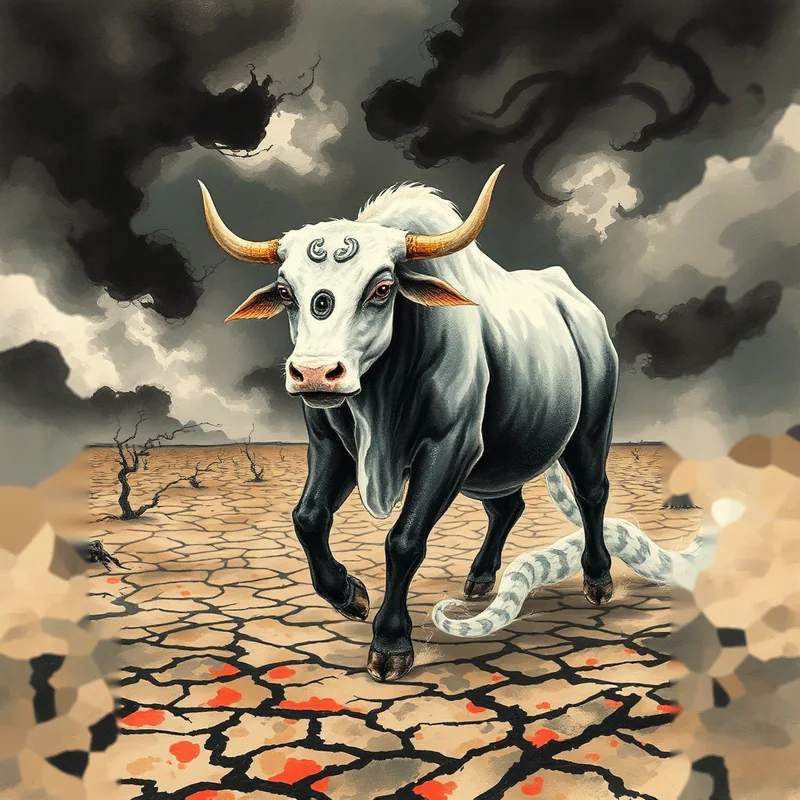
On Mount Tai lives a beast like an ox with a white head, one eye, and a snake's tail. Its name is Fei. Where it walks, water dries and grass dies; when it appears, the world suffers a great plague.
Original & Translations
东山经曰:又东北二百里,曰太山,上多金玉桢木。有兽焉,其状如牛而白首,一目而蛇尾,其名曰蜚,行水则竭,行草则死,见则天下大疫。
这是《山海经》里最凶的几条之一。三个"则"字排下来,一条比一条重:水枯,草死,天下大疫。
先说名字。蜚,读 fěi。
这个字,在先秦文献里,最重要的一个意思是:蝗虫。
《春秋》里有"蜚"的记载。《左传·隐公五年》:"秋,螟。"《公羊传》解释"螟"的时候,用"蜚"。"蜚"就是飞虫,成群飞行的虫。
而"蜚"字本身,从虫从非。非,是"飞"的本字(像鸟张两翼)。所以"蜚"的字形,就是"成群的虫在飞"。
所以"蜚"这个名字,直接指向蝗灾。
现在再看描述:状如牛而白首,一目而蛇尾。
一头牛那么大的东西,白头,一只眼,蛇尾。
这是蝗虫吗?
不是。这是一只"蝗虫之王"。
古人面对蝗灾,看见的是:天上黑压压一片,落下来,几分钟之内,一片田没了。他们抓不住,打不完,烧不尽。
于是他们做了一件事:给这场灾难一个身体。
一头牛那么大的身体——因为蝗群的声音像牛吼。史书里记蝗灾,常用"声如风雨",也有记"如牛鸣"的。
白头——蝗群飞过之后,地里剩下的是一片白。秸秆被啃光,只剩白色的根。
一目——蝗虫有复眼,也有三个单眼。但"一目"更像是"独眼":一种畸形的、不完整的东西。灾难是没有眼睛的,它不看,它只吃。
蛇尾——蝗虫的腹部是一节一节的,末端有产卵器。放大来看,那一段确实像蛇的尾。而且蝗群落地的时候,是"爬"进来的,像蛇一样贴着地面推进。
所以"蜚"是一只由蝗灾的全部感官印象拼成的兽。
然后是三个后果。
"行水则竭"——它走过水,水就干了。
蝗虫需要水吗?需要。蝗虫产卵在干燥的沙土里,但孵化需要湿度,成虫需要水分。蝗群经过的地方,会喝干所有的小水洼。而大旱之年,本来就是蝗灾之年。
"行草则死"——它走过草,草就死了。这个不用解释。
"见则天下大疫"——它出现,天下大疫。
这一条最关键。蝗灾之后,必有瘟疫。
为什么?三个原因。
第一,蝗灾之后是饥荒。人吃树皮、吃观音土、吃死畜,营养不良,免疫力崩溃。
第二,蝗虫的尸体。亿万只蝗虫死在田里、水里、路上,腐烂,污染水源。
第三,也是最直接的:人被迫迁徙。逃荒的人流,把病菌从一个地方带到另一个地方。
所以"蝗—饥—疫"是一条完整的链。古人观察了几百年,把这条链压缩成三个字:见则疫。
而太山,这座山在山东。山东是中国蝗灾最严重的省份之一。明清两代,山东的蝗灾记录数以千计。
所以蜚的出生地,选得很准。
一头牛那么大、白头、独眼、蛇尾的兽,从太山走出来,走过水,水干了;走过草,草死了;然后天下大疫。
这不是一只兽。这是一整年的灾荒,被画成了一个形状。
《山海经》里没有比这更狠的条目了。
The Classic of Eastern Mountains: two hundred li northeast is Mount Tai. Gold and jade above, and hardwood. A beast lives there like an ox with a white head, one eye, and a snake's tail. Its name is Fei. Where it passes, water dries; where it passes, grass dies; when it appears, the world suffers a great plague.
This is one of the most terrible entries in the book. Three "where" clauses in a row, each heavier than the last: water gone, grass dead, the world in plague.
The name first. Fei.
In pre-Qin texts the character's most important sense is: locust.
The Spring and Autumn Annals record fei. The Zuo Commentary notes an autumn of ming — crop-devouring insects — and the Gongyang Commentary glosses ming with fei. Fei is a flying insect; insects that fly in swarms.
And the graph itself is "insect" over fei, and fei is the original form of "to fly," a picture of a bird with wings spread. So the character pictures swarming insects in flight.
The name points straight at locust plague.
Now the description: like an ox with a white head, one eye, a snake's tail.
Is that a locust?
No. It is the king of the locusts.
What people saw in a locust plague was this: the sky goes black, the swarm comes down, and within minutes a field is gone. You cannot catch them, cannot beat them, cannot burn them out.
So they did a thing: they gave the disaster a body.
A body the size of an ox — because a swarm sounds like bellowing. Histories describing locust swarms reach for "like wind and rain," and sometimes "like oxen lowing."
A white head — after a swarm passes, the field is white. The stalks are eaten to the ground, and only the pale roots remain.
One eye — locusts have compound eyes and three simple eyes. But "one eye" reads more like "a single eye": something malformed, incomplete. Disaster has no eyes. It does not look. It only eats.
A snake's tail — a locust's abdomen is segmented, ending in an ovipositor. Magnified, that section is a snake's tail. And when a swarm lands, it comes crawling in, advancing along the ground like a snake.
So Fei is a beast assembled out of every sensory impression of a locust plague.
Then the three consequences.
"Where it passes, water dries." Do locusts need water? Yes. They lay in dry sand, but hatching requires moisture and adults need water. A swarm drinks every puddle it crosses. And a year of drought is a locust year to begin with.
"Where it passes, grass dies." No explanation needed.
"When it appears, the world suffers a great plague."
That is the crucial line. After locusts, epidemic. Always.
Why? Three reasons.
First, famine. People eat bark, eat clay, eat dead animals; nutrition collapses, immunity collapses.
Second, the corpses. Billions of locusts die in the fields, in the water, on the roads. They rot. They foul the wells.
Third, and most directly: people move. Refugees carry pathogens from one district to the next.
So locust, famine, plague form one chain. The ancients watched it for centuries and compressed it into three characters: when it appears, plague.
And Mount Tai is in Shandong. Shandong is among the worst locust provinces in China. Ming and Qing records of locust outbreaks there run into the thousands.
So Fei's birthplace is well chosen.
An ox-sized beast, white-headed, one-eyed, snake-tailed, walks out of Mount Tai. It crosses water, and the water is gone. It crosses grass, and the grass is dead. Then the world is in plague.
It is not a beast. It is one entire year of disaster, drawn into a shape.
There is nothing harsher in the Shanhaijing than this entry.
นี่คือหนึ่งในบันทึกที่ร้ายที่สุดของซานไห่จิง สาม "ก็" เรียงกัน: น้ำแห้ง หญ้าตาย โลกเกิดโรคระบาดใหญ่
ชื่อ "เฟย" ในเอกสารก่อนฉินหมายถึง "ตั๊กแตน" เป็นหลัก ตัวอักษรคือ "แมลง" + "บิน" = แมลงบินเป็นฝูง
ชื่อนี้จึงชี้ตรงไปที่ภัยตั๊กแตน
ส่วนรูปร่าง "เหมือนวัว หัวขาว ตาเดียว หางงู" ไม่ใช่ตั๊กแตน แต่เป็น "ราชาแห่งตั๊กแตน" — ร่างที่ประกอบจากทุกผัสสะของภัยครั้งนั้น
ตัวใหญ่เท่าวัว เพราะเสียงฝูงเหมือนวัวร้อง หัวขาว เพราะหลังฝูงผ่าน ทุ่งเหลือแต่รากสีขาว ตาเดียว เพราะภัยไม่มอง มันแค่กิน หางงู เพราะท้องตั๊กแตนเป็นปล้อง ปลายมีอวัยวะวางไข่ และเวลาลงมันคลานเข้ามาเหมือนงู
"ตั๊กแตน—ความอดอยาก—โรคระบาด" เป็นลูกโซ่จริง: ตั๊กแตน → ข้าวขาด → คนอพยพ → โรคระบาด ภูเขาไท่ซานในซานตงเป็นหนึ่งในพื้นที่ภัยตั๊กแตนหนักที่สุดของจีน
Ini antara catatan paling ngeri dalam Shanhaijing. Tiga "maka" berturut: air kering, rumput mati, dunia dilanda wabak besar.
Nama "fei" dalam teks pra-Qin terutama bermaksud "belalang". Aksaranya "serangga" + "terbang" = serangga terbang berkelompok.
Jadi nama itu terus menunjuk wabak belalang.
Tetapi bentuknya "macam lembu, kepala putih, satu mata, ekor ular" bukan belalang — itu "raja belalang", tubuh yang disusun daripada semua kesan deria bencana itu.
Besar seperti lembu kerana bunyi kawanan seperti lembu mengaum. Kepala putih kerana selepas kawanan lalu, sawah tinggal akar pucat. Satu mata kerana bencana tidak melihat, ia hanya makan. Ekor ular kerana perut belalang beruas, hujungnya ovipositor, dan bila mendarat ia merangkak masuk seperti ular.
"Belalang—kebuluran—wabak" ialah rantaian sebenar. Gunung Tai di Shandong antara wilayah wabak belalang terburuk di China.
Đây là một trong những mục dữ dội nhất của Sơn Hải Kinh. Ba chữ "thì" liên tiếp: nước cạn, cỏ chết, thiên hạ đại dịch.
Tên "Phỉ" trong văn hiến tiền Tần chủ yếu nghĩa là "châu chấu". Chữ gồm "trùng" + "phi" (bay) = côn trùng bay thành đàn.
Vậy tên chỉ thẳng vào nạn châu chấu.
Nhưng hình dạng "như bò, đầu trắng, một mắt, đuôi rắn" không phải châu chấu — đó là "vua châu chấu", thân thể ghép từ mọi ấn tượng giác quan của tai họa ấy.
To như bò vì tiếng đàn như bò rống. Đầu trắng vì sau khi đàn qua, ruộng chỉ còn rễ trắng. Một mắt vì tai họa không nhìn, nó chỉ ăn. Đuôi rắn vì bụng châu chấu phân đốt, cuối có cơ quan đẻ trứng, và khi đáp nó bò vào như rắn.
"Châu chấu — đói — dịch" là chuỗi thật. Núi Thái ở Sơn Đông, một trong những vùng nạn châu chấu nặng nhất Trung Quốc.
Ini salah satu catatan paling mengerikan dalam Shanhaijing. Tiga "maka" berturut: air kering, rumput mati, dunia dilanda wabah besar.
Nama "fei" dalam teks pra-Qin terutama berarti "belalang". Aksaranya "serangga" + "terbang" = serangga terbang berkelompok.
Jadi nama itu langsung menunjuk wabah belalang.
Tetapi bentuknya "seperti lembu, kepala putih, satu mata, ekor ular" bukan belalang — itu "raja belalang", tubuh yang disusun dari semua kesan indra bencana itu.
Besar seperti lembu karena bunyi kawanan seperti lembu mengaum. Kepala putih karena setelah kawanan lewat, sawah tinggal akar pucat. Satu mata karena bencana tidak melihat, ia hanya makan. Ekor ular karena perut belalang beruas, ujungnya ovipositor, dan saat mendarat ia merangkak masuk seperti ular.
"Belalang—kelaparan—wabah" adalah rantai nyata. Gunung Tai di Shandong salah satu wilayah wabah belalang terburuk di Tiongkok.
Nearby Creatures