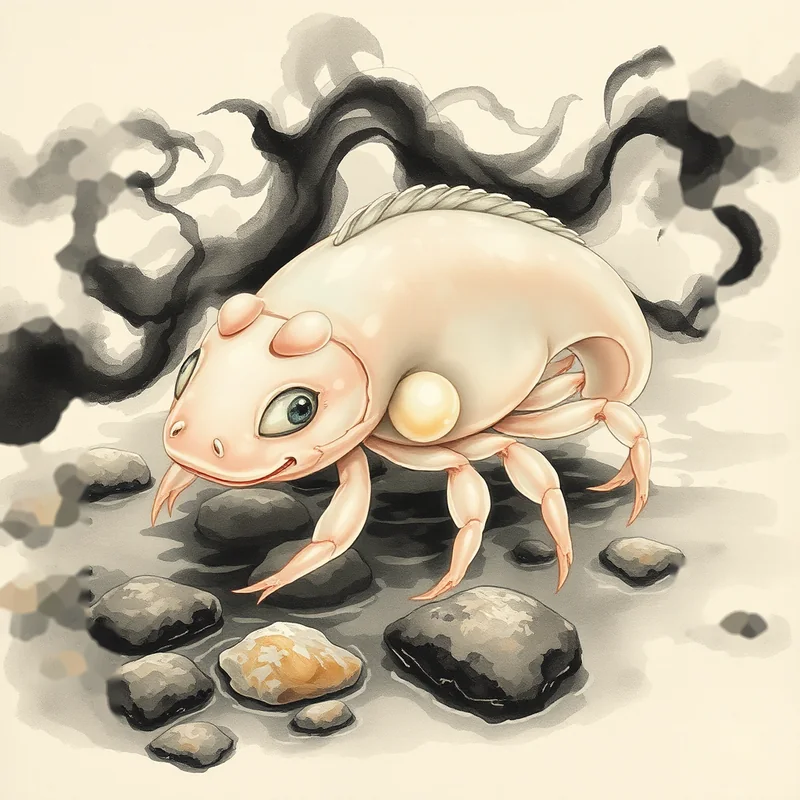
 珠蟞鱼
东山经
《东山经·东次二经》
珠蟞鱼
Pearl-Bearing Fish
4.229k东山经
Divine FishPearlMedicine
At the head of Mount Ge, the Li River rises. In it swarm pearl-bearing fish — shaped like a lung, with eyes, six legs, and pearls. Eat one, and you will not catch plague.
Original & Translations
东山经曰:葛山之首,无草木。澧水出焉,东流注于余泽,其中多珠蟞鱼,其状如肺而目,六足,有珠,食之无疠。
先看形状:像肺。有眼睛。六只脚。身上有珠。
肺这个东西,是没有固定形状的——软、湿、有纹理、摊开是一团。所以"状如肺"其实是在说:这鱼没有鱼的样子。没有鳞,没有鳍,没有流线。它就是一团会动的东西,上面长了两只眼。
然后是六足。一条鱼,六只脚,在水里走。
最后是"有珠"——它身上产珍珠。
再往后是用途:食之无疠。吃了不长恶疮,不得瘟疫。
《山海经》记录异兽有个固定套路:先写形,再写声,再写能,最后写"食之如何"。珠蟞鱼这一条,形写得很怪,声没有,能是"有珠",最后一句是药效。
所以它其实是一条"经济动物":长得恶心,但能产珠,还能入药。古人写它的时候,脑子里想的可能不是"怪物",而是"这东西能不能捞"。
葛山之首还有个细节:"无草木"。光秃秃的山头,一条河从那儿发源,河里全是这种肺一样的鱼。荒山上的一条河,河里游着一堆会走路的肺,每个里面还裹着一颗珠子。
这个画面不需要任何修饰。
The Classic of Eastern Mountains: At the head of Mount Ge there are no trees, no grass. The Li River rises there and flows east into the Yu Marsh. In it swarm pearl-bearing fish — shaped like a lung, with eyes, six legs, and pearls. Eat one, and you will not catch plague.
Start with the shape: like a lung. With eyes. Six legs. Pearls inside.
A lung has no fixed form — soft, wet, veined, a thing that sprawls. So "shaped like a lung" is really saying: this fish has no fish shape. No scales, no fins, no streamlining. It's a lump of moving matter with two eyes on it.
Then six legs. A fish with six legs, walking in the water.
Then "pearls" — it produces them.
Then the use: eat it, no plague. No sores, no pestilence.
The Shan Hai Jing has a fixed template for strange beasts: describe the shape, then the cry, then the power, then what happens if you eat it. For this fish the shape is bizarre, the cry is absent, the power is "pearls," and the last line is medical.
So it's really an economic animal: disgusting to look at, but it yields pearls and it's a medicine. Whoever wrote this wasn't thinking "monster." They were thinking "can we harvest it?"
One more detail about the head of Mount Ge: no trees, no grass. A bare ridge, a river rising out of it, and the river full of lung-shaped fish. A river on a wasteland, and in the river a swarm of walking lungs, each with a pearl wrapped inside.
That image needs no embellishment.
东山经: ต้นเขากือไม่มีต้นไม้ไม่มีหญ้า แม่น้ำหลี่เกิดที่นั่น ไหลลงทะเลสาบอวี่ ในน้ำเต็มไปด้วยปลาไข่มุก รูปร่างเหมือนปอด มีตา หกขา มีไข่มุก กินแล้วไม่เป็นโรค
ปอดไม่มีรูปร่างคงที่ นุ่ม เปียก เป็นก้อน ดังนั้น "เหมือนปอด" คือบอกว่า ปลาตัวนี้ไม่มีรูปร่างของปลา ไม่มีเกล็ด ไม่มีครีบ
แล้วก็หกขา ปลาที่มีหกขา เดินในน้ำ
และมีไข่มุก
สรุปคือมันคือสัตว์เศรษฐกิจ หน้าตาน่าเกลียด แต่ให้ไข่มุกและเป็นยา คนเขียนไม่ได้คิดว่า "สัตว์ประหลาด" แต่คิดว่า "จับมากินได้ไหม"
Klasik Gunung Timur: Di hulu Gunung Ge tiada pokok, tiada rumput. Sungai Li bermula di situ, mengalir ke paya Yu. Di dalamnya penuh ikan bermutiara — rupanya seperti paru-paru, bermata, berkaki enam, dan mengandung mutiara. Makan seekor, kau tidak akan kena wabak.
Paru-paru tiada bentuk tetap — lembut, basah, berurat. Jadi "seperti paru-paru" bermakna: ikan ini tiada bentuk ikan. Tiada sisik, tiada sirip.
Kemudian enam kaki. Ikan berkaki enam, berjalan di dalam air.
Dan mutiara.
Jadi ia binatang ekonomi: hodoh, tetapi menghasilkan mutiara dan menjadi ubat. Penulisnya tidak fikir "raksasa" — dia fikir "boleh tangkap ke?"
Kinh Sơn Đông: đầu núi Cát không cây không cỏ. Sông Lễ phát nguyên ở đó, chảy về đầm Dư. Trong sông đầy cá ngọc — hình như lá phổi, có mắt, sáu chân, trong mình có ngọc. Ăn vào thì không mắc dịch.
Lá phổi không có hình cố định — mềm, ướt, có gân. Vậy "như lá phổi" nghĩa là: con cá này không có hình cá. Không vảy, không vây.
Rồi sáu chân. Một con cá sáu chân, đi trong nước.
Và ngọc.
Nên nó là động vật kinh tế: xấu xí, nhưng cho ngọc và làm thuốc. Người ghi không nghĩ "quái vật" — họ nghĩ "bắt được không?"
Klasik Gunung Timur: di hulu Gunung Ge tak ada pohon, tak ada rumput. Sungai Li bermula di sana, mengalir ke rawa Yu. Di dalamnya penuh ikan bermutiara — bentuknya seperti paru-paru, bermata, berkaki enam, mengandung mutiara. Makan satu, kau tak kena wabak.
Paru-paru tak punya bentuk tetap — lembut, basah, berurat. Jadi "seperti paru-paru" berarti: ikan ini tak berbentuk ikan. Tanpa sisik, tanpa sirip.
Lalu enam kaki. Ikan berkaki enam, berjalan di air.
Dan mutiara.
Jadi ia hewan ekonomi: buruk rupa, tapi menghasilkan mutiara dan jadi obat. Penulisnya tak berpikir "monster" — dia berpikir "bisa ditangkap?"
Nearby Creatures