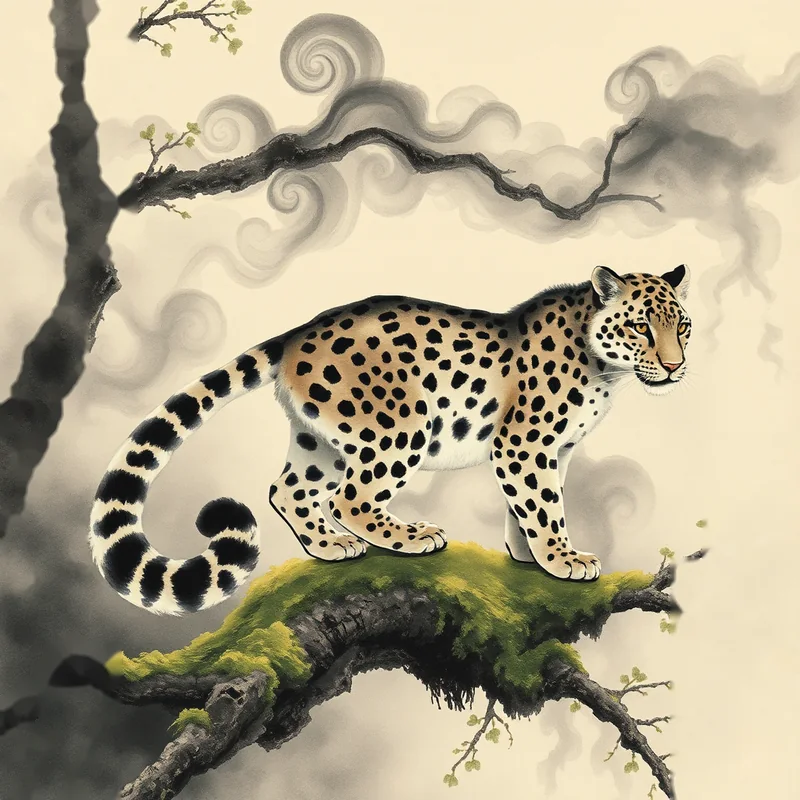
 驺吾
北山经
《海内北经》
驺吾
Zouwu
4.761k北山经
BeastAuspiciousLeopardProtection
In the land of Linshi is a rare beast, large as a tiger, complete in five colours, with a tail longer than its body. Its name is Zouwu; ride it and you travel a thousand li a day.
Original & Translations
海内北经曰:林氏国有珍兽,大若虎,五采毕具,尾长于身,名曰驺吾,乘之日行千里。
驺吾,也写作驺虞。
这两个名字,在中国文化里是完全不同的两个东西。
驺吾是《山海经》里的一只兽:像虎,五色,尾巴比身子长,能骑,一天跑一千里。
驺虞是《诗经》里的一只兽:白虎,黑纹,不吃活的动物,只吃死的;不踩青草,不踏活虫;君王有德,它才出现。
一个是坐骑,一个是祥瑞。
后来,这两个名字合成了一个。
《毛传》注《诗经·召南·驺虞》:"驺虞,义兽也,白虎黑文,不食生物,有至信之德则应之。"
"应之"——它回应德。不是它自己想来,是德把它召来的。
这就把一只动物,变成了一套政治检测系统。
君王如果仁德,天下太平,驺虞就会出现。君王如果暴虐,它就不来。
问题在于:它从来不来。
于是"驺虞出现"这件事,变成了一种可以上报的消息。
地方官报祥瑞,是中国官僚制度里一个长期存在的项目。汉唐有,宋明有,清代最盛。报什么?白雉、嘉禾、甘露、麒麟、凤凰、驺虞。
报了有什么好处?升官,免税,记功。
于是驺虞的图,被一遍一遍地画出来,进呈给皇帝。
明代有一幅《驺虞图》,画一只白色的虎形兽,身上有黑色条纹,尾巴很长,站在草地上。清代也有。这些图,画的都是同一只从来没存在过的动物。
有意思的是,这些图里的驺虞,长得越来越像一种真实的动物。
云豹。
云豹,体长一米,尾长八十厘米——尾巴几乎是身长的一半,在猫科里比例最高之一。它的毛色是灰黄或者茶色,身上有大块的、边缘黑色的云状斑纹,斑纹中间的颜色比周围浅。这种斑,古人叫"五采"。
云豹是树栖的。它的踝关节可以向后转一百八十度,能头朝下从树上爬下来。它的犬齿比例是猫科里最长的,像剑齿虎。
一只云豹,在树上是几乎看不见的。它不动的时候,就是一团云。
"五采毕具",可能说的就是这个:一块灰黄,一块黑边,一块浅心,一块白腹,一块深背。
"尾长于身",云豹的尾巴确实长。
"大若虎",这一条不对。云豹只有二十公斤,比虎小得多。但古人看见一只云豹从树上下来,展开身体,尾巴拖在后面,那个瞬间的体积感,会被高估。
"乘之日行千里",这一条更不对。云豹不能骑。
但"驺"这个字,是马旁。
驺,是古代管马的官,也是骑士、车驾的侍从。"驺骑"是皇帝的仪仗骑兵。"驺"字本身,就和马、和速度、和出行有关。
所以"驺吾"这个名字,可能不是动物的名字,是一个职位的名字:一种跑得很快的、供人骑乘的东西。
而"吾",是"我",也是"抵御"(敔)。
一个名字里,同时有马、有速度、有"我"、有"防御"。
这就是神话命名的混乱:一个名字,被几百年的人反复使用,每一代都往里加一点东西,最后没人知道它原来是什么。
回到那只猫。
云豹今天是什么状况?
极危。中国的野外种群,估计不到一百只。台湾云豹,2014 年之后没有再确认的记录,被认为已经灭绝。
它住在云南、西藏墨脱、海南的原始林里。它需要很大的连续森林,因为它的家域很大,而森林在被切成小块。
一只云豹,一天走不了千里。它一天走几公里,在自己的领地里转一圈,看看有没有麂子。
它不吃死物。它只吃活的。
这一点,和驺虞一样。
所以那只被画在绢上、进呈给皇帝、用来证明"当今圣上有德"的白虎,可能真的存在过。
它只是一只猫。它不吃死肉,它住在树上,它的尾巴很长,它快要没有了。
而"仁兽"这个词,今天听起来像个笑话。
一个不吃活物的 predator,被用来证明一个杀人如麻的制度的仁慈。
这可能是《山海经》里最讽刺的一条记录。
The Classic of the Regions Within the Seas, North: in the land of Linshi is a rare beast, large as a tiger, complete in the five colours, its tail longer than its body. Its name is Zouwu; ride it, and you go a thousand li in a day.
Zouwu is also written Zouyu.
The two names became two quite different things in Chinese culture.
Zouwu is the Shanhaijing beast: tiger-like, five-coloured, tail longer than body, rideable, a thousand li a day.
Zouyu is the Book of Songs beast: white tiger, black stripes, does not eat living things, eats only what is already dead; does not tread on green grass, does not step on living insects; appears only when the ruler is virtuous.
One is a mount. One is an omen.
Later the two names merged.
The Mao commentary on the Zouyu ode says: "Zouyu is a beast of righteousness, a white tiger with black markings. It does not eat living creatures. Where there is perfect trust and virtue, it responds."
"Responds" — it answers to virtue. It does not come of its own accord; virtue summons it.
Which turns an animal into a political detection system.
If the ruler is benevolent and the realm is at peace, the zouyu appears. If the ruler is cruel, it stays away.
The problem: it never appears.
So "the zouyu has appeared" became a reportable event.
Local officials reporting auspicious signs is a long-running item in Chinese bureaucracy. Han and Tang had it, Song and Ming had it, and the Qing had it most of all. What was reported? White pheasants, giant grain, sweet dew, qilin, phoenixes, zouyu.
What was the benefit? Promotion, tax remission, merit recorded.
So pictures of the zouyu were painted, again and again, and sent up to the throne.
A Ming painting of the zouyu shows a white tiger-shaped animal with black stripes and a very long tail, standing in grass. The Qing produced more. Every one of them depicts an animal that never existed.
The interesting part: in these paintings the zouyu comes to look more and more like a real animal.
The clouded leopard.
Body a metre, tail eighty centimetres — the tail nearly half the body, one of the highest proportions in the cat family. Coat grey-yellow or tawny, with large cloud-shaped blotches edged in black, the centres paler than the ground. The ancients called that "five colours."
The clouded leopard is arboreal. Its ankle joints rotate a hundred and eighty degrees, so it can climb down a trunk head first. Its canines, relative to skull size, are the longest of any cat — a sabre-tooth in miniature.
A clouded leopard in a tree is almost invisible. When it holds still, it is a piece of cloud.
"Complete in five colours" may describe exactly that: a grey-yellow field, a black edge, a pale centre, a white belly, a dark back.
"Tail longer than body": true of the clouded leopard.
"Large as a tiger": not true. A clouded leopard is twenty kilograms, far smaller than a tiger. But watching one come down a tree, body extended, tail trailing, the sense of bulk is easily overestimated.
"Ride it a thousand li a day": also not true. You cannot ride a clouded leopard.
But the character zou has the horse radical.
Zou was an official in charge of horses, and also a mounted guard, an outrider. The zouqi were imperial escort cavalry. The character itself is bound up with horses, speed, and travel.
So "zouwu" may not be the animal's name at all. It may be a job title: something fast, something ridden.
And wu is "I," and also "to ward off."
One name containing horse, speed, self, and defence.
This is how mythic naming works: a name is used for centuries, each generation adds a little, and in the end nobody knows what it originally was.
Back to the cat.
Where does the clouded leopard stand now?
Critically endangered. The wild population in China is estimated at under a hundred. The Formosan clouded leopard has not been confirmed since 2014 and is considered extinct.
It lives in the primary forests of Yunnan, Medog in Tibet, and Hainan. It needs large unbroken forest, because its home range is large and the forest is being cut into pieces.
A clouded leopard cannot do a thousand li in a day. It does a few kilometres, circling its territory, checking for muntjac.
It does not eat carrion. It eats only what is alive.
Which is the same as the zouyu.
So the white tiger painted on silk, sent up to the throne, used to prove that the present sage emperor was virtuous, may genuinely have existed.
It was just a cat. It does not eat dead meat, it lives in trees, its tail is long, and it is nearly gone.
And the phrase "beast of righteousness" now sounds like a joke.
A predator that will not eat anything living, used to prove the benevolence of a system that killed people by the thousand.
It may be the most ironic entry in the whole book.
ในแคว้นหลินซื่อมีสัตว์หายาก "ตัวใหญ่เหมือนเสือ มีสีครบทั้งห้า หางยาวกว่าลำตัว ชื่อโจวอู๋ ขี่แล้ววันหนึ่งไปได้พันลี้"
ชื่อนี้ยังเขียนอีกแบบว่า "โจวอวี้" ซึ่งในคัมภีร์กวีโบราณหมายถึง "สัตว์แห่งคุณธรรม" — เสือขาวลายดำ ไม่กินสิ่งมีชีวิต กินแต่ซาก ไม่เหยียบหญ้าเขียว ไม่ย่ำแมลงเป็น ๆ และจะปรากฏเมื่อกษัตริย์มีคุณธรรมเท่านั้น
ดังนั้นสัตว์ตัวหนึ่งจึงกลายเป็น "ระบบตรวจสอบคุณธรรม" ของราชสำนัก
ปัญหา: มันไม่เคยปรากฏ
แต่ข้าราชการท้องถิ่นสามารถ "รายงาน" ว่าเห็นมัน แล้วได้เลื่อนตำแหน่ง ลดภาษี
ภาพวาดโจวอู๋จึงถูกวาดซ้ำแล้วซ้ำอีกเพื่อถวายฮ่องเต้
และภาพเหล่านั้นค่อย ๆ กลายเป็นสัตว์ที่มีอยู่จริง: เสือดาวลายเมฆ
ตัวยาวหนึ่งเมตร หางแปดสิบเซนติเมตร — สัดส่วนหางต่อลำตัวสูงที่สุดในวงศ์แมว ลายสีดำขอบคล้ายก้อนเมฆ ตรงกลางอ่อนกว่า
มันอาศัยบนต้นไม้ ข้อเท้าหมุนได้เกือบ 180 องศา ปีนลงหัวทิ่มได้ เขี้ยวยาวที่สุดในวงศ์แมวเมื่อเทียบกับขนาดกะโหลก
"หางยาวกว่าลำตัว" ถูก "สีครบห้า" ถูก "ตัวใหญ่เหมือนเสือ" ผิด (มันหนักแค่ยี่สิบกิโลกรัม) "ขี่ได้" ผิด
ชื่อ "โจว" มีหมวดม้าในตัวอักษร เดิมเป็นชื่อตำแหน่งข้าราชการดูแลม้า
วันนี้เสือดาวเมฆอยู่ในขั้นใกล้สูญพันธุ์อย่างยิ่ง ในจีนเหลือไม่ถึงหนึ่งร้อยตัว
มันไม่กินซาก มันกินแต่ของเป็น ๆ — เหมือนโจวอวี้
แต่คำว่า "สัตว์แห่งคุณธรรม" ใช้พิสูจน์ความเมตตาของระบบที่ฆ่าคนเป็นพัน ๆ — นี่คือบันทึกที่ประชดที่สุดบทหนึ่ง
Di negeri Linshi ada binatang nadir: "besar seperti harimau, lengkap lima warna, ekornya lebih panjang daripada badannya, namanya Zouwu; menunggangnya, sehari seribu li."
Nama ini juga ditulis Zouyu, yang dalam kitab puisi klasik bermakna "binatang kebajikan": harimau putih berjalur hitam, tidak makan benda hidup, hanya bangkai, tidak memijak rumput hijau, tidak memijak serangga hidup, dan muncul hanya bila raja berbudi.
Jadi seekor binatang menjadi "sistem pengesan kebajikan" istana.
Masalahnya: ia tidak pernah muncul.
Tetapi pegawai daerah boleh "melaporkan" penampakannya, lalu naik pangkat dan dikecualikan cukai.
Lukisan Zouwu pun dibuat berulang kali untuk dipersembahkan kepada maharaja.
Dan lukisan itu perlahan-lahan menjadi binatang yang benar-benar wujud: harimau dahan (clouded leopard).
Panjang badan satu meter, ekor lapan puluh sentimeter — nisbah ekor kepada badan tertinggi dalam keluarga kucing. Bintik hitam bertepi seperti awan, tengahnya lebih cerah.
Ia hidup di pokok; sendi buku lalinya berpusing hampir 180 darjah, boleh turun pokok kepala dahulu. Taringnya terpanjang dalam keluarga kucing berbanding saiz tengkorak.
"Ekor lebih panjang daripada badan" betul. "Lengkap lima warna" betul. "Besar seperti harimau" salah (berat hanya dua puluh kilogram). "Boleh ditunggang" salah.
Nama "zou" mengandungi radikal kuda; asalnya jawatan pegawai kuda.
Hari ini harimau dahan sangat terancam; di China kurang seratus ekor.
Ia tidak makan bangkai; ia makan hanya yang hidup — sama seperti Zouyu.
Tetapi frasa "binatang kebajikan" digunakan untuk membuktikan belas kasihan sistem yang membunuh beribu-ribu orang — inilah catatan paling ironik dalam kitab ini.
Nước Lâm Thị có thú quý: "lớn như hổ, đủ năm màu, đuôi dài hơn mình, tên Trâu Ngô; cưỡi nó một ngày đi nghìn dặm."
Tên này còn viết là Trâu Ngu, trong Kinh Thi nghĩa là "thú của đức": hổ trắng vằn đen, không ăn vật sống, chỉ ăn xác, không giẫm cỏ xanh, không đạp côn trùng sống, và chỉ xuất hiện khi vua có đức.
Vậy một con vật trở thành "hệ thống kiểm tra đức hạnh" của triều đình.
Vấn đề: nó không bao giờ xuất hiện.
Nhưng quan địa phương có thể "báo cáo" đã thấy nó, rồi được thăng chức, giảm thuế.
Tranh Trâu Ngô được vẽ đi vẽ lại để dâng lên vua.
Và những bức tranh ấy dần trở thành một con vật có thật: báo gấm (clouded leopard).
Mình dài một mét, đuôi tám mươi xăng-ti-mét — tỉ lệ đuôi trên mình cao nhất họ mèo. Đốm đen viền như đám mây, giữa nhạt hơn.
Nó sống trên cây; khớp cổ chân xoay gần 180 độ, có thể tụt xuống thân cây chúi đầu. Nanh dài nhất họ mèo so với hộp sọ.
"Đuôi dài hơn mình" đúng. "Đủ năm màu" đúng. "Lớn như hổ" sai (chỉ nặng hai mươi ki-lô-gam). "Cưỡi được" sai.
Tên "trâu" có bộ mã; gốc là chức quan coi ngựa.
Ngày nay báo gấm cực kỳ nguy cấp; ở Trung Quốc còn dưới một trăm con.
Nó không ăn xác; nó chỉ ăn thứ còn sống — giống Trâu Ngu.
Nhưng cụm "thú của đức" được dùng để chứng minh lòng nhân của một chế độ giết người hàng loạt — đây là ghi chép mỉa mai nhất trong kinh.
Negeri Linshi punya binatang langka: "besar seperti harimau, lengkap lima warna, ekornya lebih panjang dari tubuhnya, namanya Zouwu; menungganginya, sehari seribu li."
Nama ini juga ditulis Zouyu, yang dalam kitab puisi klasik berarti "binatang kebajikan": harimau putih berjalur hitam, tidak makan benda hidup, hanya bangkai, tidak memijak rumput hijau, tidak memijak serangga hidup, dan muncul hanya bila raja berbudi.
Jadi seekor binatang menjadi "sistem pendeteksi kebajikan" istana.
Masalahnya: ia tidak pernah muncul.
Tetapi pejabat daerah boleh "melaporkan" penampakannya, lalu naik pangkat dan dibebaskan pajak.
Lukisan Zouwu pun dibuat berulang kali untuk dipersembahkan kepada kaisar.
Dan lukisan itu perlahan-lahan menjadi binatang yang benar-benar ada: macan dahan (clouded leopard).
Panjang badan satu meter, ekor delapan puluh sentimeter — rasio ekor terhadap badan tertinggi dalam keluarga kucing. Bintik hitam bertepi seperti awan, bagian tengahnya lebih cerah.
Ia hidup di pohon; sendi pergelangan kakinya berputar hampir 180 derajat, bisa turun pohon kepala dulu. Taringnya terpanjang dalam keluarga kucing dibanding ukuran tengkorak.
"Ekor lebih panjang dari badan" benar. "Lengkap lima warna" benar. "Besar seperti harimau" salah (beratnya hanya dua puluh kilogram). "Bisa ditunggangi" salah.
Nama "zou" mengandung radikal kuda; asalnya jabatan pejabat kuda.
Kini macan dahan sangat terancam; di Tiongkok tinggal kurang dari seratus ekor.
Ia tidak makan bangkai; ia hanya makan yang hidup — sama seperti Zouyu.
Tetapi frasa "binatang kebajikan" dipakai untuk membuktikan belas kasih sistem yang membunuh ribuan orang — inilah catatan paling ironis dalam kitab ini.
Nearby Creatures