 常羲
西山经
《大荒西经》
常羲
Changxi
4.758k西山经
DeityMoonCreationMother
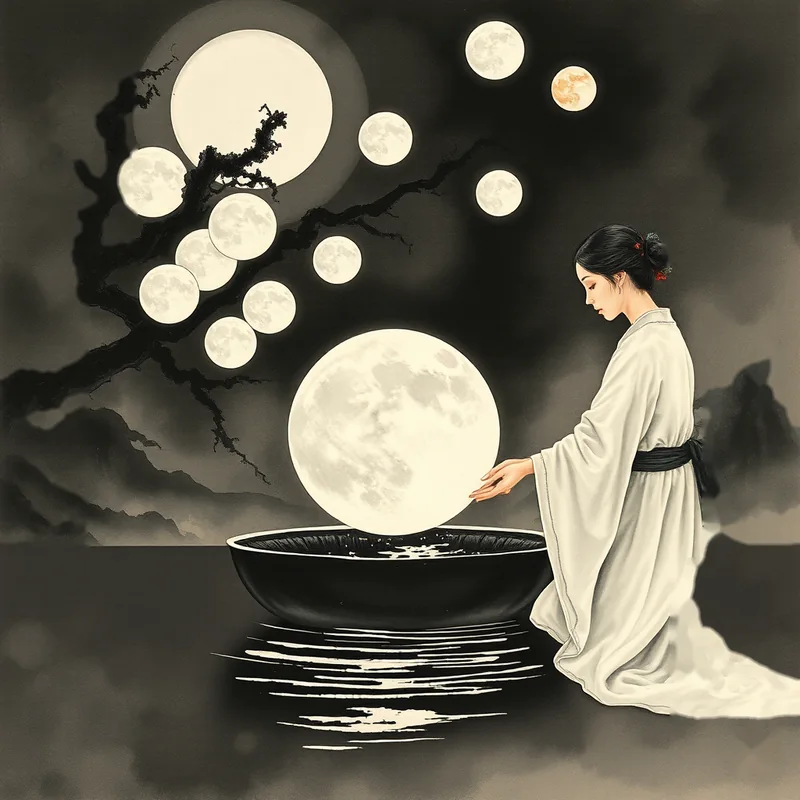
A woman is bathing the moon. Di Jun's wife Changxi bore twelve moons, and this is where she first bathed them.
Original & Translations
大荒西经曰:有女子方浴月。帝俊妻常羲,生月十有二,此始浴之。
十七个字。
这是常羲在整部《山海经》里出现的全部篇幅。十七个字,一个动作,一个身份,一个数字。
对比一下羲和:东南海之外,甘水之间,有羲和之国,有女子名曰羲和,方日浴于甘渊,羲和者,帝俊之妻,生十日。二十六个字。
多出来的九个字,是地名。常羲没有国,没有甘渊,没有扶桑。她只是"有女子方浴月"。
一个连住处都没有的母亲。
先说数字。
十二。
十二个月。十二地支:子丑寅卯辰巳午未申酉戌亥。十二时辰。木星十二年绕天一周,所以叫岁星。十二是一个在天上可以数出来的数。
但它不是一个整齐的数。
一个朔望月是二十九天十二小时四十四分。十二个朔望月是三百五十四天八小时四十九分。一个回归年是三百六十五天五小时四十九分。
差十一天。
也就是说,如果只用十二个月,三年之后,正月就会跑到夏天去。
中国的解法是闰月。十九年七个闰月,叫"十九年七闰"。这个周期,春秋时期就已经掌握,《左传》里明确记载。
所以"生月十有二"这句话,背后是一套非常复杂的天文运算。
一个母亲生了十二个月亮,每个月亮管一个月。十二个月过完,一年还没过完。剩下的十一天,怎么办?
古人把这个问题,交给了"闰"。
闰月没有名字,没有节气,没有神。它是十二个月亮之外多出来的那一段,是历法的一个补丁。
所以常羲生的十二个月亮,其实不够用。每年都有一段日子,不属于任何一个月亮。
再看"浴"。
月出和日出一样,从海面或者地平线升起。月亮升起的时候,是红的、大的、边缘抖动的。
但月亮还有一个太阳没有的特征:它会变形。
初一的月亮看不见。初三是一弯细钩。初七是半圆。十五是满月。二十二又是半圆。三十又看不见。
一个月里,月亮换了八种形状。
古人怎么解释这个?
一种解释是:月亮在洗澡。它每洗一次,就瘦一点;洗到最后,没了;然后再长回来。
另一种解释是:月亮是一只兔子,在捣药;或者是一只蟾蜍;或者是一个人在砍桂树。月海的暗斑,被看成了图案。
还有一种解释,就是常羲。她每个月给月亮洗一次,洗完的月亮是新的,圆的;然后月亮自己会脏,会缺,一个月后又需要洗。
"此始浴之",这是她第一次给它们洗澡。
第一次。十二个孩子,第一次下水。
然后是常羲后来的命运。
她的名字,有三个写法:常羲、常仪、尚仪。
常仪,是帝喾的妃子,生了帝挚。《帝王世纪》里有她。
嫦娥,是后羿的妻子,偷了不死药,奔月。
很多学者认为,常羲、常仪、嫦娥,是同一个名字在不同时代的变形。常羲是月母,嫦娥是月神。一个生月亮,一个住在月亮里。
如果这条线成立,那么常羲的故事就完整了:
她生了十二个月亮,给它们洗澡,把它们送上天。几千年后,她的名字变成了一个偷药的女人,一个人住在月宫里,抱着一只兔子,看着一棵砍不倒的树。
从母亲,到寡妇。
这个转变里,有一个东西被丢掉了:十二。
嫦娥只有一个人,一个宫,一只兔子。十二个月亮不见了,只剩下一个。
而十二这个数字,还在。它活在历法里,活在地支里,活在十二生肖里。每年过年,我们说今年是龙年、蛇年,说的就是常羲生下的那十二个孩子中的一个。
只是没有人再记得,它们有一个母亲。
最后说一件事。
羲和和常羲,是帝俊的两个妻子。一个在东南,一个在西南。一个管日,一个管月。
这是一个非常整齐的对称。整齐到不像自然生长的神话,像是有人整理过。
《山海经》的《大荒经》四篇,确实是四方向的结构:东、南、西、北,每一方有一组神,一组国,一组山水。羲和在南,常羲在西。这个安排,是为了让四方都有内容。
所以常羲可能不是"被遗忘",而是"被安排"。
在一个四方的框架里,她只需要负责西边和月亮。别的不用管。
于是她只有十七个字。
十七个字,十二个月亮,一个动作。
在中国神话里,这是最节俭的一笔。
The Classic of the Great Wilderness, West: a woman is bathing the moon. Di Jun's wife Changxi bore twelve moons, and this is where she first bathed them.
Seventeen characters.
That is the whole of Changxi's appearance in the Shanhaijing. Seventeen characters, one action, one identity, one number.
Compare Xihe: beyond the southeast sea, among the sweet waters, lies the land of Xihe; a woman is named Xihe, and she is bathing the sun in the Sweet Pool; Xihe is the wife of Di Jun, and she bore ten suns. Twenty-six characters.
The extra nine are place names. Changxi has no country, no sweet pool, no fusang tree. She is only "a woman bathing the moon."
A mother with no address.
The number first.
Twelve.
Twelve months. Twelve earthly branches. Twelve double-hours. Jupiter circles the sky in twelve years, which is why it is called the year star. Twelve is a number you can count in the sky.
But it is not a tidy number.
A synodic month is twenty-nine days, twelve hours, forty-four minutes. Twelve of them make three hundred and fifty-four days, eight hours, forty-nine minutes. A tropical year is three hundred and sixty-five days, five hours, forty-nine minutes.
A gap of eleven days.
Which means: with twelve months only, in three years the first month of spring has drifted into summer.
The Chinese solution was the intercalary month. Seven intercalary months in nineteen years. The cycle was already understood in the Spring and Autumn period and is stated plainly in the Zuo Commentary.
So behind "bore twelve moons" sits a very complex piece of astronomy.
A mother bears twelve moons, one for each month. Twelve months pass, and the year has not finished. What happens to the remaining eleven days?
The ancients handed the problem to the leap month.
The leap month has no name, no solstice, no god. It is the extra stretch outside the twelve moons, a patch in the calendar.
So Changxi's twelve moons are not enough. Every year there is a stretch of days belonging to no moon at all.
Now "bathe."
The moon, like the sun, rises from the sea or the horizon. Rising, it is red, large, its edge unsteady.
But the moon has a feature the sun does not: it changes shape.
On the first day it is invisible. By the third it is a thin hook. By the seventh, half. On the fifteenth, full. By the twenty-second, half again. On the thirtieth, gone.
In one month the moon runs through eight shapes.
How did the ancients explain that?
One explanation: the moon is being washed. Each wash leaves it thinner; washed to nothing, it grows back.
Another: the moon is a rabbit pounding medicine, or a toad, or a man chopping a cassia tree that heals itself. The dark maria are read as a picture.
A third is Changxi. She washes the moon once a month; what comes out of the bath is new and round; then the moon soils itself and wanes, and a month later needs washing again.
"This is where she first bathed them."
The first time. Twelve children, first bath.
Then what became of her.
Her name has three forms: Changxi, Changyi, Shangyi.
Changyi is a consort of Di Ku and mother of Di Zhi, and appears in the Records of Emperors.
Chang'e is the wife of Hou Yi, who stole the elixir and fled to the moon.
Many scholars hold that Changxi, Changyi, and Chang'e are one name deformed across eras. Changxi is the moon mother; Chang'e is the moon goddess. One gives birth to moons; one lives in one.
If that line holds, the story completes itself:
She bore twelve moons, bathed them, sent them up. Millennia later her name belongs to a woman who stole a drug and lives alone in the lunar palace with a rabbit, watching a tree that will not fall.
From mother to widow.
Something was dropped in the transfer: twelve.
Chang'e has one person, one palace, one rabbit. The twelve moons are gone; one remains.
And the number twelve survives anyway. It lives in the calendar, in the branches, in the zodiac. Every new year we say this is the year of the dragon, of the snake — one of the twelve children Changxi bore.
Nobody remembers they had a mother.
One last thing.
Xihe and Changxi are the two wives of Di Jun. One in the southeast, one in the southwest. One governs days, one governs months.
It is a very neat symmetry. Neat enough to look arranged rather than grown.
The four Great Wilderness chapters are indeed built on the four directions: east, south, west, north, each with a set of gods, a set of countries, a set of mountains and waters. Xihe is in the south, Changxi in the west. The arrangement gives every direction its content.
So Changxi may not have been forgotten. She may have been assigned.
Inside a four-square frame she only needs to cover the west and the moon. Nothing else.
So she gets seventeen characters.
Seventeen characters, twelve moons, one action.
It is the most economical entry in Chinese myth.
"มีหญิงกำลังอาบดวงจันทร์ ฉางซี มเหสีของตี้จวิ้น ให้กำเนิดดวงจันทร์สิบสองดวง ที่นี่นางเริ่มอาบพวกมัน"
สิบเจ็ดตัวอักษร — ทั้งหมดของฉางซีในซานไห่จิง
เทียบกับซีเหอผู้มีแคว้น มีสระ มีต้นไม้ และยี่สิบหกตัวอักษร ฉางซีไม่มีแม้ที่อยู่
"สิบสอง" คือจำนวนเดือน จำนวนกิ่งดิน จำนวนปีที่ดาวพฤหัสโคจรครบรอบ
แต่หนึ่งเดือนจันทรคติ 29.53 วัน สิบสองเดือนได้ 354 วัน ขาดปีสุริยคติ 11 วัน ถ้าใช้เพียงสิบสองเดือน สามปีผ่านไปเดือนอ้ายจะเลื่อนไปอยู่กลางฤดูร้อน
จีนแก้ด้วยการเพิ่มเดือนอธิกมาส เจ็ดครั้งในสิบเก้าปี — ความรู้ทางดาราศาสตร์ที่ซับซ้อนมาก
เดือนที่เพิ่มขึ้นไม่มีชื่อ ไม่มีเทพ เป็นเพียงส่วนเกินของปฏิทิน
"อาบ" คือคำอธิบายการขึ้นของดวงจันทร์: แดง ใหญ่ ขอบสั่นไหว และเปลี่ยนรูปร่างทุกคืน — ข้างขึ้นข้างแรมแปดระยะ
คำอธิบายหนึ่งคือ: พระจันทร์ถูกอาบน้ำ ทุกครั้งที่อาบจะผอมลงจนหาย แล้วค่อยอ้วนกลับมา
ต่อมาชื่อของนางกลายเป็นฉางเอ๋อ ผู้กินยาอมตะแล้วเหาะไปอยู่บนดวงจันทร์
จากแม่ สู่หญิงม่ายที่อยู่คนเดียวในวังจันทรา
"สิบสอง" หายไป เหลือดวงเดียว
แต่ตัวเลขสิบสองยังอยู่ — ในปฏิทิน ในกิ่งดิน ในปีนักษัตร ทุกปีใหม่เราพูดถึงปีมะโรง ปีมะเส็ง ซึ่งเป็นหนึ่งในสิบสองลูกของนาง
เพียงไม่มีใครจำได้ว่าพวกมันมีแม่
"Seorang wanita sedang memandikan bulan. Changxi, isteri Di Jun, melahirkan dua belas bulan, dan di sinilah ia mula memandikannya."
Tujuh belas aksara — keseluruhan kemunculan Changxi dalam Shanhaijing.
Bandingkan Xihe yang mempunyai negeri, kolam, pokok dan dua puluh enam aksara; Changxi tiada tempat tinggal.
"Dua belas" ialah bilangan bulan, bilangan cabang bumi, bilangan tahun Jupiter melengkapkan orbit.
Tetapi satu bulan sinodik 29.53 hari; dua belas bulan hanya 354 hari, kurang sebelas hari daripada tahun suria. Jika hanya dua belas bulan digunakan, selepas tiga tahun bulan pertama musim bunga beralih ke musim panas.
China menyelesaikannya dengan bulan lompat: tujuh kali dalam sembilan belas tahun — pengetahuan astronomi yang rumit.
Bulan lompat tiada nama, tiada dewa; ia hanya tampalan dalam kalendar.
"Mandikan" ialah catatan tentang bulan terbit: merah, besar, tepi bergetar, dan berubah bentuk setiap malam — lapan fasa.
Satu tafsiran: bulan dimandikan. Setiap kali dimandikan ia menipis hingga hilang, lalu membesar semula.
Kemudian namanya menjadi Chang'e, wanita yang mencuri ubat keabadian dan terbang ke bulan.
Dari ibu kepada balu yang tinggal sendirian di istana bulan.
"Dua belas" hilang; tinggal satu.
Tetapi angka dua belas kekal — dalam kalendar, dalam cabang bumi, dalam zodiak. Setiap tahun baru kita menyebut tahun naga, tahun ular: salah satu daripada dua belas anak Changxi.
Hanya tiada yang ingat mereka ada ibu.
"Một người nữ đang tắm mặt trăng. Thường Hy, vợ Đế Tuấn, sinh mười hai mặt trăng, và đây là nơi nàng bắt đầu tắm chúng."
Mười bảy chữ — toàn bộ sự xuất hiện của Thường Hy trong Sơn Hải Kinh.
So với Hy Hòa có nước, có ao, có cây và hai mươi sáu chữ; Thường Hy không có cả nơi ở.
"Mười hai" là số tháng, số địa chi, số năm Sao Mộc đi hết một vòng.
Nhưng một tháng âm lịch là 29,53 ngày; mười hai tháng chỉ 354 ngày, thiếu mười một ngày so với năm dương lịch. Nếu chỉ dùng mười hai tháng, sau ba năm tháng giêng sẽ trôi vào giữa mùa hè.
Trung Quốc giải quyết bằng tháng nhuận: bảy lần trong mười chín năm — một hiểu biết thiên văn rất phức tạp.
Tháng nhuận không có tên, không có thần; nó chỉ là miếng vá của lịch.
"Tắm" là ghi chép về lúc trăng mọc: đỏ, lớn, mép rung, và đổi hình mỗi đêm — tám pha.
Một cách lý giải: trăng được tắm. Mỗi lần tắm nó gầy đi đến mất hẳn, rồi lại béo trở lại.
Về sau tên nàng thành Hằng Nga, người trộm thuốc bất tử rồi bay lên cung trăng.
Từ người mẹ đến góa phụ sống một mình trong cung trăng.
"Mười hai" biến mất; chỉ còn một.
Nhưng con số mười hai vẫn còn — trong lịch, trong địa chi, trong mười hai con giáp. Mỗi năm mới ta nói năm Thìn, năm Tỵ: một trong mười hai đứa con của Thường Hy.
Chỉ không ai còn nhớ chúng có mẹ.
"Seorang wanita sedang memandikan bulan. Changxi, istri Di Jun, melahirkan dua belas bulan, dan di sinilah ia mulai memandikannya."
Tujuh belas aksara — keseluruhan kemunculan Changxi dalam Shanhaijing.
Bandingkan Xihe yang punya negeri, kolam, pohon dan dua puluh enam aksara; Changxi tidak punya tempat tinggal.
"Dua belas" adalah jumlah bulan, jumlah cabang bumi, jumlah tahun Jupiter menyelesaikan orbit.
Tetapi satu bulan sinodik 29,53 hari; dua belas bulan hanya 354 hari, kurang sebelas hari dari tahun surya. Jika hanya dua belas bulan dipakai, setelah tiga tahun bulan pertama musim semi bergeser ke musim panas.
Tiongkok menyelesaikannya dengan bulan kabisat: tujuh kali dalam sembilan belas tahun — pengetahuan astronomi yang rumit.
Bulan kabisat tidak punya nama, tidak punya dewa; ia hanya tambalan dalam kalender.
"Mandikan" adalah catatan tentang bulan terbit: merah, besar, tepi bergetar, dan berubah bentuk setiap malam — delapan fase.
Satu tafsir: bulan dimandikan. Setiap kali dimandikan ia menipis hingga hilang, lalu membesar lagi.
Kemudian namanya menjadi Chang'e, wanita yang mencuri obat keabadian dan terbang ke bulan.
Dari ibu menjadi janda yang tinggal sendirian di istana bulan.
"Dua belas" hilang; tinggal satu.
Tetapi angka dua belas bertahan — dalam kalender, dalam cabang bumi, dalam zodiak. Setiap tahun baru kita menyebut tahun naga, tahun ular: salah satu dari dua belas anak Changxi.
Hanya tidak ada yang ingat mereka punya ibu.
Nearby Creatures